Growing two or more crops together is an ancient Indian practice. It spreads risk, uses land efficiently, and helps small farmers earn more from limited area. But not all systems of multiple cropping are the same. Mixed cropping and intercropping look similar but are actually different practices with different results.
What Is Mixed Cropping?
Mixed cropping is the practice of growing two or more crops in the same field at the same time, without any fixed row pattern. The seeds are usually broadcast or sown together. Farmers traditionally use it in rainfed areas to reduce the risk of total crop failure.
Example: Sowing wheat and gram together in the same field, or bajra mixed with moth bean, with no separate rows.
What Is Intercropping?
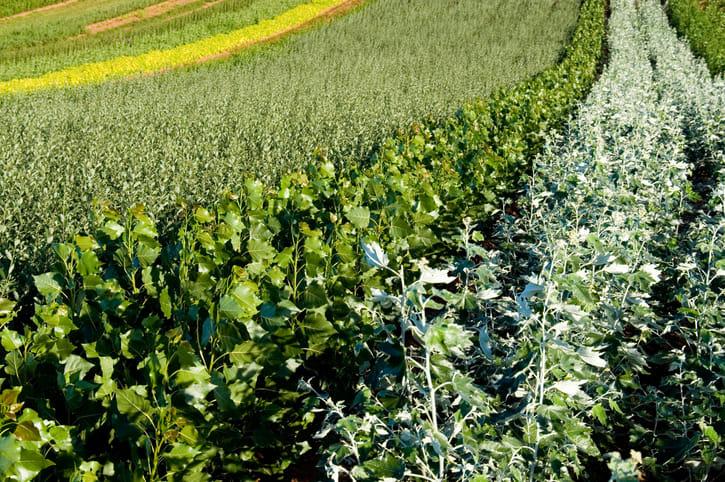
Intercropping is the practice of growing two or more crops in the same field in a definite row pattern. Crops are arranged in alternate or grouped rows, allowing each to receive enough light, water, and nutrients.
Example: Cotton intercropped with pigeon pea in a 6:1 or 8:1 row ratio, or maize with cowpea.
Mixed Cropping vs Intercropping: Key Differences
Feature | Mixed Cropping | Intercropping |
|---|---|---|
Row Arrangement | No fixed rows; seeds mixed | Definite row pattern (e.g., 2:1, 6:1) |
Crop Selection | Crops with similar maturity often chosen | Crops can have different maturity and growth habits |
Management | Difficult to weed, fertilize, or harvest separately | Easier to manage each crop separately |
Yield Recording | Combined yield only | Yield of each crop measurable |
Risk Coverage | Moderate | High |
Suitability | Rainfed, traditional farming | Modern, irrigated, and rainfed farming |
Benefits of Both Systems
- Better use of land, light, and nutrients.
- Reduced risk: if one crop fails, the other can still give income.
- Improved soil fertility when a legume is included.
- Better weed and pest suppression compared to single crops.
- Continuous supply of food and fodder to the family.
Common Indian Examples
Mixed Cropping Examples
- Wheat + Gram (Northern India, rainfed plots).
- Bajra + Moth bean (Rajasthan, dry regions).
- Sorghum + Pigeon pea (traditional dryland systems).
- Maize + Cowpea (hill regions).
Intercropping Examples
- Cotton + Pigeon pea (6:1 or 8:1 row ratio).
- Maize + Soybean (2:1).
- Sugarcane + Onion or Potato in early stages.
- Groundnut + Pigeon pea (3:1 or 5:1).
- Coconut + Banana + Pepper (multi-tier in Kerala).
Which Is Better: Mixed Cropping or Intercropping?
Intercropping is generally considered better for modern farms because:
- Each crop can be sown, weeded, and harvested separately.
- Fertilizer and irrigation can be matched to each crop.
- Mechanization is easier with row spacing.
- Yield of each crop can be measured and improved over time.
Mixed cropping still has a place in rainfed, low-input traditional farming and on very small plots where mechanization is not practical.
Tips for Successful Intercropping
- Choose crops with different growth heights and root depths.
- Pair a cereal with a legume to gain nitrogen benefit.
- Match crops with similar growing season but staggered harvest.
- Keep row ratio so the main crop is not shaded too much.
- Plan herbicide use carefully — selective products must be safe for both crops.
Conclusion
Mixed cropping and intercropping are both useful systems for Indian farms, especially small and rainfed ones. Intercropping offers more control, higher yield, and easier management, while mixed cropping is simpler and traditional. Choose based on your land size, resources, and crop goals, and consult your local agricultural extension officer for region-specific combinations.
.jpg&w=828&q=75)