Introduction
Paddy is the most important food crop in India, and during the Kharif season it is grown in nearly every state. With heavy monsoon rains, high humidity, and dense canopy, paddy fields face many fungal diseases. Among them, sheath blight in paddy is one of the most damaging — second only to blast in many states. The disease starts on the leaf sheath near the water line and quickly climbs upward, drying leaves and reducing grain filling. In closely planted, heavily fertilized fields, sheath blight can spread within just a few days. Farmers need to know early symptoms, favorable conditions, and proper control measures to protect yield.
What is Sheath Blight in Paddy?
Sheath blight is a fungal disease caused by Rhizoctonia solani. The fungus survives in the soil and crop residue as small black or brown structures called sclerotia. When the field is flooded, these sclerotia float and stick to the leaf sheath at the water line. Under warm, humid conditions, they germinate and produce greyish-green water-soaked lesions. The disease spreads from the lower leaves to the upper leaves and even to the panicle. Sheath blight mainly affects the leaf sheath, leaf blade, and finally the panicle. Early monitoring is important because once the disease reaches the flag leaf, yield loss becomes very heavy.
Symptoms
- Initial greyish-green water-soaked oval lesions on the leaf sheath at or near the water line.
- As the lesions grow, they become elliptical (snake-skin like) with grey centre and dark brown irregular margins.
- Lesions join together to form large patches; affected sheath dries up.
- Disease moves upwards to the leaf blade, causing drying and death of leaves.
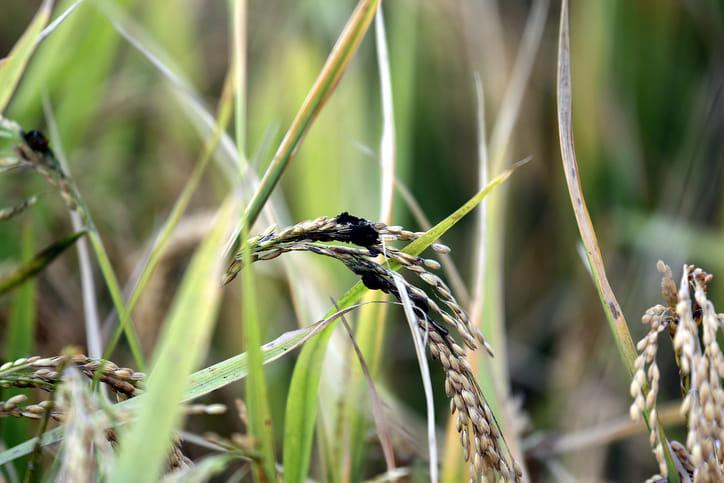
- Small white to brown sclerotia (mustard seed sized) seen on the lesion surface; these fall into the soil and survive.
- In severe cases, the flag leaf and panicle dry up, causing chaffy or partially filled grains.
- Patchy drying of the field, especially in dense, lush areas.
- Yield impact: 15–50% loss is common; up to 60% in heavily infected fields.
Farmer Tip: Examine the lower leaf sheath just above the water line. If you see snake-skin like patches with brown margin and grey centre, it is sheath blight. Mark the area and start control immediately.
Favorable Conditions
Sheath blight is mainly a disease of dense, well-fertilised, and humid paddy crops. The major favorable conditions are:
- Continuous high humidity above 95% inside the canopy.
- Warm temperature between 28–32°C with cloudy weather.
- Continuous standing water and waterlogged conditions.
- Very dense planting and overlapping leaves with no air movement.
- Excessive nitrogen fertilizer (especially urea) creating lush, soft growth.
- Carry-over of sclerotia in soil and stubble from previous crop.
- Poor field sanitation; weeds and grasses on bunds carrying the fungus.
- Continuous rice-rice cropping without rotation.
Preventive Measures
- Use certified, healthy seed from a reliable source.
- Treat seed with bio-agents like Trichoderma viride or Pseudomonas fluorescens before sowing.
- Choose tolerant varieties recommended for your region.
- Maintain proper spacing (20 x 15 cm); avoid very dense transplanting.
- Provide alleyways every 2 metres for better air circulation and easy spraying.
- Apply nitrogen in 3 split doses; avoid heavy single dose of urea.
- Apply potash and zinc as per soil test recommendation; balanced nutrition reduces disease.
- Drain the field for 2–3 days at maximum tillering and again at booting.
- Plough the field deeply after harvest to bury sclerotia.
- Burn or compost the infected stubble; don't leave it in the field.
- Practice crop rotation with pulses, oilseeds, or vegetables wherever possible.
- Keep bunds clean and free from grasses that may host the fungus.
Management Practices
Sheath blight is best controlled through Integrated Disease Management (IDM). Use clean seed, balanced fertilizer, proper spacing, biological products, and chemical fungicides only when needed. Farmers should not depend only on chemical sprays; repeated use leads to resistance, soil residue problems, and high cost without good results.
Mechanical Control
- Drain water from the field for 2–3 days when sheath blight is first noticed; this disturbs the fungus.
- Cut alleyways every 2 metres for air movement and spray penetration.
- Remove and destroy heavily infected plants and stubble.
- Plough deeply after harvest to bury sclerotia deep in the soil.
- Keep bunds and irrigation channels free of weeds.
Biological Control
Biological products are very useful for both prevention and early-stage control of sheath blight. They build natural protection on the leaf surface and reduce sclerotial germination in the soil. Useful BigHaat products include:
Product Name | Technical Content | Dosage |
Bacillus spp. & Pseudomonas spp | Liquid base 1-2lit/Acre Carrier base 2 -5 kg/Acre | |
Pseudomonas fluorescens | 4 kg/acre with 40 kg FYM/organic manure |
Chemical Control
Use chemical fungicides only after confirming the disease and when lesions are spreading on the lower leaf sheath. Direct the spray to the lower part of the canopy where the disease starts. Rotate chemical groups, spray in early morning or evening, follow label dosage, and wear protective clothing.
Product Name | Technical Content | Dosage |
Trifloxystrobin 25% + Tebuconazole 50% WG | 80gm/Acre | |
Azoxystrobin 18.2% + Difenoconazole 11.4% SC | 200ml/Acre | |
Validamycin 3% L | 600-800ml/Acre | |
Thiophanate Methyl 70% WP | 200gm/Acre | |
Tebuconazole 25.9% EC | 200-300ml/Acre |
Safety Tip: Always read the product label, follow the recommended dosage, and consult a local agronomist before spraying.
Best Time to Take Action
Start scouting at the maximum tillering stage and continue till booting. Apply preventive bio-fungicides at tillering and booting stages, especially in known disease-prone fields. Drain the field at first appearance of lesions. Chemical sprays are most effective when only 5–10% of tillers show sheath blight lesions on lower sheath. A second spray 12–15 days later may be needed if rains continue. Avoid applying fungicides after grain filling — by then most of the loss is already done.
Common Mistakes Farmers Should Avoid
- Planting paddy too closely; dense canopy traps humidity.
- Applying heavy single dose of urea at maximum tillering.
- Spraying only on top of the canopy; the fungus is on the lower sheath and needs full coverage.
- Using the same fungicide season after season - leads to resistance.
- Spraying just before rain - chemical washes off.
- Leaving infected stubble and using it as cattle feed in nearby fields.
- Ignoring early lesions and waiting until flag leaf is affected.
Conclusion
Sheath blight in paddy is a fast-moving fungal disease that can damage even healthy-looking fields within a few days. The best protection is to follow Integrated Disease Management — use treated seed, correct spacing, balanced fertilizer, and good drainage. Walk through the field every week, especially after rain, and check the lower leaf sheath. Use Trichoderma and Pseudomonas as preventive measures, and apply chemical fungicides only when the disease starts spreading. Always rotate chemical groups, spray at the correct time, and follow safety practices. Early identification, regular scouting, and integrated control will protect yield and keep your soil healthy for the next season.
Note: The information contained herein is for informational purposes only. Nothing herein shall be construed to be financial or legal advice. Viewers are advised to do their own research before making any decisions.