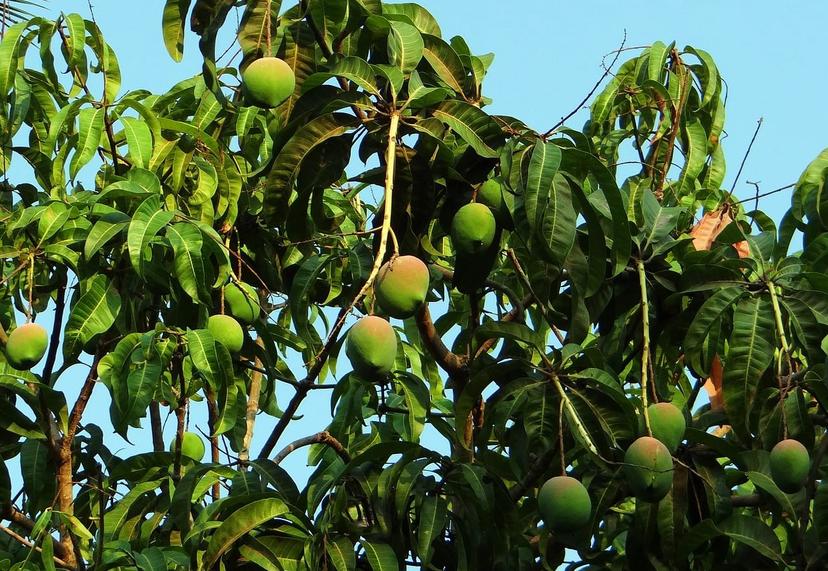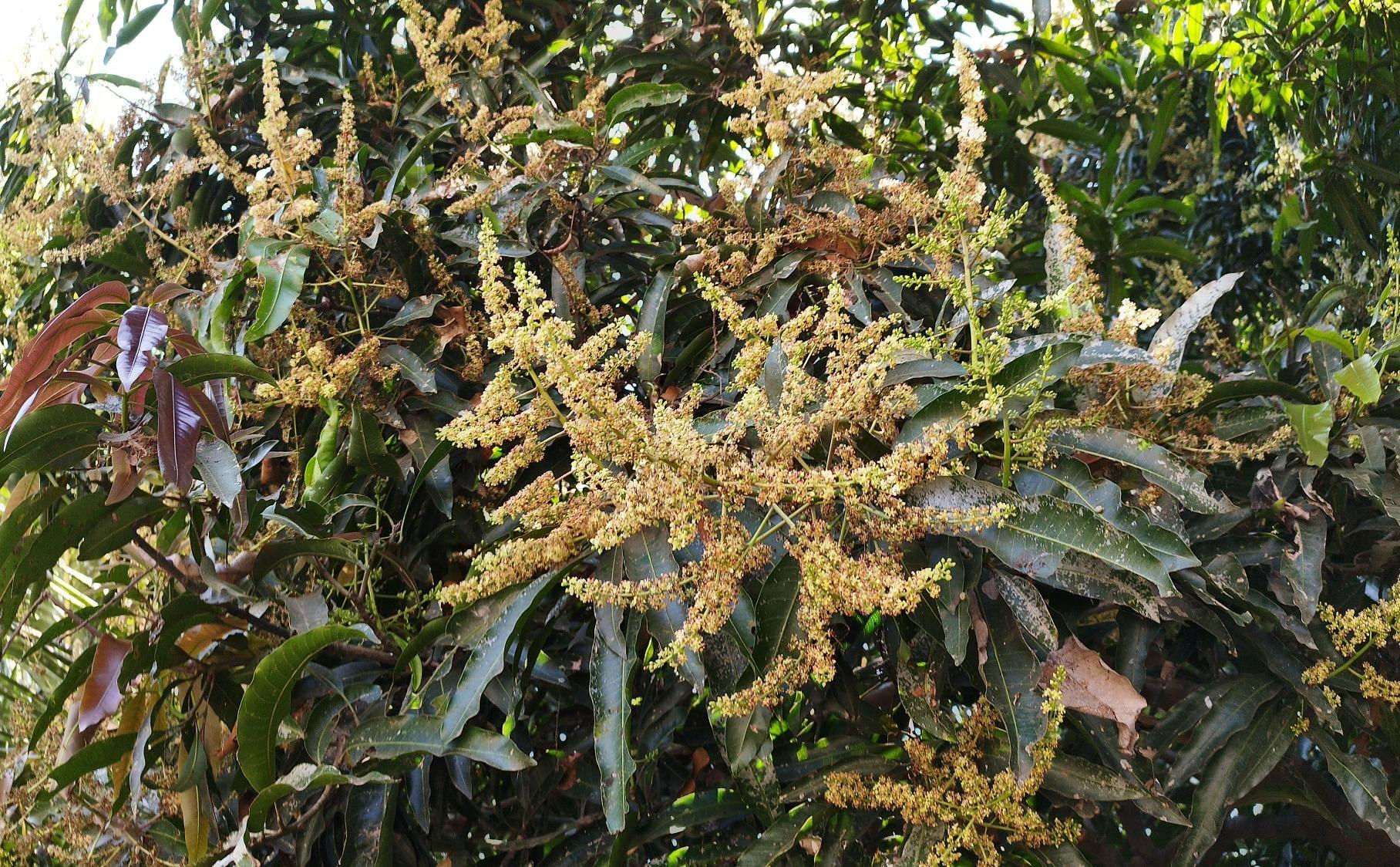
Mango flowers are hermaphrodite, monoecious, and are borne from inflorescence. Among all the flowers, only a few develop into fruits. Although mango flowers are hermaphrodites, cross-pollination contributes to the maximum fruit set. They are mostly pollinated by birds and insects such as bees, beetles, ants, wasps, and flies. Mango flowers bloom from December and can extend up to March. However, fruit development starts from January to May depending upon the time of flower initiation.
Mango Flower Initiation:
- Favorable conditions: Flowering depends on temperature, rainfall, and humidity. Rain before and during flowering can delay flowering, while cloudy weather causes flower drop.
- Pruning: Prune in mid-December (pre-flowering stage) to promote floral flush.
- Plant growth regulators: Ethephon, Paclobutrazol, and Alpha Naphthyl Acetic Acid help induce flowering and improve fruit set.
Major Pests affecting Mango Flowers:
Mango Hopper:
Mango hopper is one of the most damaging pests during flowering. Nymphs and adults suck sap from flowers and young stalks, which leads to drying and flower drop.
Symptoms of mango hopper
- Withering and shedding of florets
- Affected flower stalks become sticky due to honeydew secretion, which causes sooty mould development
Mango Hopper Management:
Application – First spray during panicle emergence stage, second spray after 15 days of first spray, and later, depending on pest intensity
|
Product name |
Technical content |
Dosage (per acre or per lit water) |
|---|---|---|
|
Azadiractin 10000 PPM |
325-450 ml |
|
|
Metarhizium anisopliae |
Foliar spray: 2 ml/lit Soil application: 2 lit |
|
|
Thiamethoxam 12.6% + Lambda-cyhalothrin 9.5% ZC |
0.3 ml/lit |
|
|
Tolfenpyrad 15% EC |
2 ml/lit |
|
|
Micronutrients with amino acid, growth-supporting co-factors, and biostimulant |
Foliar – 2-3 ml/lit Soil Drenching- 5 ml/lit |
Flower gall midge / Inflorescence midge
This pest damages flower buds from the inside. If not controlled early, buds fail to open and fall down.
Symptoms of inflorescence midge
- Maggots penetrate into the flower bud by making holes and feeding on the inner content
- The affected inflorescence is stunted and malformed
- Affected flower buds fail to open and fall down
Management of Inflorescence midge / Flower gall midge:
Application – Three to five sprays at 15-30 days intervals, depending on pest intensity
|
Product name |
Technical content |
Dosage (per acre or per lit water) |
|---|---|---|
|
Azadiractin 1500 PPM (0.15%) EC |
2-2.5 ml/litre |
|
|
Thiamethoxam 25 % WG |
0.3 – 0.5 gm/lit |
|
|
Lambda Cyhalothrin 5 % EC |
2 ml/liter |
|
|
Ethephon 39 SL (39% w/w) |
1- 2.5 ml/lit or 200-500 ml/acre |
|
|
20% Boron in water-soluble form. |
Drip: 500 gm Foliar: 1 gm/lit |
Mango Mealy Bug
Mealy bug sucks sap from flower parts and can dry the inflorescence quickly.
Symptoms of mango mealy bug
- Pinkish nymph and adult mealy bug present on mango inflorescence
- Nymphs suck the juice from flower pedicels and cause drying of inflorescence
Mango Mealy Bug Management:
Application – Spray during the pre-bloom stage at 15-30 days interval, depending on pest intensity
|
Product name |
Technical content |
Dosage (per acre or per liter water) |
|---|---|---|
|
Neem Oil extracts (Azardiractin)
|
Foliar Spray: 1 – 2 ml/lit |
|
|
Beauveria bassiana |
Foliar spray – 2.5 ml/lit |
|
|
Dimethoate 30% EC |
1.5 – 2.5 ml/l |
|
|
Flupyradifurone |
2 ml/lit |
|
|
Humic acid 6% and Fulvic acid |
Foliar spray: 405 – 485 ml |
Mango Flower Webber
Flower webber larvae tie flowers together and damage the inflorescence stalk, which reduces flowering and fruit set.
Symptoms of mango flower webber
- Affected flowers are webbed together by the larva
- Larva penetrates into the inflorescence stalk by making holes
Mango Flower Webber Management:
Application – Three to five sprays at 15-30 day interval, depending on pest intensity
|
Product name |
Technical content |
Dosage (per acre or per lit water) |
|---|---|---|
|
Plant Extracts |
Foliar Spray: 3 – 5 ml/lit |
|
|
Thiamethoxam 12.6% + Lambda cyhalothrin 9.5 % ZC |
0.4 ml/litre |
|
|
Quinalphos 25 % EC |
2 ml/litre |
|
|
Paclobutrazol
|
|
Major Diseases affecting Mango Flowers:
Mango Powdery Mildew
Powdery mildew is a common mango flower disease during cool and humid weather. It causes white fungal growth and early flower drop.
Symptoms of powdery mildew
- White superficial powdery fungal growth is seen on the flowers
- Leads to premature dropping of affected flowers
Management of Powdery mildew in Mango flower:
Application – Spray fungicides at 14 – 20 day intervals during the flowering stage and later, depending upon disease infection
|
Product name |
Technical content |
Dosage (per acre or per lit water) |
|---|---|---|
|
Pseudomonas fluorescence |
Foliar: 2.5 ml/lit |
|
|
Natural extracts & antioxidants |
Foliar: 0.5 – 1 gm/lit
|
|
|
Meptyldinocap 35.7% EC |
0.7 ml/lit |
|
|
Fluxapyroxad 250 G/L + Pyraclostrobin 250 G/L SC |
0.4 ml/lit |
|
|
Sulphur 20% |
2.5 ml/l |
|
|
Amino Acids & Peptides Mixture |
1 – 2 ml/lit |
(Note: Multiplex Sulphur Liquid fertiliser is not compatible with all pesticides and fungicides)
Mango malformation
Mango malformation affects floral buds and stops normal flower opening. This can sharply reduce fruit production.
Symptoms of mango malformation
- Affected floral buds are transformed into vegetative buds with a large number of small leaves
- It gives an appearance of a ‘witch’s broom’
- Affected flower buds do not open and remain dull green
Management of mango malformation in mango flower:
Application – Depending upon disease seriousness and mite infestation, spray with 15 – 18 day interval from pre-blossom stage
|
Product name |
Technical content |
Dosage (per acre) |
|---|---|---|
|
Trichoderma viride |
Foliar: 1ml/lit or 3 g/lit |
|
|
Zineb 68% + Hexaconazole 4% |
2-2.5 gm/litre |
|
|
Carbendazim 50% DF |
2 gm/lit |
|
|
Sulfur 80%
|
1 – 1.5 ml/lit |
|
|
Alpha Naphthyl Acetic Acid 4.5 SL (4.5% w/w) |
0.4ml/litre water (10 ppm) 0.8ml/litre water (100 ppm) |
Anthracnose
Anthracnose causes blossom blight in mango and leads to flower shedding. It spreads fast in rainy and highly humid weather.
Symptoms of anthracnose
- Causes ‘blossom blight’ in mango
- Black minute spots appear on the floral parts
- Infected floral parts shed off, leading to partial or complete de-blossoming
Management of Anthracnose in mango flower:
Application – Spray at 15 days interval during flowering to control blossom infection.
|
Product name |
Technical content |
Dosage (per acre or per lit water) |
|---|---|---|
|
Pseudomonas fluorescence |
2 – 5 ml/lit
|
|
|
Copper Oxychloride 50% WG |
1 gm/lit water |
|
|
Carbendazim 12 % + Mancozeb 63 % WP |
1.5-2.5 gm/lit water |
|
|
Bio-organics and traces of micronutrients |
2ml/lit |
|
|
Major, Secondary and Micronutrients |
2 to 2.5 ml/lit |
|
|
(Used along with Multiplex Kranti micronutrient fertilizer) |
Contains spreading, wetting and sticking agent |
1 ml/lit |
(NOTE: Though Plant growth enhancers are compatible with most pesticides and fungicides, it is suggested for individual application to have good result)
Important:
- Pest and disease should be controlled in Mango during Flower Emergence to Full Bloom stage by using pesticides and fungicides
- If not controlled at this stage, it will wipe off all the flowers and fruits in the tree
- Foliar fertilizer and growth enhancer/growth boosters can also be used in every 7 – 10 days
- Pesticides and fungicides should not be sprayed during Full Bloom stage since pollination by insects will get affected at this time.
Enhance your mango farming success with our strategies. Read more in [Blooming Success: Strategies for Managing Mango Flowers to Boost Yields]