

Introduction
Powdery mildew of mango, caused by Oidium mangiferae, is an important fungal disease affecting flowers, young fruits, and leaves of mango trees. Unlike anthracnose which primarily attacks fruits, powdery mildew's primary damage is on flowers, causing flower drop and poor fruit set. The disease appears as white, powdery coating on flower buds, panicles, and young leaves during the flowering period. In severe cases, powdery mildew can cause 30-60% flower drop, directly reducing the crop load and annual productivity. The disease thrives in dry conditions during the pre-monsoon and monsoon seasons when many mango varieties are flowering. Early identification and intervention are critical because once flower drop occurs, it cannot be reversed—that season's crop potential is lost. This comprehensive guide will help you recognize powdery mildew early on mango flowers and implement effective management strategies to protect your mango trees' flowering and fruiting potential.
What is Powdery Mildew of Mango?
Powdery mildew of mango is caused by the fungus Oidium mangiferae, an obligate parasite that affects primarily the flowering parts of mango trees. Unlike most fungal diseases that require water droplets for infection, powdery mildew spores germinate in dry to moderately humid conditions and spread through wind. The fungus produces copious amounts of spores that spread rapidly between trees and throughout the orchard. Once established on flower buds, the fungus causes necrosis of floral tissues, leading to bud drop and flower abortion before fruit set. The disease is particularly problematic because the critical damage occurs during the short flowering window when chemical or biological control options are limited due to pollinator concerns.
Symptoms
Learn to identify powdery mildew on mango at different growth stages:
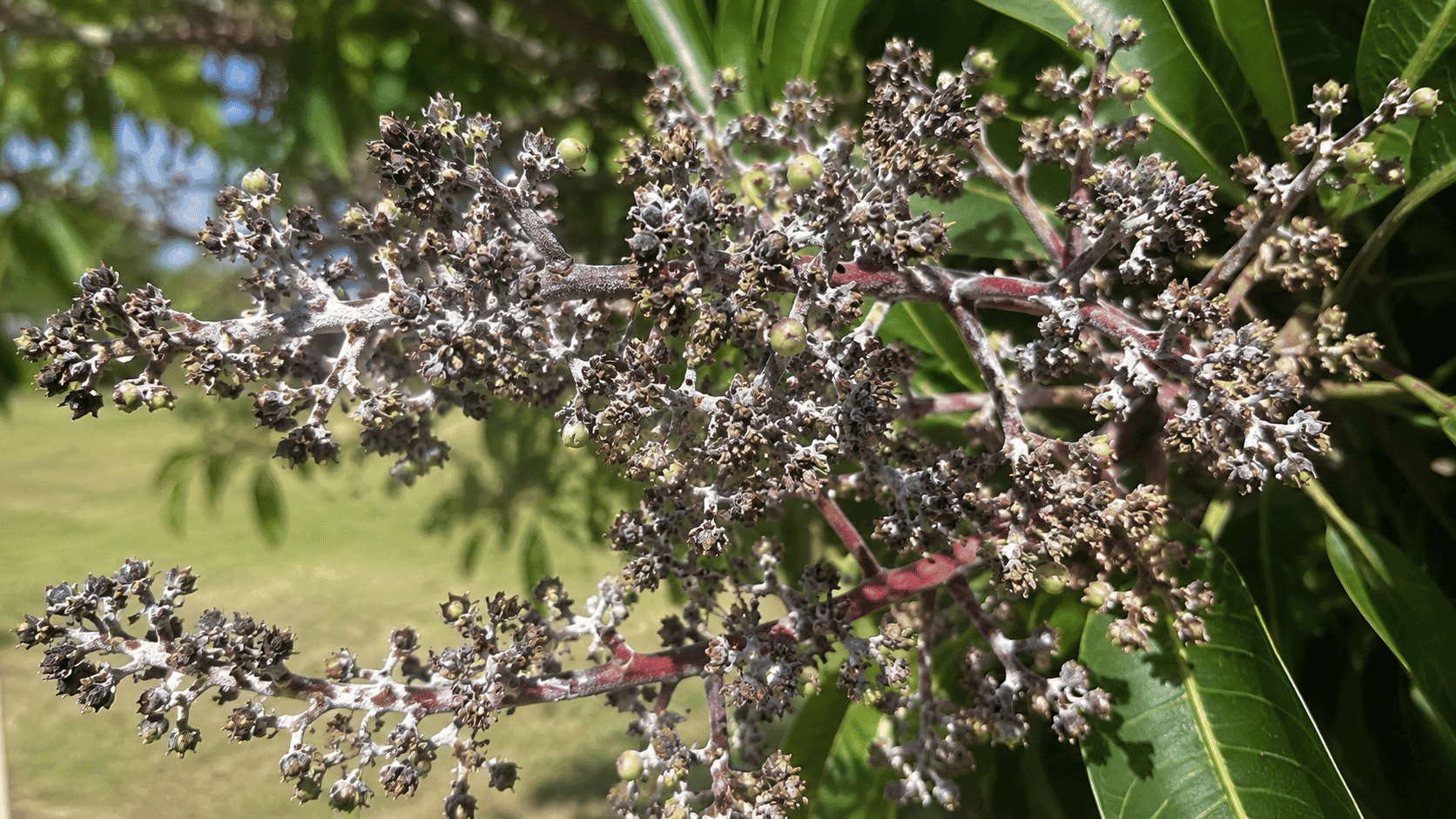
- Flower bud symptoms: White to grayish powdery coating appears on unopened flower buds
- Panicle infection: Entire flowering panicles become covered with white powder; flowers become distorted
- Flower drop: Infected flowers dry, wither, and drop prematurely, often before opening
- Young leaf symptoms: New leaves developing with panicles show similar white coating
- Distorted fruits: Young fruits that develop show russeting or rough surface texture
- Progressive symptoms: Coating becomes darker, turning gray-brown as disease progresses
- Whole panicle death: Severe infections kill entire flowering panicles, resulting in complete crop loss on affected branches
- Tree appearance: Trees show sparse flowering; canopy has bare flowering branches
- Yield loss: 30-60% reduction in fruit set due to flower drop; poor fruit development
Farmer Tip: Inspect flower buds and panicles 2-3 weeks before flowering begins. At the first sign of white powder on panicles, begin preventive fungicide applications immediately. Once flowers drop, no treatment can recover them.
Favorable Conditions
Powdery mildew of mango thrives under these conditions:
- Dry season with low rainfall: Unique among fungal diseases, powdery mildew prefers dry weather
- Moderate humidity (40-60%): Ideal for spore germination and infection
- Temperature range of 15-25°C: Optimal for fungal growth; disease often severe during cool flowering season
- Flowering season synchronization: When many trees are flowering simultaneously, disease spreads rapidly
- Susceptible varieties: Some mango varieties like Dasheri, Langra, and Kesar show higher susceptibility
- Nearby infected trees: Proximity to mango trees with powdery mildew provides inoculum source
- Shade and reduced air circulation: Dense canopy favors fungus persistence
Preventive Measures
Prevention is critical because once flowers drop, prevention becomes cure recovery is impossible:
- Choose resistant varieties: Grow varieties with better tolerance like Alphonso or Neelum where possible
- Monitor susceptible trees closely: If you grow susceptible varieties, increase scouting frequency
- Prune for air circulation: Open up canopy to 40-50% light penetration to reduce humidity
- Field sanitation: Remove mummified fruits and infected twigs that harbor fungal spores
- Balanced nutrition: Apply micronutrients (especially zinc) to strengthen trees' disease resistance
- Avoid water stress: Maintain adequate soil moisture; water stress weakens disease resistance
- Scout flowering stage closely: Inspect panicles 2-3 weeks before flowering begins
- Begin preventive sprays early: Apply fungicides starting 2-3 weeks before flowering
Management Practices
Integrated management for powdery mildew of mango requires preventive approach starting pre-flowering.
Cultural Control
Non-chemical methods form the foundation:
- Remove infected panicles: At early symptom stage, carefully remove affected panicles and destroy
- Improve canopy structure: Prune to improve air circulation and reduce humidity
- Avoid shade: Don't intercrop with tall trees that create shade over mango flowering zone
Biological Control
Apply these biological products:
Product Name | Technical Content | Dosage |
Sulphur Wettable Powder | Elemental sulphur 80% w/w | 3-4 g/L water |
Trichoderma Viride WP | Trichoderma viride 1 × 10⁷ CFU/g | 5-6 g/L water |
Neem Oil 3% EC | Cold-pressed neem oil 3% w/v | 5% solution (50 ml/L) |
Bacillus subtilis WP | Bacillus subtilis 1 × 10⁸ CFU/g | 10 ml/10 L water |
Potassium Bicarbonate | Potassium bicarbonate 85% w/w | 2-3 g/L water |
Chemical Control
Chemical fungicides for powdery mildew control:
Product Name | Technical Content | Dosage |
Hexaconazole 5% EC | Hexaconazole 5% w/v | 1-1.5 ml/L water |
Penconazole 5% EC | Penconazole 5% w/v | 0.5 ml/L water |
Dinocap 48% EC | Dinocap 48% w/v | 0.5 ml/L water |
Sulphur Wettable Powder | Elemental sulphur 80% w/w | 3-4 g/L water |
Azoxystrobin 25% SC | Azoxystrobin 25% w/v | 1 ml/L water |
Safety Tip: Do NOT spray fungicides during flowering when pollinating insects are active. Apply before flowering begins. Never spray when temperature exceeds 32°C. Always read label carefully.
Best Time to Take Action
- Pre-flowering: Begin inspection 4-6 weeks before expected flowering
- Preventive sprays: Start fungicide applications 2-3 weeks before flowering
- Spray frequency: Apply every 7-10 days up to flowering stage
- During flowering: Avoid broad-spectrum sprays; observe and monitor closely
- Post-flowering: Resume regular fungicide sprays after pollination period
Common Mistakes Farmers Should Avoid
- Not scouting pre-flowering: By the time symptoms are obvious, significant flower drop has occurred
- Starting treatment too late: Begin sprays 2-3 weeks before flowering, not during
- Poor coverage: Powdery mildew spreads on panicles which can be hard to spray. Ensure thorough coverage
- Spraying during flowering: This kills pollinating insects essential for fruit set
- Neglecting susceptible varieties: Some varieties need extra attention. Monitor them closely
Conclusion
Powdery mildew of mango is a uniquely devastating disease because its damage occurs during the short, critical flowering window when once flowers drop, no treatment can recover them. The key to success is preventing the disease before it impacts flowers through pre-flowering scouting, early detection, and preventive fungicide applications starting 2-3 weeks before flowering begins. Choose less susceptible varieties where possible and maintain tree vigor through proper nutrition and water management. Scout panicles intensively during pre-flowering period to catch early symptoms. Apply sulfur or systemic fungicides preventively before disease pressure becomes high. Never spray broad-spectrum fungicides during the actual flowering period when pollinating insects are active. With vigilant monitoring and timely preventive treatment, you can minimize flower drop and ensure consistent, productive mango crops year after year.
Note: The information contained herein is for informational purposes only. Nothing herein shall be construed to be financial or legal advice. Viewers are advised to do their own research before making any decisions.