

Introduction
Mango anthracnose, caused by the fungus Colletotrichum gloeosporioides, is arguably the most destructive disease threatening mango production in India and across the world. Known as the 'silent killer' of mangoes, anthracnose can remain dormant on apparently healthy fruits, only to reveal itself as severe rot and decay after harvest or in storage, rendering the entire fruit unmarketable. This is what makes it particularly dangerous: by the time you see the disease, it's often too late to save the fruit. Losses from anthracnose can reach 40-80% in susceptible varieties during wet seasons, causing catastrophic economic damage to farmers who cannot sell their fruits. The disease affects not only fruit quality but also flower and young shoot health. This comprehensive guide will teach you to recognize anthracnose early, understand its causes, and implement integrated management strategies to protect your mango harvest and maintain premium fruit quality in the market.
What is Mango Anthracnose?
Mango anthracnose is a fungal disease caused primarily by Colletotrichum gloeosporioides (formerly known as Glomerella cingulata). The disease can affect all above-ground parts of the mango tree—leaves, flowers, twigs, and most destructively, fruits. The pathogen is soil-borne and seed-borne, and produces spores that spread through water splash, wind, and contact. What makes anthracnose particularly dangerous is that the fungus can infect fruits while they appear completely healthy, remaining latent inside the fruit tissue. This latent infection becomes visible only after harvest, during ripening, or in storage—by which time the fruit is already lost.
The disease thrives in warm, humid conditions typical of the monsoon and post-monsoon seasons, making pre-harvest and early post-harvest management critical. Early identification of infected flowers and young fruits is essential because treating them before fruit maturity can prevent massive post-harvest losses.
Symptoms
Learn to identify mango anthracnose at every growth stage:
- Flower symptoms: Flowers darken, shrivel, and drop from panicle; entire panicles may die
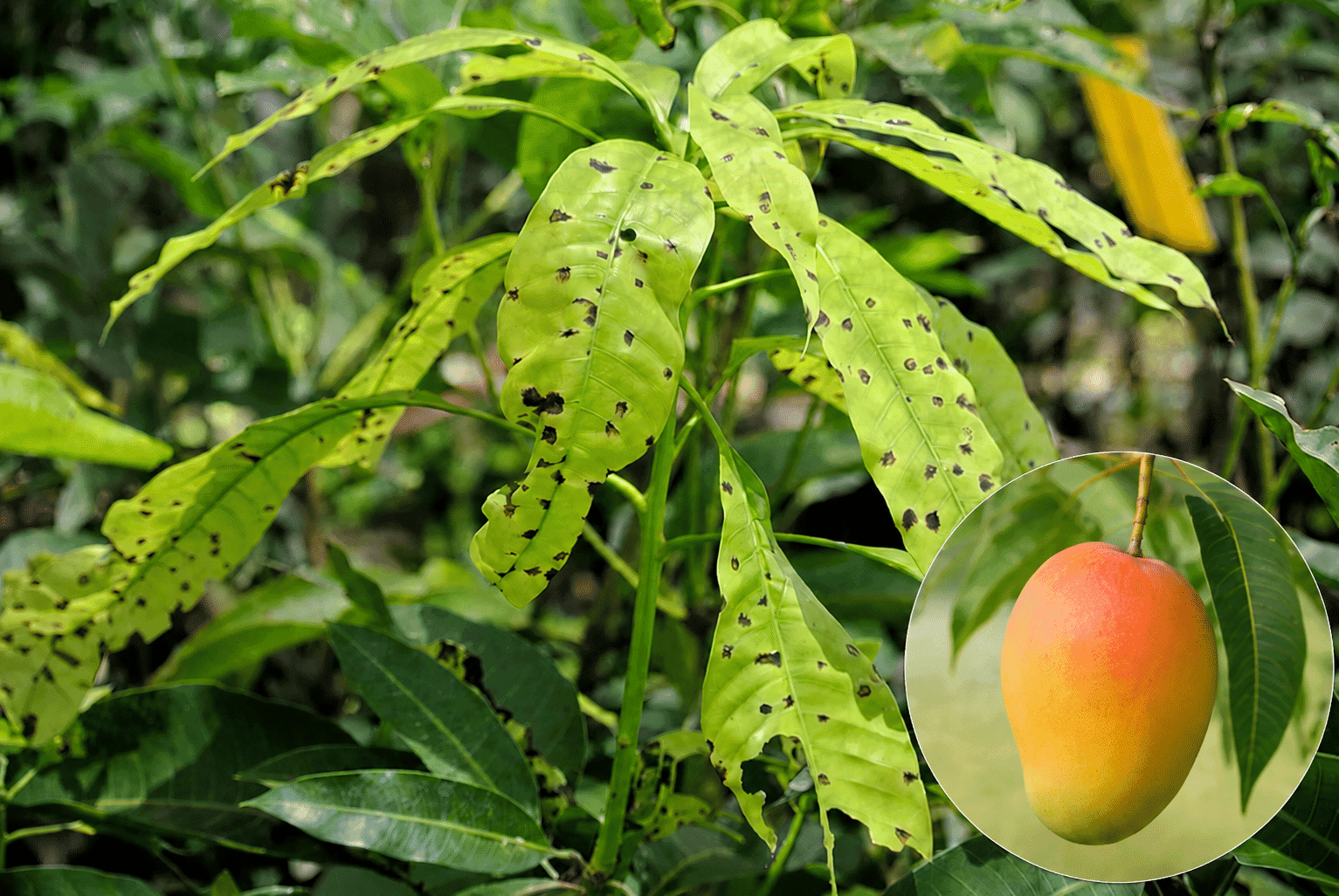
- Leaf symptoms: Circular or irregular brown spots with dark margins appear on leaves; spots may have yellow halos
- Twig/shoot symptoms: Cankers appear on young shoots with gummy exudate; dieback of twigs occurs
- Early fruit symptoms (pre-harvest): Small, dark, slightly sunken spots appear on developing fruits; spots are often inconspicuous
- Latent infection: Fruits appear healthy on tree but harbor fungus inside; disease appears only after harvest
- Ripe fruit rot (post-harvest): Large, dark brown, sunken lesions with concentric rings appear on ripe fruits
- Pink spore masses: In wet conditions, pink or salmon-colored spore masses (acervuli) appear on lesions
- Progressive rot: Infected areas become soft and rot advances, eventually covering entire fruit
- Storage rot: Fruits that appeared healthy develop anthracnose rot within 3-5 days of storage at room temperature
- Whole plant appearance: Canopy shows yellowing and premature leaf drop; sparse flowering may occur in severe cases
- Yield and quality impact: 40-80% fruit loss in severe cases; even slightly infected fruits are rejected in quality-conscious markets
Farmer Tip: Don't judge mango disease status by how fruits look on the tree. Carefully inspect harvested fruits 3-5 days after collection. If rot appears suddenly, it was latent anthracnose. Scout your orchard during monsoon for flower and leaf symptoms to catch the disease early.
Favorable Conditions
Anthracnose thrives under these conditions common during the kharif and monsoon seasons:
- High humidity (above 85%): Essential for spore germination and infection
- Heavy rainfall and leaf wetness: Spores are water-dispersed and require water for infection
- Warm temperatures (25-30°C): Optimal temperature for fungal growth and spore production
- Dense canopy with poor air circulation: Retains moisture and creates ideal microclimate for fungus
- Stressed trees: Weak or nutritionally deficient trees are more susceptible to infection
- Infected crop residue: Fallen leaves, twigs, and mummified fruits harbor spores and perpetuate the disease
- Contaminated tools and equipment: Pruning tools spread spores between trees if not sterilized
- Susceptible varieties: Some varieties like Langra, Dasheri, and Kesar are more prone to severe anthracnose than others
- Poor field sanitation: Uncollected dropped fruits and dead wood provide continuous inoculum
Preventive Measures
Prevention is critical because once latent infection occurs, cure is impossible. Preventive management must begin before flowering:
- Field sanitation: Remove all fallen leaves, mummified fruits, and dead twigs from under the tree and from branches. Burn or bury these materials to destroy fungal spores.
- Sterilize tools: Dip pruning shears in 1% bleach solution between cuts to prevent spreading spores between trees.
- Prune for air circulation: Remove crossing branches, lower branches near ground, and inward-growing branches to improve air flow and reduce humidity around fruits.
- Maintain tree health: Apply balanced fertilization to strengthen plant immune response. Zinc and potassium deficiency reduces disease resistance.
- Avoid waterlogging: Ensure good drainage around trees to prevent root stress and weakening.
- Use disease-free planting material: Source saplings from certified nurseries with clean stock.
- Choose resistant varieties: Grow varieties with better anthracnose tolerance such as Alphonso, Neelum, or Chausa where possible.
- Avoid overhead irrigation during flowering and fruiting: Use drip irrigation or ground application to keep foliage dry.
- Regular scouting: Monitor trees weekly from flowering onwards for early symptoms on flowers and young leaves.
Management Practices
Managing anthracnose requires an integrated approach combining sanitation, cultural practices, biological control, and timely chemical treatment:
Mechanical and Cultural Control
Non-chemical measures form the foundation of management:
- Remove infected flowers and panicles: When you observe blackened, dried flowers, remove the entire affected panicle and destroy it to prevent spore spread.
- Thin fruit: Remove 25-30% of young fruits at tennis ball stage, leaving 10-15 cm between remaining fruits. This improves air circulation and fruit health.
- Remove infected fruits: Pick off fruits showing any spots or lesions and destroy them before they spread spores.
- Post-harvest handling: Never place harvested fruits directly on soil. Use clean collection baskets and store fruits in well-ventilated conditions at 13-18°C to prevent rot development.
- Harvest at proper maturity: Don't harvest unripe fruits, as latent infections become obvious in immature fruits.
- Prune to open canopy: Open up the canopy to 40-50% light penetration to reduce humidity and increase drying after rain.
Biological Control
Biological products can suppress anthracnose when used early:
Product Name | Technical Content | Dosage |
Trichoderma Viride WP | Trichoderma viride 1 × 10⁷ CFU/g | 5-6 g/L water |
Pseudomonas fluorescens | Pseudomonas fluorescens 1 × 10⁸ CFU/ml | 10 ml/L water |
Bacillus subtilis WP | Bacillus subtilis 1 × 10⁸ CFU/g | 10 ml/10 L water |
Sulphur Wettable Powder | Elemental sulphur 80% w/w | 3-4 g/L water |
Copper Oxide 50% WP | Copper oxide 50% w/w | 3 g/L water |
Apply biological products every 10-14 days from flowering through fruit development for best results.
Chemical Control
Chemical fungicides are necessary when disease pressure is high. Use these products:
Product Name | Technical Content | Dosage |
Carbendazim 50% WP | Carbendazim 50% w/w | 2 g/L water |
Mancozeb 75% WP | Mancozeb 75% w/w | 2.5-3 g/L water |
Hexaconazole 5% EC | Hexaconazole 5% w/v | 1-1.5 ml/L water |
Propiconazole 25% EC | Propiconazole 25% w/v | 1 ml/L water |
Azoxystrobin 25% SC | Azoxystrobin 25% w/v | 1 ml/L water |
Spray schedule: Start at 75% flowering and repeat every 10-12 days through fruit development. Critical periods are flowering and fruit development when spores spread most. Stop sprays 21 days before harvest.
Safety Tip: Always follow label instructions for mixing and application. Carbendazim and hexaconazole are banned in some countries; check your local regulations. Rotate chemical groups to prevent resistance. Never spray when rain is expected.
Best Time to Take Action
- Year-round: Field sanitation must be continuous—remove fallen fruits, dead wood, and leaves regularly
- Pre-flowering (August): Begin scouting for disease symptoms and start preventive fungicide applications
- At flowering (September-October): First spray application; this is most critical period
- Fruit development (October-January): Continue fungicide sprays every 10-12 days through fruit maturation
- Pre-harvest (January-February): Stop sprays 21 days before harvest; inspect and remove infected fruits
- Post-harvest: Handle fruits carefully; store at 13-18°C to prevent latent infection from developing
Common Mistakes Farmers Should Avoid
- Starting fungicide sprays too late: If you wait until visible symptoms appear, infection is already established. Start at 75% flowering.
- Assuming fruits are healthy when they look good: Latent infection is invisible. Scout carefully and don't harvest too early.
- Neglecting field sanitation: Fallen fruits and dead wood are primary spore sources. Cleaning up costs less than managing disease.
- Poor spray coverage: Spray must reach all flowers and developing fruits. Use adequate water volume and proper nozzles.
- Spraying during or after rain: Rain washes off fungicides. Never spray if rain is forecast within 6 hours.
- Using same fungicide repeatedly: Resistance develops quickly. Rotate between different chemical groups.
- Poor post-harvest handling: Bruised, scratched, or improperly stored fruits develop rot quickly. Handle carefully and store cold.
Conclusion
Mango anthracnose is a formidable disease that has destroyed countless crops and livelihoods, but it is absolutely preventable and manageable with proper knowledge and consistent effort. The key to success is understanding that anthracnose often remains hidden until harvest, so your management must be preventive, not reactive. Begin with rigorous field sanitation—remove every piece of infected plant material from under the trees and destroy it. Ensure good drainage, promote air circulation through proper pruning, and maintain tree health through balanced nutrition. Most importantly, begin fungicide applications at 75% flowering and continue every 10-12 days through fruit development, because this is when spores are actively infecting flowers and young fruits. Use biological products early in the season for additional protection and reserve chemical fungicides for high-risk periods. Rotate fungicide classes to prevent resistance development. Never ignore the critical importance of post-harvest handling—bruised or improperly stored fruits are vulnerable to rapid rot development. With commitment to integrated management combining field sanitation, cultural practices, biological control, and timely chemical treatment, you can produce high-quality, rot-free mangoes that command premium prices in fresh markets and bring reliable income to your farm.
Note: The information contained herein is for informational purposes only. Nothing herein shall be construed to be financial or legal advice. Viewers are advised to do their own research before making any decisions.