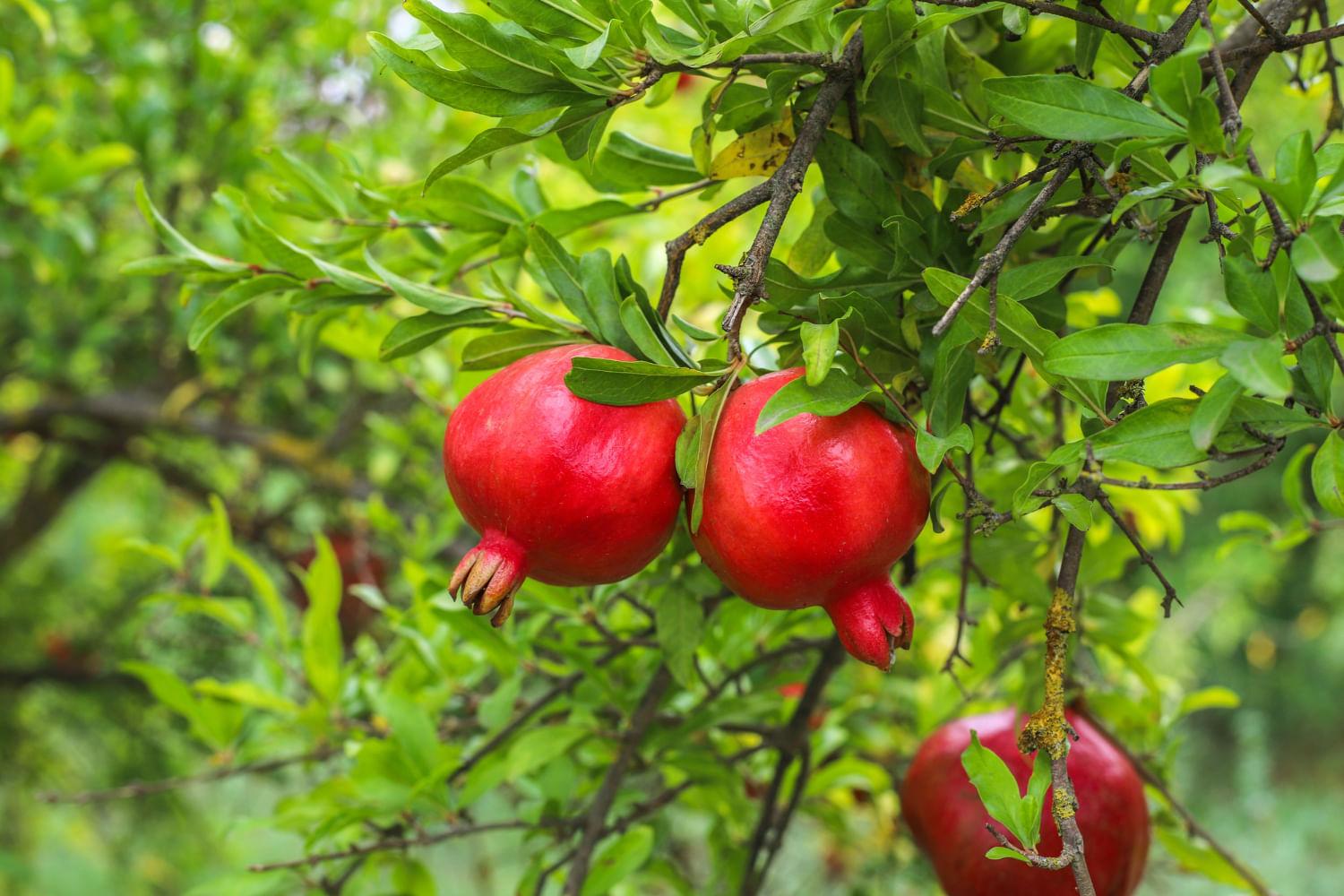
If your pomegranate trees are flowering abundantly but failing to produce large, marketable fruits, Bahar treatment might be the solution. Keep reading to learn when and how to apply this treatment for your pomegranate orchard.
What is the Bahar treatment?
Bahar treatment is a horticultural practice that involves controlling vegetative growth through pruning and inducing flowering at a desired season. This technique helps synchronize flowering, improve pomegranate fruit quality, and ultimately enhance yield, leading to a more productive and profitable harvest.
Purpose of Bahar Treatment
Pomegranate trees can flower throughout the year if they receive enough moisture in the soil. However, continuous flowering leads to irregular fruiting, resulting in smaller fruits and lower yields. Therefore, pomegranate trees are subjected to Bahar treatment to regulate their flowering and fruiting patterns.
Other Benefits Include:
- Pruning and thinning increase airflow, reduce humidity and minimise the risk of pest and disease attack.
- It allows the remaining branches to receive more sunlight and nutrients, resulting in better fruit quality, colour, size and flavour.
What is the Ideal Timing to Induce Flowering?
In tropical conditions, pomegranate cultivation experiences three distinct flowering seasons: ambia bahar, mrig bahar and hasta bahar. The choice of flowering season depends on factors such as irrigation water availability or rainfall, market demand and incidence of pests and diseases in the specific area.
1.Mrig bahar (June-July)
- Harvesting time: December to February.
- It is advantageous in areas with assured rainfall starting in June and continuing until September.
- This season is favoured as flowering and fruiting coincide with the rainy season or immediately after the rains.
2.Hasta bahar (September-October)
- Harvesting time: March to April.
- It is beneficial in areas where the monsoon typically starts in August with an erratic pattern.
- Due to their visually appealing rind, dark-colored arils and limited availability during this season, they have a higher market value.
3.Ambia bahar (January-February)
- Harvesting time: June to September.
- This is suitable for areas with assured irrigation facilities during April-May or where the monsoon starts early and withdraws by September, allowing for the induction of flowering in October.
- This season is suitable for export-quality fruits as the dry weather during fruit development contributes to attractive colour and quality.
Steps to Perform Bahar Treatment in Pomegranate
In perennial crops, stress induces flowering, and for pomegranates, moisture stress is used to encourage this process.
Step 1: Stop giving irrigation at least 30 - 35 days before bahar treatment in case of light sandy soil and 40 - 45 days or even 2 months in case of sandy loam soil.
Step 2: Prune the trees for proper canopy (40 - 45 days after stopping irrigation).
Step 3: Within 2 days after pruning, spray Ethrel 2.5 ml/lit + DAP 5 gm/lit of water on the pruned trees for defoliation, and just after defoliation (80 - 85% leaf fall), light pruning (15-25 cm) is done.
Step 4: Within 2-3 days after pruning, apply the required amount of nutrients* to the soil. The nutrients suggested below is for 2-5 year crop, and subsequently the quantity of the nutrients or fertilizers has to be increased based on the crop age and plant size.
|
Nutrient |
Manure/Fertilizer |
Dosage (per plant) |
|---|---|---|
|
Organic |
FYM |
20 kg |
|
N |
Ammonium Sulphate |
2 kg |
|
P |
Single Super Phosphate (SSP) |
1.6 kg |
|
K |
Muriate of Potash (MOP) |
1.3 kg |
|
Zn |
3 – 5 ml/lit of water |
|
|
Mg |
2 gm/lit of water |
|
|
B |
1 gm/lit of water |
Step 5: After applying nutrients, cover with soil (earthing up) and give light irrigation. In the first irrigation, use 8-12 litres of water per plant for applying manure and fertilizers. For the next two days, the quantity of water must be half of the initial amount. Excess irrigation at this stage can adversely affect flowering. After the third irrigation, stop watering for 5-6 days.
If the above steps are followed timely and without fail, it will result in profuse flowering and better fruit set. Initially more male flowers appear and subsequently, hermaphrodite flowers appear and produce fruits. Regular plant protection measures should be followed throughout the cropping season.
NOTE: Bahar treatment should be performed on pomegranate trees older than 18 months, depending on plant growth.
Frequently Asked Questions
What is Bahar treatment for pomegranate trees?
Bahar treatment is a practice used to synchronize flowering in pomegranate trees by controlling vegetative growth to improve fruit quality and increase yield.
When should Bahar treatment be applied to pomegranate trees?
Bahar treatment should be applied after stopping irrigation and pruning, followed by nutrient application to induce flowering. Timing varies depending on the type of soil and plant size.
What is the ideal time to induce flowering for pomegranates?
The best time to induce flowering depends on your region's rainfall pattern. Mrig bahar (June-July), Hasta bahar (September-October), and Ambia bahar (January-February).