

Introduction
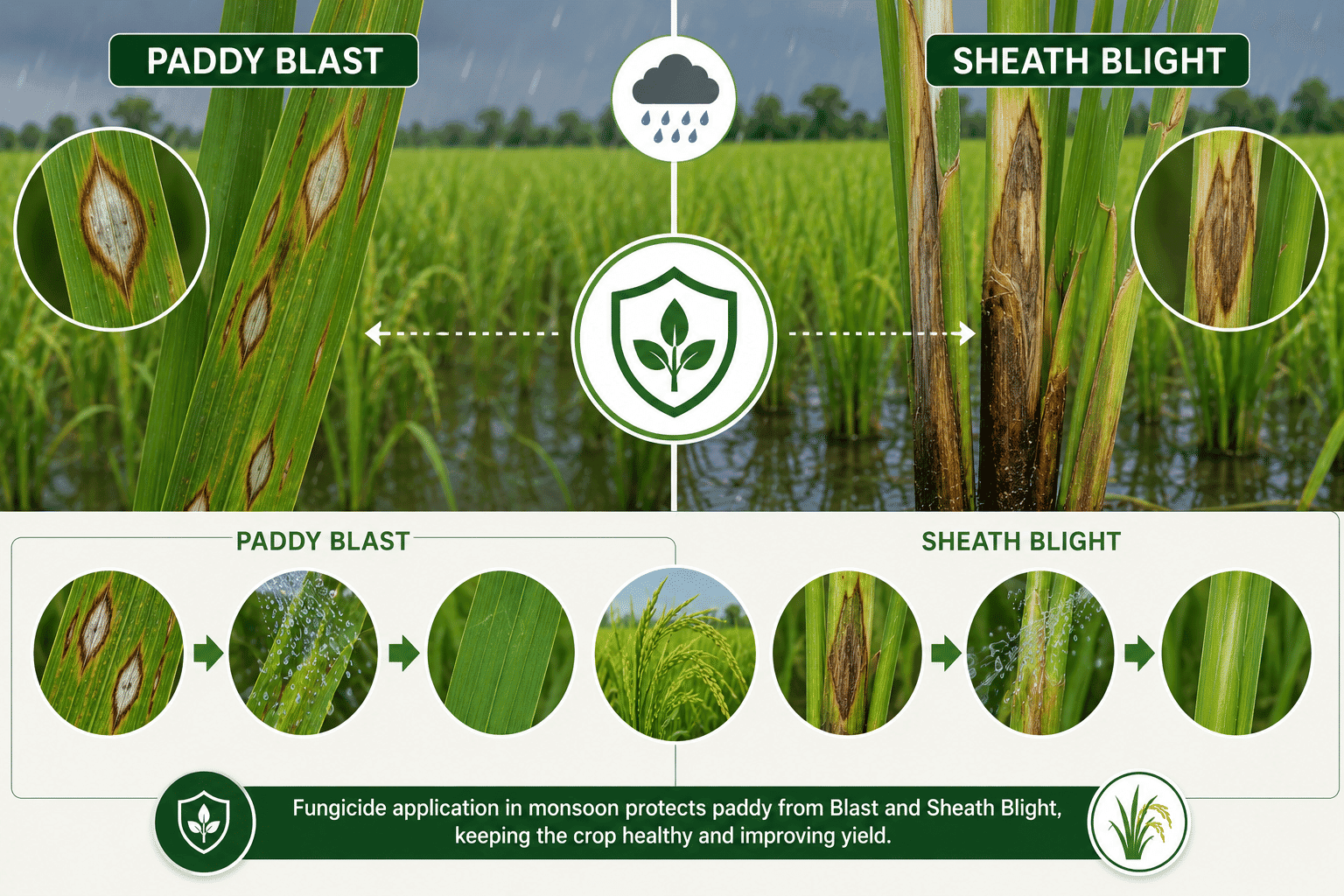
Paddy is one of the most important kharif crops in India. During monsoon, high humidity, cloudy weather, dense crop growth, and excess nitrogen make paddy more prone to fungal diseases. Among them, blast and sheath blight are two major diseases that can reduce crop yield if not managed on time.
Blast can affect leaves, nodes, neck, and panicles, while sheath blight mainly starts from the lower leaf sheath and moves upward. In severe disease conditions, both diseases can reduce tillering, grain filling, and overall yield.
In this article, let us understand the symptoms, favourable conditions, and commonly used fungicide options for paddy blast and sheath blight management in monsoon 2026.
Why Blast and Sheath Blight Spread Fast in Monsoon
You may have seen disease patches spreading quickly after continuous rain. This usually happens when:
- Relative humidity remains high
- Leaves stay wet for a long time
- Plant spacing is too close
- Nitrogen is applied in excess
- Field drainage is poor
- The crop canopy becomes dense
- The same paddy variety is grown repeatedly in disease-prone areas
Field Symptoms Farmers Should Not Ignore
Paddy Blast Symptoms
- Diamond-shaped or spindle-shaped spots on leaves
- Grey or whitish centre with brown border
- Spots joining together in severe infection
- Brown to black lesions on nodes
- Neck blast causing panicles to bend or break
- Poor grain filling in affected panicles
Sheath Blight Symptoms
- Greyish-green, water-soaked patches on lower leaf sheath
- Oval or irregular lesions with brown margins
- Disease moving upward under humid conditions
- Lodging or weak tillers in severe cases
- Circular or patchy spread in the field
Top 10 Fungicide Options for Paddy Blast and Sheath Blight
Use only products registered for paddy and for the target disease as per the approved label. Do not use any molecule only because it is available in the market.
|
Sr. No. |
Product Name |
Technical Name |
Dosage |
|
1 |
Tricyclazole 75% WP |
120-160gm/Acre |
|
|
2 |
Isoprothiolane 40% EC |
400ml/Acre |
|
|
3 |
Hexaconazole 5% SC |
200ml/Acre |
|
|
4 |
Validamycin 3% L |
800ml/Acre |
|
|
5 |
Propiconazole 25% EC |
200ml/Acre |
|
|
6 |
Azoxystrobin 18.2% + Difenoconazole 11.4% SC |
200ml/Acre |
|
|
7 |
Carbendazim 50% WP |
100-200gm/Acre |
|
|
8 |
Tebuconazole 25.9% EC |
300ml/Acre |
|
|
9 |
Kasugamycin 3% SL |
400-600ml/Acre |
|
|
10 |
Tebuconazole 50% + Trifloxystrobin 25% WG |
80gm/Acre |
Conclusion
Paddy blast and sheath blight are serious monsoon diseases, but they can be managed with early diagnosis, balanced nutrition, proper spacing, drainage, and need-based fungicide use.
The fungicides listed above are commonly used options, but final selection must be based on crop stage, disease type, local recommendation, and field condition.