

Introduction
Paddy is one of the most important food crops for farmers, and healthy green leaves are necessary for good tillering, panicle formation, grain filling, and final yield. During the crop season, many pests attack paddy, and leaf folder or leaf roller is one of the common pests that can reduce crop growth if not managed at the right time.
Leaf folder mainly damages the leaves by folding them and feeding from inside. Because the larva remains protected inside the folded leaf, farmers may not notice the pest in the early stage. If the attack increases, many leaves in the field appear folded, dried, and whitish. This reduces the green leaf area and directly affects the plant’s ability to prepare food. Regular field observation is very important, especially from the tillering stage to the booting stage.
What is Paddy Leaf Folder/Roller?
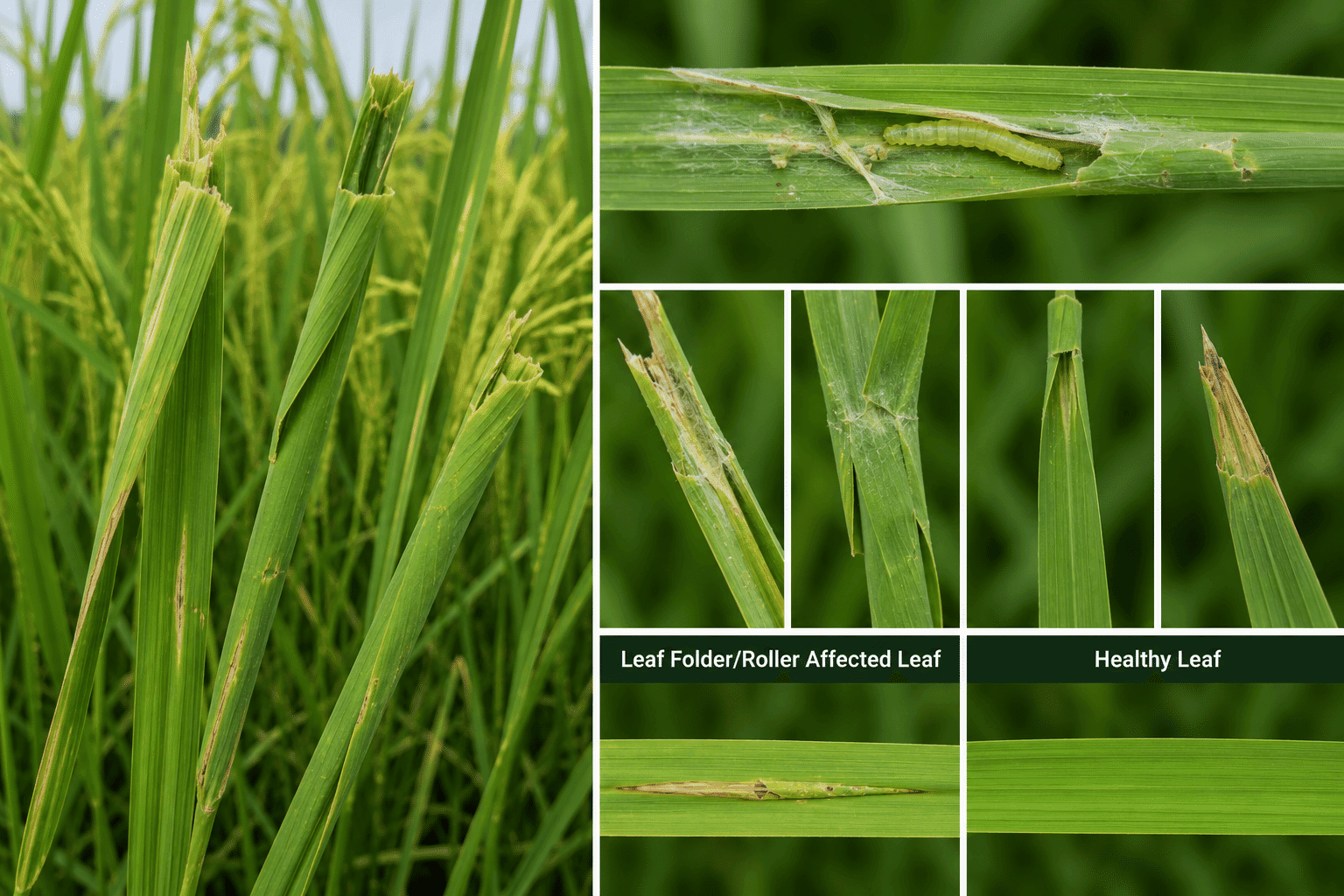
Paddy leaf folder is the larval stage of a moth. The adult moth lays eggs on paddy leaves. After hatching, the small larvae start feeding on the leaf surface. As they grow, they fold the leaf blade lengthwise and tie the edges with silken threads. The larva stays inside this folded leaf and scrapes the green tissue.
This feeding results in white, papery streaks on the leaves. In the beginning, only a few leaves may be affected, but under favorable conditions, the pest can spread quickly across the field. The damage is more serious when many leaves are folded during active crop growth.
Symptoms of Leaf Folder/Roller in Paddy
Farmers can identify leaf folder infestation by observing the leaves carefully. The pest causes very specific symptoms that are different from many other paddy pests.
Common symptoms include:
- Leaves folded lengthwise like a tube
- Leaf edges joined with silken threads
- White or transparent streaks on folded leaves
- Scraped green tissue inside the folded leaf
- Larvae found inside the folded leaves
- Drying of damaged leaf portions
- Reduced green leaf area
- Slow crop growth in severe infestation
- Field appearing whitish or scorched in heavy attack
- Moths flying around the field during evening hours
When the folded leaf is opened, farmers can usually see a greenish larva inside. Fresh damage appears as whitish scraping, while older damage turns dry and brown.
Damage Caused by Leaf Folder in Paddy
Leaf folder does not cut the plant like stem borer, but it reduces the working leaf area of the crop. Paddy leaves are responsible for photosynthesis, which helps the plant prepare food for tillers, panicles, and grains. When leaves are folded and scraped, the plant becomes weak and grain filling may be affected.
Major damage caused by leaf folder includes:
- Reduction in photosynthesis
- Weak tiller growth
- Poor crop vigor
- Drying of affected leaves
- Poor panicle development in severe cases
- Reduced grain filling
- Lower grain weight
- Yield reduction when infestation is heavy
Damage during the tillering stage affects plant growth, while damage near panicle initiation and booting stage can affect grain formation. If the flag leaf or upper leaves are damaged, the effect on yield may be higher because these leaves support grain filling.
Favorable Conditions for Pest Development
Leaf folder population increases when the field environment supports moth activity and larval survival. Farmers should be more alert during the following conditions:
- Warm and humid weather
- Cloudy days
- Frequent rainfall or high humidity
- Dense paddy crop canopy
- Excess nitrogen fertilizer use
- Continuous paddy cultivation
- Presence of grassy weeds around the field
- Excessive use of broad-spectrum insecticides
High nitrogen application makes the crop lush and tender, which attracts pests. Dense crop growth also gives a good hiding place for larvae and adult moths. If beneficial insects are killed due to unnecessary spraying, leaf folder population may increase faster.
Monitoring and Field Scouting
Early monitoring is the best way to manage leaf folder before it causes heavy damage. Farmers should not wait until the whole field appears white or dry. Field scouting should be done regularly from tillering stage onwards.
During field inspection:
- Walk in a zig-zag pattern across the field.
- Check plants from different locations, not only field borders.
- Observe both young and older leaves.
- Look for folded leaves and white scraping marks.
- Open folded leaves to check for live larvae.
- Monitor moth activity during evening hours.
- Check whether damage is increasing after rainfall or cloudy weather.
Farmers can inspect a few hills from different parts of the field every week. If the number of folded leaves is increasing and live larvae are present, control measures should be started early.
Management Practices for Paddy Leaf Folder/Roller
Leaf folder can be managed effectively through integrated pest management. Farmers should combine cultural, mechanical, biological, and need-based chemical methods. Depending only on insecticides may increase cost and harm natural enemies.
Cultural Control Methods
Good crop management reduces pest buildup and keeps plants healthy.
Farmers should follow these practices:
- Avoid excessive nitrogen fertilizer application.
- Apply nitrogen in split doses as recommended.
- Maintain proper plant spacing to avoid dense canopy.
- Keep field bunds clean and remove grassy weeds.
- Avoid continuous paddy cultivation in the same field where possible.
- Maintain balanced fertilizer use with proper potassium application.
- Avoid water stagnation for long periods.
- Remove crop residues after harvest.
Balanced nutrition helps the paddy crop tolerate pest attack better. Excess urea should be avoided because it encourages soft leaf growth, which is preferred by leaf folder larvae.
Mechanical and Physical Control
Mechanical methods are useful when infestation is noticed early.
- Collect and destroy folded leaves containing larvae.
- In small fields, open and crush larvae inside folded leaves.
- Install light traps to monitor adult moth activity.
- Remove weeds from bunds and nearby areas.
- Avoid unnecessary disturbance that spreads moths from one field to another.
Light traps help farmers know when adult moth activity is increasing. This gives an early warning for possible egg laying and larval attack.
Biological Control Methods
Many natural enemies help control leaf folder in paddy fields. Farmers should protect these beneficial insects by avoiding unnecessary pesticide sprays.
Important natural enemies include:
- Spiders
- Dragonflies and damselflies
- Parasitoid wasps
- Predatory beetles
- Trichogramma egg parasitoids
Biological control works better when used early and when the field has a good population of natural enemies. Farmers should avoid repeated spraying of broad-spectrum insecticides, as these may kill useful insects and lead to pest resurgence.
Chemical Control Measures
Chemical spraying should be done only when infestation is high and live larvae are present. Spraying without checking the field increases cost and may not give good results.
Farmers should follow these points:
- Use only recommended insecticides for paddy leaf folder.
- Spray at the early larval stage for better control.
- Follow label dosage and instructions carefully.
- Do not repeat the same insecticide again and again.
- Rotate insecticides with different modes of action.
- Ensure proper spray coverage on leaves.
- Avoid spraying when natural enemy population is high and pest damage is low.
Once the larva is fully protected inside the folded leaf, control becomes more difficult. Therefore, early-stage spraying gives better results.
Precautions During Spraying
- Spray during morning or evening hours.
- Avoid spraying during strong winds or rainfall.
- Use clean water for spray preparation.
- Maintain proper spray volume for good leaf coverage.
- Do not use higher than recommended dosage.
- Wear gloves, mask, and protective clothing.
- Keep children and animals away from the sprayed field.
- Wash hands and equipment properly after spraying.
Farmers should always follow local agricultural recommendations before selecting any chemical.
Preventive Measures for Farmers
Leaf folder can be prevented or reduced by following simple practices throughout the crop season:
- Monitor the crop regularly from tillering stage.
- Avoid excess nitrogen and follow balanced fertilization.
- Keep bunds and field borders weed-free.
- Maintain proper spacing and avoid very dense crop growth.
- Conserve spiders and other natural enemies.
- Use light traps for monitoring moth activity.
- Take action when early folded leaves are seen.
- Avoid unnecessary pesticide sprays.
Timely action is more effective than trying to control the pest after severe damage.
Conclusion
Paddy leaf folder or leaf roller is an important pest that damages paddy leaves by folding them and feeding from inside. The main symptoms are folded leaves, white scraping marks, drying leaf portions, and larvae hidden inside the folded leaves. Severe infestation reduces photosynthesis, weakens crop growth, affects grain filling, and lowers yield.
Farmers can manage this pest effectively through regular field scouting, balanced fertilizer use, weed removal, conservation of natural enemies, and need-based insecticide spraying. Early detection is the key to successful management. By following integrated pest management practices, farmers can protect paddy leaves, improve grain filling, reduce yield loss, and increase overall crop profit.