

Introduction
Nutrition management is one of the most important parts of Kharif paddy cultivation. During monsoon, rainfall, waterlogging, cloudy weather, and nutrient losses can affect crop growth.
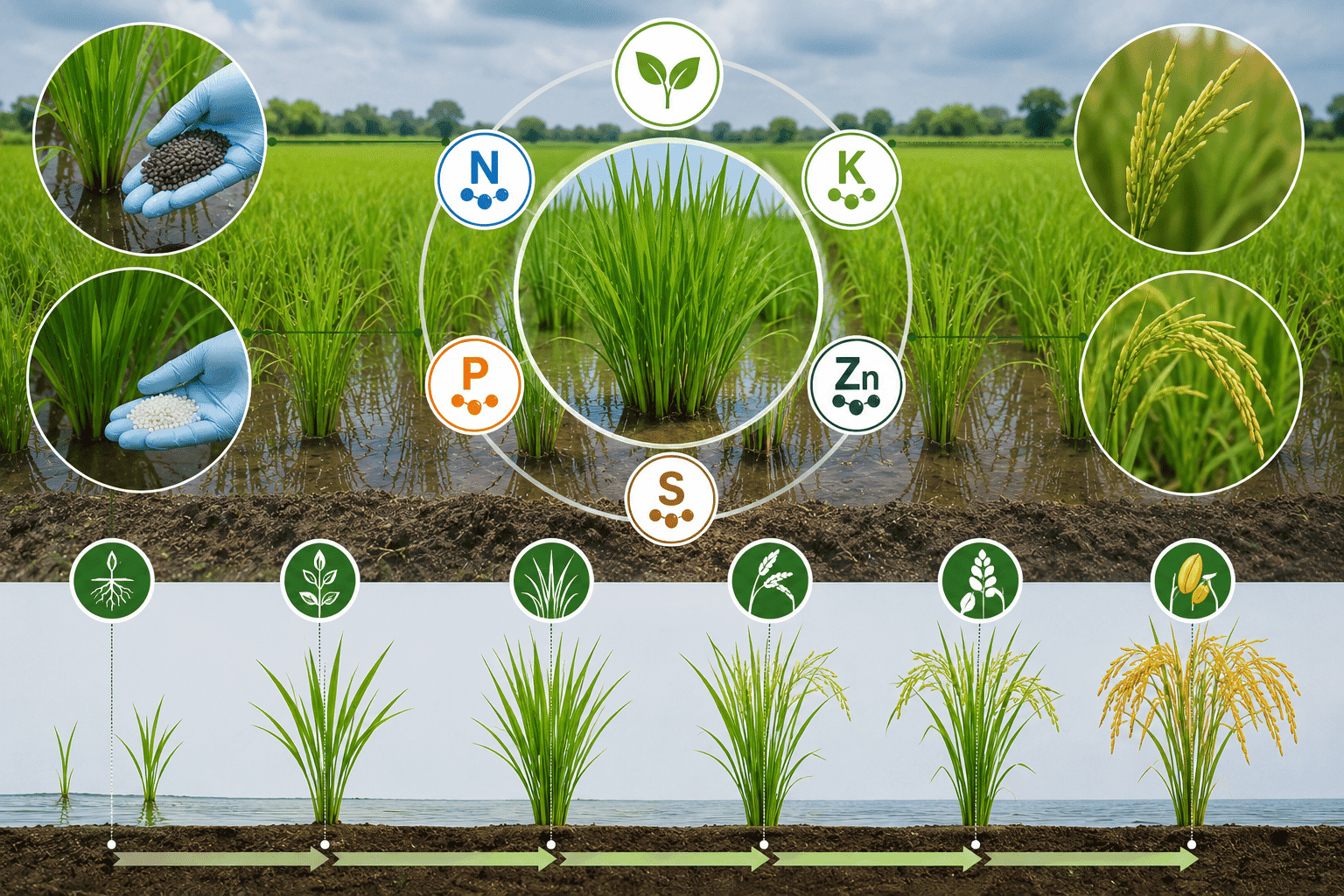
Paddy needs balanced nutrition from nursery to grain filling. Nitrogen supports tillering and leaf growth. Phosphorus supports root growth. Potassium improves crop strength, grain filling, and stress tolerance. Zinc, sulphur, and other micronutrients are also important in many soils.
Good nutrition management in Kharif paddy means right nutrient, right time, right method, and right dose based on soil test and local recommendation.
Why Nutrition Management is Important in Kharif Paddy
Kharif paddy grows during the rainy season. Because of this, nutrient management is different from summer or irrigated-season rice.
During Kharif:
- Nitrogen loss may increase due to heavy rain
- Zinc deficiency may appear in some fields
- Waterlogging can reduce root activity
- Cloudy weather can slow crop growth
- Nutrients may not be used properly if roots are weak
- Excess nitrogen can increase pest and disease risk
- Poor potassium can reduce crop strength and grain filling
Balanced nutrient management helps the crop develop strong roots, healthy tillers, good panicles, better grain filling, and improved tolerance to stress.
Major Nutrients Required by Paddy
1. Nitrogen
Nitrogen is needed for leaf growth, tillering, and crop greenness. Paddy uses nitrogen heavily during vegetative growth and tillering.
Role of nitrogen
- Supports tiller formation
- Improves leaf growth
- Helps crop canopy development
- Supports panicle formation when applied correctly
Problem with excess nitrogen
Too much nitrogen can make the crop soft and dense. It may increase lodging, pest attack, and disease pressure such as blast and sheath blight.
2. Phosphorus
Phosphorus supports early root development and seedling establishment.
Role of phosphorus
- Improves root growth
- Helps early crop establishment
- Supports tillering
- Improves energy movement inside the plant
Phosphorus should usually be applied early because it is less mobile in soil compared to nitrogen.
3. Potassium
Potassium improves crop strength and helps the plant manage stress.
Role of potassium
- Strengthens stem
- Supports grain filling
- Improves resistance to lodging
- Helps water regulation inside the plant
- Supports tolerance to pest, disease, and moisture stress
4. Zinc
Zinc deficiency is common in many paddy fields, especially in alkaline soils, newly levelled fields, sandy soils, and continuously flooded conditions.
Role of zinc
- Supports early growth
- Helps leaf development
- Supports enzyme activity in plants
- Helps normal tillering
Zinc deficiency should be corrected early. Delayed correction can reduce crop growth.
5. Sulphur and Other Micronutrients
Sulphur supports protein formation and crop growth. Iron, manganese, copper, boron, and other micronutrients are required in small quantities.
Micronutrients should not be applied randomly. Use them based on soil test, deficiency symptoms, or local advisory.
Best Method: Soil Test-Based Nutrition
Soil testing is the best starting point for paddy nutrition. It helps farmers know whether the field is low, medium, or high in nutrients.
Soil test helps decide:
- Nitrogen requirement
- Phosphorus need
- Potassium need
- Zinc deficiency risk
- Soil pH problem
- Organic carbon status
- Need for lime, gypsum, or other amendments where advised
If soil test is not available, follow the local agriculture department, KVK, or state agriculture university recommendation for your area and variety.
Stage-Wise Nutrition Management in Kharif Paddy
1. Before Nursery Sowing
Nursery nutrition affects seedling strength. Weak seedlings do not establish well after transplanting.
Important steps
- Use healthy seed
- Prepare well-drained nursery
- Apply organic manure where locally recommended
- Avoid excess nitrogen in nursery
- Correct zinc deficiency if nursery has a history of poor growth
- Avoid dense nursery sowing
Do not overfeed the nursery. Soft seedlings may suffer more after transplanting.
2. Before Transplanting or Main Field Preparation
Main field preparation is the right time to apply basal nutrients.
Basal application usually includes
- Organic manure or compost, if available
- Full or major part of phosphorus
- Potassium as per local recommendation
- Zinc where soil is deficient or local advisory recommends
- Green manure incorporation where practised
Phosphorus and zinc are more useful when applied early. Delayed application may not correct early root weakness properly.
3. At Transplanting Stage
Healthy establishment after transplanting is important.
Key points
- Use healthy seedlings
- Avoid very old seedlings where possible
- Maintain proper spacing
- Avoid deep transplanting
- Keep suitable water level
- Avoid heavy nitrogen immediately if seedlings are stressed
Good establishment helps the crop use nutrients better.
4. Early Tillering Stage
This is a major nitrogen-demand stage. Nitrogen applied at the right time supports tiller formation.
Management points
- Apply nitrogen in split doses as per local schedule
- Do not apply nitrogen when field has deep standing water
- Drain excess water before fertilizer application where needed
- Apply fertilizer when water is shallow
- Maintain proper water level after application
5. Active Tillering Stage
Active tillering decides the number of productive tillers.
Crop needs at this stage
- Balanced nitrogen
- Good root activity
- Proper water level
- Weed control
- Pest and disease monitoring
Excess nitrogen at this stage can create too much vegetative growth. This may increase disease and lodging risk later.
6. Panicle Initiation Stage
Panicle initiation is a very important stage for yield formation. Nutrient stress at this stage can affect panicle size and grain number.
Management points
- Apply nitrogen split as per recommendation
- Ensure potassium is not deficient
- Avoid moisture stress
- Avoid excess nitrogen
- Monitor pest and disease risk
- Correct visible deficiencies with local advisory
Potassium is especially important for crop strength and grain filling support.
7. Flowering and Grain Filling Stage
At this stage, the crop needs healthy leaves and proper nutrient movement to grains.
Important points
- Avoid late heavy nitrogen application
- Maintain proper water level
- Protect crop from pest and disease
- Avoid nutrient stress
- Monitor potassium deficiency symptoms
- Avoid unnecessary foliar sprays close to harvest
Late excess nitrogen may delay maturity, increase lodging, and increase disease risk.
General Fertilizer Timing in Kharif Paddy
Exact dose depends on soil test, variety, crop duration, soil type, and local recommendation. But the timing principle is usually as follows:
|
Crop Stage |
Nutrition Focus |
|
Field preparation |
Organic manure, phosphorus, potassium, zinc where needed |
|
Transplanting establishment |
Root growth and seedling recovery |
|
Early tillering |
Nitrogen split for tiller formation |
|
Active tillering |
Balanced growth and tiller maintenance |
|
Panicle initiation |
Nitrogen and potassium support as per recommendation |
|
Flowering |
Avoid stress and protect healthy leaves |
|
Grain filling |
Potassium support and healthy canopy management |
Do not apply fertilizer only by calendar date. Match fertilizer timing with crop stage and field condition.
Nutrient Deficiency Symptoms in Paddy
1. Nitrogen Deficiency
Symptoms
- Pale green or yellow leaves
- Older leaves yellow first
- Poor tillering
- Slow growth
- Thin crop stand
Nitrogen deficiency may appear after heavy rainfall due to leaching and loss. Confirm with crop stage and field condition before applying.
2. Phosphorus Deficiency
Symptoms
- Poor root growth
- Stunted plants
- Dark green leaves in some cases
- Purple or reddish colour in some varieties
- Delayed maturity
Phosphorus deficiency is more common in cold, poor-root-growth, or low-phosphorus soils.
3. Potassium Deficiency
Symptoms
- Yellowing or drying from leaf tips and margins
- Weak stems
- Poor grain filling
- More lodging risk
- Higher stress sensitivity
Potassium deficiency can become more visible during later crop stages.
4. Zinc Deficiency
Symptoms
- Yellowing or bronzing of young leaves
- Stunted plants
- Poor tillering
- Brown spots on leaves
- Uneven crop growth
- Delayed recovery after transplanting
IRRI notes that zinc deficiency affects plant colour and turgor and is an important rice nutrient issue.
5. Iron Toxicity or Nutrient Imbalance
In some waterlogged and acidic soils, leaves may show bronzing due to iron toxicity or other nutrient imbalance. This can be confused with deficiency.
Do not apply micronutrients randomly. Identify the exact problem with local expert support.
ICAR-CRRI has published guidance on identifying nutrient deficiencies, toxicities, and diseases in rice because symptoms can be confused with drought, excess water, herbicide injury, pest attack, and disease.
Water Management and Fertilizer Use
Water condition affects fertilizer efficiency in paddy.
Before fertilizer application
- Avoid deep standing water
- Drain excess water if needed
- Apply fertilizer when water level is shallow
- Avoid fertilizer application before heavy rain
- Avoid applying urea in flowing water
- Refill water after fertilizer settles, as per local practice
Heavy rain soon after fertilizer application can reduce nutrient use efficiency and waste money.
Organic Manure and Green Manuring
Organic sources improve soil health and support nutrient availability.
Useful organic options
- Farmyard manure
- Compost
- Green manure crops
- Rice straw compost
- Vermicompost where available
- Azolla where locally practised
- Biofertilizers as per local recommendation
Organic sources should be used along with balanced fertilizer planning. They may not fully replace chemical fertilizers in high-yielding paddy without proper nutrient calculation.
Foliar Nutrition in Paddy
Foliar spray can help in some situations, especially when root uptake is poor or a specific nutrient deficiency is confirmed.
But foliar nutrition should not replace soil-applied fertilizers.
Use foliar spray only when:
- Deficiency is identified
- Crop is at suitable stage
- Weather is favourable
- Product is recommended for paddy
- Local advisory supports it
Avoid foliar spray:
- During hot afternoon
- Before rainfall
- During strong wind
- On severely stressed crop
- Without knowing the deficiency
- By mixing many products together
Nutrition Management in Direct Seeded Rice
Direct seeded rice may need slightly different nutrient and weed management compared to transplanted paddy.
Important points:
- Ensure good early weed control
- Apply nutrients based on soil test
- Avoid nitrogen loss during heavy rain
- Split nitrogen properly
- Monitor zinc deficiency
- Maintain good crop stand
- Avoid overuse of nitrogen in early stage
In direct seeded rice, early weed competition can take away nutrients and reduce crop growth. Nutrition and weed control should be planned together.
Nutrition Management in Transplanted Paddy
Transplanted paddy needs good seedling recovery and tiller formation.
Important points:
- Apply basal nutrients during field preparation
- Use nitrogen in splits
- Keep shallow water after transplanting
- Avoid deep water during early establishment
- Correct zinc deficiency early
- Maintain balanced nutrition at panicle initiation
Transplanted crop should not be pushed with heavy nitrogen too early if seedlings are weak.
Common Mistakes to Avoid
- Applying all nitrogen at one time
- Applying urea before heavy rainfall
- Using excess nitrogen for greener crop
- Ignoring phosphorus and potassium
- Applying zinc without need or at wrong time
- Not using soil test
- Applying fertilizer in deep standing water
- Ignoring organic matter
- Confusing disease symptoms with nutrient deficiency
- Ignoring drainage during heavy rain
- Repeating foliar sprays without diagnosis
Balanced nutrition gives better results than only making the crop dark green.
Paddy Nutrition After Heavy Rainfall
After heavy rain, check the field before applying any fertilizer.
Field checklist
|
Field Condition |
Action |
|
Standing water |
Drain excess water first |
|
Crop yellowing |
Check roots and waterlogging damage |
|
Fertilizer washed away |
Take local advice before reapplication |
|
Zinc-like symptoms |
Confirm with local expert |
|
Crop lodged |
Avoid further nitrogen |
|
Field has blast or sheath blight risk |
Avoid excess nitrogen |
|
Soil still saturated |
Wait for workable condition |
Do not immediately apply urea just because crop looks yellow after rain. Yellowing may be due to root stress, waterlogging, disease, or nutrient loss.
Integrated Nutrition Management Plan
Good paddy nutrition should combine soil, water, organic matter, and fertilizers.
Practical plan
- Test soil before season where possible
- Apply organic manure during land preparation
- Apply basal phosphorus and potassium as per recommendation
- Apply zinc only where needed or advised
- Use nitrogen in split doses
- Avoid fertilizer application before heavy rain
- Maintain proper water level
- Correct deficiency only after diagnosis
- Avoid excess nitrogen during disease-prone weather
- Monitor crop from tillering to grain filling
This approach improves nutrient use and reduces wastage.
Safety Precautions During Fertilizer and Spray Use
- Wear gloves while handling fertilizers
- Avoid direct contact with skin and eyes
- Do not mix fertilizers with pesticides unless advised
- Store fertilizers in a dry place
- Keep fertilizers away from children and animals
- Do not store fertilizer near food or seed
- Wash hands after handling fertilizer
- Use clean water for foliar spray
- Follow product label instructions
Safe handling protects both farmer and crop.
Conclusion
Nutrition management in Kharif paddy should be planned according to soil test, crop stage, water condition, and local recommendation. Nitrogen should be applied in split doses, phosphorus and potassium should not be ignored, and zinc should be corrected where needed.
During monsoon, avoid fertilizer application before heavy rain or in deep standing water. After heavy rainfall, check root health and field condition before applying nutrients.