

Introduction
Tomato is one of the most profitable vegetable crops grown by farmers due to its high market demand and regular income throughout the season. Healthy leaves are very important for proper plant growth, flowering, and fruit development. However, leaf eating caterpillars are serious pests that can damage tomato plants by feeding on leaves, tender shoots, flowers, and sometimes young fruits.
If the infestation is not identified and controlled at the right time, severe defoliation can occur within a few days. This weakens the plant, reduces fruit setting, affects fruit quality, and lowers overall yield. Therefore, farmers should regularly monitor the crop and follow timely pest management practices to protect the tomato field.
What is Leaf Eating Caterpillar in Tomato?
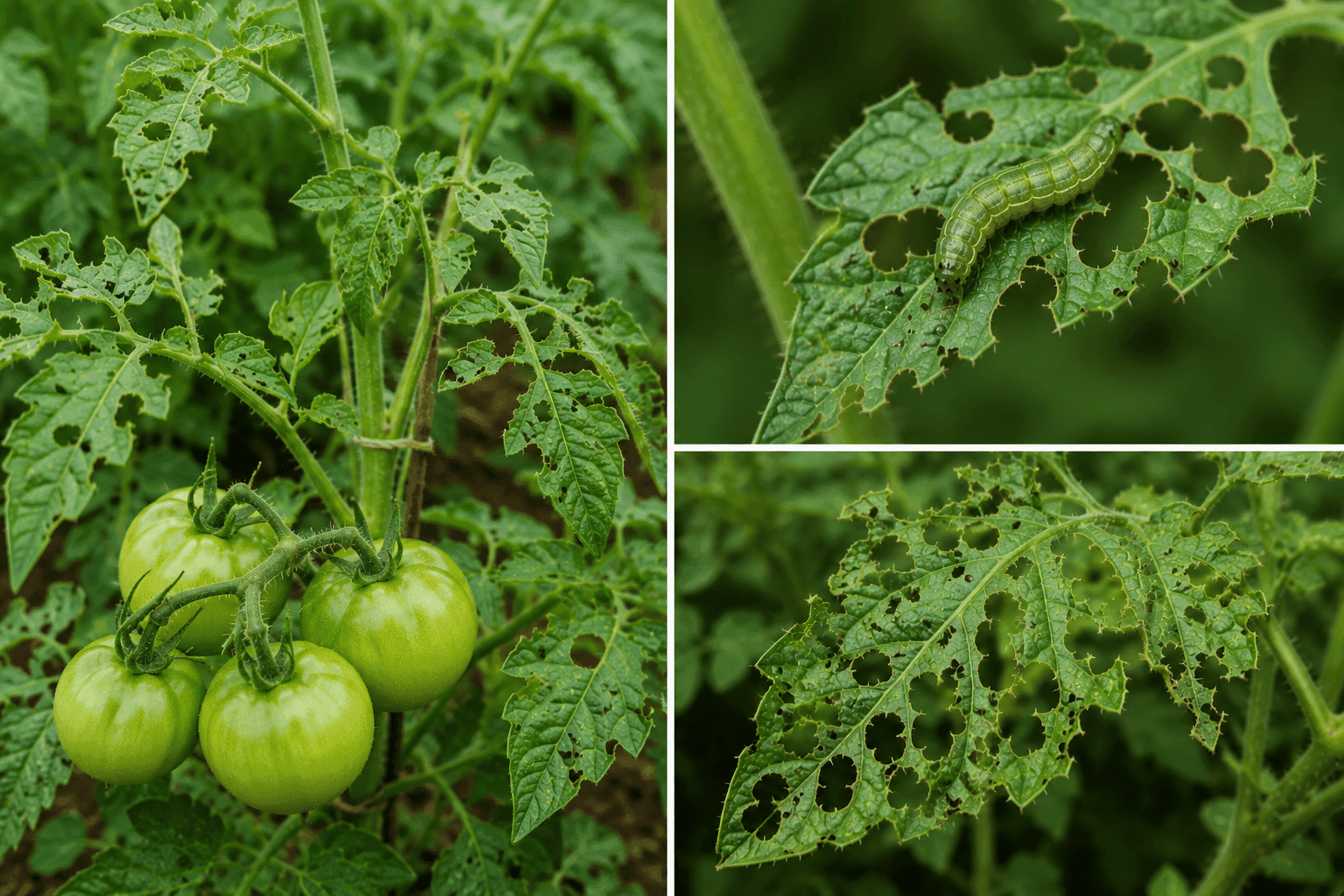
Leaf eating caterpillars are the larval stage of moths. Adult moths lay eggs on tomato leaves, and after hatching, the young larvae begin feeding on the crop. Small larvae initially scrape the leaf surface and create tiny feeding marks. As they grow bigger, they eat larger portions of leaves and create irregular holes.
In severe infestation, caterpillars may completely eat the leaf lamina, leaving only veins and stems behind. The pest mainly attacks during vegetative growth but can continue damaging the crop during flowering and fruiting stages.
Identification and Early Symptoms
Early identification helps farmers take quick action before the infestation spreads across the field. Caterpillars may appear green, brown, grey, or black depending on the species and growth stage. They are commonly found on leaves, tender shoots, flowers, and sometimes near fruits.
Common symptoms of infestation include:
- Small holes on tender leaves
- Scraping marks on leaf surface
- Irregular feeding damage on leaves
- Leaves eaten from edges
- Black fecal pellets on leaves
- Caterpillars hiding under leaves during daytime
- Drying of heavily damaged leaves
- Damage to flower buds and flowers
- Feeding marks on tender fruits
- Weak and stunted plant growth
- Severe defoliation during heavy infestation
The caterpillars are more active during morning and evening hours. Young tomato plants are more vulnerable because early leaf loss affects plant establishment and future fruit production.
Damage Caused by Leaf Eating Caterpillars
Leaf eating caterpillars directly reduce the green leaf area responsible for photosynthesis. When plants lose too many leaves, food production inside the plant decreases, leading to weak growth and poor flowering.
Heavy infestation during flowering and fruiting stages reduces fruit setting and fruit size. Caterpillars may also feed on tender fruits, making them unfit for market. Damaged fruits develop scars, holes, and poor appearance, reducing market value and farmer profit.
Severe infestation can completely defoliate plants, especially during favorable weather conditions. If timely management is not followed, the pest can spread rapidly and cause major yield losses.
Favorable Conditions for Pest Development
Leaf eating caterpillars multiply quickly under favorable environmental and field conditions. Farmers should be more alert during:
- Warm and humid weather
- Cloudy conditions
- Irregular rainfall
- Dense crop canopy
- Excess nitrogen fertilizer use
- Poor field sanitation
- Presence of weeds around the field
- Continuous tomato cultivation in the same field
Excess nitrogen fertilizer promotes soft vegetative growth, which attracts caterpillars. Dense crop canopy provides shelter for larvae and makes pest management difficult. Weeds and crop residues also help pests survive and multiply.
Monitoring and Field Scouting
Regular crop observation is very important for early detection and control. Farmers should inspect the crop every 3–4 days, especially during vegetative and flowering stages.
During field scouting:
- Check upper and lower leaf surfaces carefully
- Observe tender shoots and flower buds
- Look for eggs and young larvae
- Identify fresh feeding holes and scraping marks
- Watch for black fecal pellets on leaves
- Observe moth activity during evening hours
Light traps can also be installed in the field to monitor adult moth activity. Increased moth movement indicates a higher risk of caterpillar infestation.
Best Control Measures for Leaf Eating Caterpillar in Tomato
Integrated pest management provides better and long-lasting control. Farmers should combine cultural, mechanical, biological, and chemical methods instead of depending only on chemical sprays.
Cultural Control Methods
- Keep the field clean and remove weeds regularly.
- Avoid excessive nitrogen fertilizer application.
- Follow crop rotation practices.
- Maintain proper spacing for better air circulation.
- Remove crop residues after harvest.
- Practice deep summer ploughing to expose pupae to sunlight and predators.
Mechanical Control Methods
- Collect and destroy caterpillars during early infestation.
- Remove and destroy egg masses found on leaves.
- Remove heavily damaged leaves and shoots.
- Install bird perches in the field to encourage birds that feed on caterpillars.
- Use light traps to reduce adult moth population.
Mechanical methods are more effective during the early crop stage and in small fields.
Biological Control Methods
Natural enemies help reduce caterpillar population naturally. Farmers should conserve beneficial insects by avoiding unnecessary broad-spectrum insecticide sprays.
Useful biological control options include:
- Trichogramma parasitoids
- Predatory birds
- Spiders
- Ladybird beetles
- Bacillus thuringiensis (Bt) formulations
Bt formulations work effectively against young caterpillars and are safer for beneficial insects and the environment.
Chemical Control Measures
When infestation becomes severe and crosses the economic threshold level, farmers can use recommended insecticides. Chemical spraying should be done only after proper field observation.
Farmers should follow these important points:
- Use only recommended insecticides for tomato crop.
- Follow label instructions and recommended dosage carefully.
- Rotate insecticides with different modes of action to avoid resistance development.
- Avoid repeated use of the same chemical.
- Ensure proper spray coverage on leaves and tender plant parts.
Timely spraying during the early larval stage gives better results than spraying after caterpillars become fully grown.
Precautions During Spraying
- Spray during morning or evening hours.
- Avoid spraying during strong winds or rainfall.
- Cover both upper and lower leaf surfaces properly.
- Use clean water for spray preparation.
- Wear gloves, mask, and protective clothing during spraying.
- Keep children and animals away from the sprayed field.
- Follow waiting period before harvesting fruits.
Preventive Measures for Farmers
Preventive practices help reduce pest infestation and crop damage.
Farmers should:
- Monitor the field regularly every 3–4 days.
- Use healthy and disease-free seedlings.
- Follow timely sowing practices.
- Maintain field sanitation throughout the crop period.
- Remove weeds from field bunds and nearby areas.
- Encourage natural enemies in the field.
- Use balanced fertilizers instead of excess nitrogen.
- Avoid continuous tomato cultivation in the same field.
Conclusion
Leaf eating caterpillars are serious pests in tomato cultivation and can cause heavy damage if ignored during the early stages. They reduce leaf area, weaken plant growth, damage flowers and fruits, and lower overall yield and fruit quality. Early identification, regular field monitoring, balanced fertilizer use, clean cultivation, and timely control measures are essential for effective management.
Farmers should follow integrated pest management practices by combining cultural, mechanical, biological, and chemical methods for better and sustainable control. Timely action helps protect tomato plants, improve fruit quality, reduce crop loss, and increase overall farm profit.