

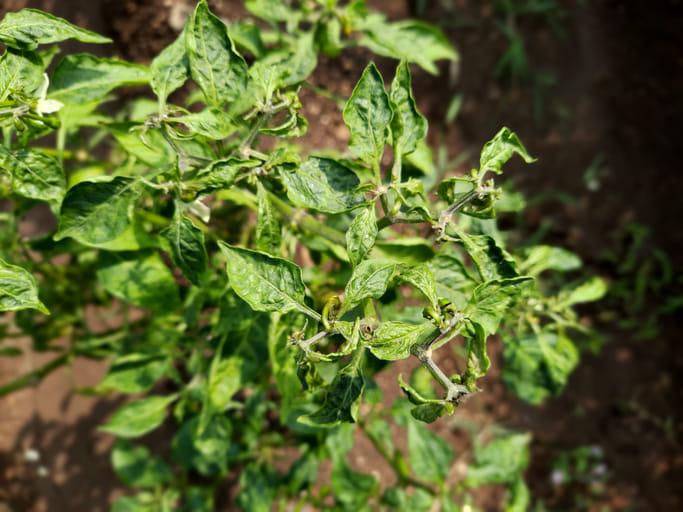
Leaf curl virus is one of the most damaging diseases of chilli and tomato in India. Caused by begomoviruses and spread by whiteflies, it can wipe out 60 to 100 percent of yield once it sets in. Since no chemical can cure an infected plant, the only effective strategy is prevention and vector management.
Symptoms of Leaf Curl Virus
- Upward or downward curling of young leaves.
- Yellow mottling and crinkling of leaf surface.
- Reduced leaf size and shortened internodes (bunchy top).
- Twisted, deformed stems.
- Few flowers and small, deformed fruits.
- Severely stunted plants if infected at early stage.
How the Virus Spreads
- The whitefly Bemisia tabaci is the main vector.
- Once a plant is infected, every whitefly that feeds on it carries the virus.
- Volunteer plants, weeds (e.g., Croton, Datura, Parthenium) act as virus reservoirs.
- Infected nursery seedlings spread the virus to the main field.
- Seeds rarely transmit the virus; it is primarily insect-borne.
1. Start With Resistant Varieties
Several Indian seed companies and institutions like IIVR Varanasi, IIHR Bengaluru, and TNAU release leaf-curl-tolerant chilli and tomato hybrids. Always ask your local agriculture officer for the latest tolerant varieties suited to your district.
2. Healthy Nursery Practices
- Raise nursery under 40 to 50 mesh insect-proof net or polyhouse.
- Treat seed with Imidacloprid 70 WS at 5 g per kg of seed (follow label).
- Remove curled or virus-symptom seedlings before transplanting.
- Maintain yellow sticky traps inside the nursery.
3. Control Whiteflies — the Vector
- Install 8 to 12 yellow sticky traps per acre.
- Spray neem oil 1500 to 10000 ppm at 3 to 5 ml per litre at early infestation.
- Use recommended insecticides above ETL: Diafenthiuron, Spiromesifen, Pyriproxyfen, Flonicamid, or Buprofezin.
- Rotate insecticide groups every 2 to 3 sprays to delay resistance.
- Avoid synthetic pyrethroids alone, which can flare whitefly numbers.
4. Field Sanitation
- Rogue out and burn infected plants as soon as symptoms appear.
- Remove weed hosts in and around the field.
- Do not grow chilli, tomato, brinjal, or tobacco continuously in the same plot.
- Avoid overlapping crops; have a clean break between two host crops.
5. Use Border and Trap Crops
- Plant 2 to 3 rows of maize or sorghum on field borders as a wind and vector barrier.
- Marigold rows attract beneficial insects.
- Reflective silver mulch in nursery beds repels whiteflies.
6. Balanced Nutrition Reduces Severity
Excess nitrogen creates lush, soft leaves favoured by whiteflies. Use balanced fertilization with potassium, calcium, and zinc to harden plant tissue and improve tolerance.
Quick Action Checklist
Stage | Action |
|---|---|
Nursery | Net cover, seed treatment, sticky traps |
Transplanting | Plant only healthy seedlings |
0–30 DAT | Weekly whitefly monitoring, neem sprays |
30–60 DAT | Rotate insecticides, rogue infected plants |
After harvest | Burn residue, deep ploughing |
Conclusion
Leaf curl virus has no cure once a plant is infected. Success depends on resistant varieties, clean nursery, strict whitefly control, and prompt removal of infected plants. Follow label instructions on every chemical and consult your local KVK or agriculture officer for the latest tolerant varieties.