

Introduction
Cucurbits such as cucumber, bottle gourd, bitter gourd, ridge gourd, pumpkin, ash gourd, watermelon, and muskmelon are important vegetable crops grown by many farmers for regular income. These crops grow fast and give good returns when plants remain healthy. However, downy mildew is one of the most serious diseases in cucurbit crops and can cause heavy yield loss if not managed at the right time.
Downy mildew mainly affects the leaves of cucurbit plants. The disease reduces the green leaf area, weakens the plant, and affects flowering, fruit development, fruit size, and overall yield. If infection is ignored during favorable weather conditions, the disease can spread very quickly across the field. Therefore, early identification, regular field monitoring, and timely control measures are very important.
What is Downy Mildew in Cucurbits?
Downy mildew is a fungal-like disease that affects cucurbit crops, especially during humid and wet weather. The disease mainly attacks the leaves and spreads through airborne spores. These spores can move from infected plants to healthy plants through wind, rain splash, and high humidity conditions.
Once the disease starts in the field, it spreads fast if leaves remain wet for a long time. Crops grown in dense canopy, poor air circulation, and humid weather are more prone to severe infection.
Symptoms of Downy Mildew in Cucurbits
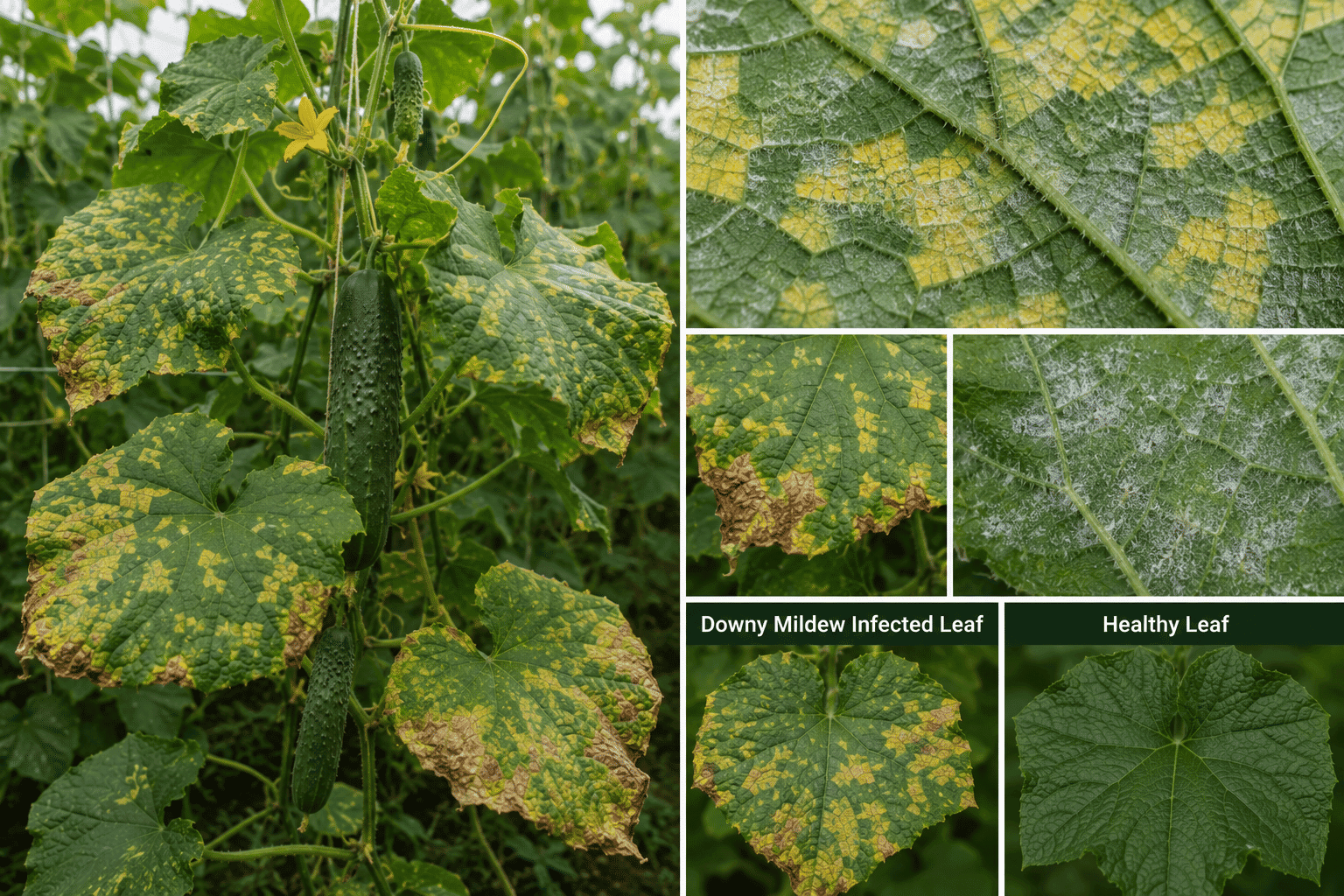
Farmers should regularly inspect the crop for early symptoms because early control gives better results. Downy mildew symptoms are mostly seen on leaves.
Common symptoms include:
- Small yellow spots on the upper surface of leaves
- Angular yellow patches limited by leaf veins
- Greyish or purple fungal growth on the lower side of leaves
- Yellow spots turning brown as disease increases
- Drying of infected leaf areas
- Leaves becoming weak and papery
- Premature drying and falling of leaves
- Reduced plant growth
- Poor flowering and fruit development
- Small and poor-quality fruits in severe infection
In many cucurbit crops, the yellow patches appear angular because they are restricted by leaf veins. This is an important symptom for identifying downy mildew in the field.
Damage Caused by Downy Mildew
Downy mildew reduces the photosynthetic area of the plant by damaging leaves. Since leaves prepare food for the plant, severe leaf infection directly affects crop growth and fruit production.
Major losses caused by downy mildew include:
- Reduced green leaf area
- Weak and slow plant growth
- Poor flowering and fruit setting
- Reduced fruit size
- Poor fruit quality and shine
- Premature drying of vines
- Lower yield and market value
- Increased cost of disease control
In crops like cucumber and gourds, healthy leaves are very important for continuous fruit production. When leaves dry early, fruit development becomes poor and harvesting period may reduce.
Favorable Conditions for Disease Development
Downy mildew spreads rapidly under certain weather and field conditions. Farmers should be more alert during:
- Cool and humid weather
- Cloudy weather
- Frequent rainfall
- Heavy dew formation
- Long leaf wetness period
- Dense crop canopy
- Poor air circulation
- Overhead irrigation
- Poor field sanitation
The disease becomes more severe when leaves remain wet for many hours. Dense planting and poor ventilation create a humid environment inside the crop canopy, which supports disease development.
How Downy Mildew Spreads
Downy mildew spreads mainly through spores produced on infected leaves. These spores are carried by wind and moisture to healthy plants.
The disease can spread through:
- Wind-borne spores
- Rain splash
- Irrigation water splash
- Infected crop residues
- Dense and humid crop canopy
- Continuous cucurbit cultivation in the same area
Once infection starts, new spores are produced quickly under humid conditions. This leads to fast disease spread in the field.
Monitoring and Field Scouting
Regular field scouting helps farmers detect the disease early and prevent severe spread. Farmers should inspect the crop every 3–4 days during humid, cloudy, or rainy weather.
During field inspection:
- Check older leaves first for yellow spots
- Observe the lower side of leaves for greyish or purple growth
- Look for angular yellow patches on leaves
- Inspect dense crop areas where humidity is high
- Remove severely infected leaves if disease is limited
- Monitor disease spread after rainfall or heavy dew
Early detection is very important because downy mildew spreads quickly once favorable conditions are present.
Best Control Measures for Downy Mildew in Cucurbits
Integrated disease management gives better and long-lasting control. Farmers should combine cultural, preventive, biological, and chemical methods instead of depending only on fungicide sprays.
Cultural Control Methods
- Use healthy and disease-free seeds or seedlings.
- Maintain proper spacing between plants for good air circulation.
- Avoid dense crop canopy.
- Remove weeds from the field and bunds.
- Avoid overhead irrigation, especially during evening hours.
- Provide proper drainage to avoid excess moisture.
- Remove and destroy severely infected leaves.
- Do not leave infected crop residues in the field after harvest.
- Follow crop rotation with non-cucurbit crops.
Good field sanitation and proper spacing reduce humidity around plants and help slow disease development.
Irrigation and Canopy Management
Water management is very important in controlling downy mildew. Excess moisture and wet leaves favor disease spread.
Farmers should:
- Irrigate in the morning instead of evening.
- Avoid water splashing on leaves.
- Use drip irrigation where possible.
- Remove unnecessary plant growth to improve airflow.
- Avoid water stagnation in the field.
When leaves dry quickly after irrigation or rain, disease development reduces.
Biological Management
Biological methods help improve plant health and reduce disease pressure naturally. Farmers can use beneficial microbial products as part of integrated disease management.
Useful biological practices include:
- Use of beneficial microbial formulations
- Application of well-decomposed compost
- Use of biofertilizers to improve plant health
- Maintaining soil organic matter
Biological methods work better when used regularly and along with good cultural practices.
Chemical Control Measures
When disease symptoms appear or weather conditions are highly favorable, farmers can use recommended fungicides for downy mildew management. Spraying should be done at the early stage of infection for better results.
Farmers should follow these important points:
- Use only recommended fungicides for cucurbit crops.
- Follow label dosage and spray instructions carefully.
- Rotate fungicides with different modes of action.
- Avoid repeated use of the same fungicide.
- Ensure proper coverage on both upper and lower leaf surfaces.
- Spray before disease becomes severe.
The lower side of leaves should be covered properly because fungal growth often develops there. Timely spraying gives better control than spraying after severe leaf drying.
Precautions During Spraying
- Spray during morning or evening hours.
- Avoid spraying during strong winds or rainfall.
- Use clean water for spray preparation.
- Ensure proper coverage of the leaf surface.
- Do not use more than the recommended dosage.
- Wear gloves, mask, and protective clothing.
- Keep children and animals away from the sprayed field.
- Follow the waiting period before harvesting fruits.
Since cucurbit vegetables are harvested frequently, following the waiting period after spraying is very important for consumer safety.
Preventive Measures for Farmers
Farmers can reduce the risk of downy mildew by following preventive practices from the beginning of the crop season:
- Select healthy seeds and seedlings.
- Maintain proper plant spacing.
- Monitor the crop regularly during humid weather.
- Avoid excess irrigation and water stagnation.
- Use drip irrigation where possible.
- Remove infected leaves and crop residues.
- Follow crop rotation.
- Keep the field clean and weed-free.
- Take timely control action after seeing early symptoms.
Preventive management is more effective and economical than controlling severe infection later.
Conclusion
Downy mildew is a serious disease of cucurbit crops and can cause heavy yield loss if ignored during the early stages. The disease mainly damages leaves, causing yellow angular spots, greyish growth on the lower leaf surface, leaf drying, weak plant growth, and poor fruit development.
Early identification, regular field scouting, proper spacing, good drainage, weed management, removal of infected leaves, and timely fungicide application are essential for effective control. Farmers should follow integrated disease management practices instead of depending only on chemical sprays. Timely action helps protect cucurbit plants, improve fruit quality, reduce crop loss, and increase overall farm profit.