

Introduction
Fall armyworm is a serious pest of maize, especially during the Kharif and monsoon season. It mainly damages young and vegetative maize plants by feeding on leaves and hiding inside the central whorl.
During warm and humid weather, the pest can multiply quickly. If the infestation is not noticed early, larvae move deep into the whorl, making control difficult. ICAR guidance on fall armyworm highlights early diagnosis, regular scouting, and integrated management as important steps for reducing crop damage.
Effective management depends on four things: early scouting, removal of egg masses and larvae, clean crop management, and need-based use of recommended insecticides.
What is Fall Armyworm in Maize?
Fall armyworm is a caterpillar pest. The adult moth lays eggs on maize leaves. After hatching, small larvae start feeding on leaf surfaces. As they grow, they move into the central whorl of the maize plant.
The pest is difficult to manage at a later stage because grown larvae hide inside the whorl. This is why early field checking is very important.
The fall armyworm life cycle includes egg, larval stages, pupa, and adult moth. CABI notes that the larvae pass through six growth stages before becoming fully grown, and the feeding damage is mainly seen on maize leaves and whorls.
Why Fall Armyworm Attack Increases During Monsoon
Fall armyworm activity often increases during monsoon because maize plants are soft, green, and actively growing. Warm and humid weather also supports pest development.
The risk may be higher when:
- Maize is sown late
- Nearby fields already have pest attack
- Farmers miss early scouting
- Excess nitrogen is applied
- Weeds and crop residues remain unmanaged
- Same crop is grown continuously in the area
Monsoon rainfall may wash away some small larvae, but it does not give complete protection. Field checking after rain is still necessary.
Symptoms of Fall Armyworm in Maize
Fall armyworm damage can be identified by checking the leaves and central whorl.
Common symptoms
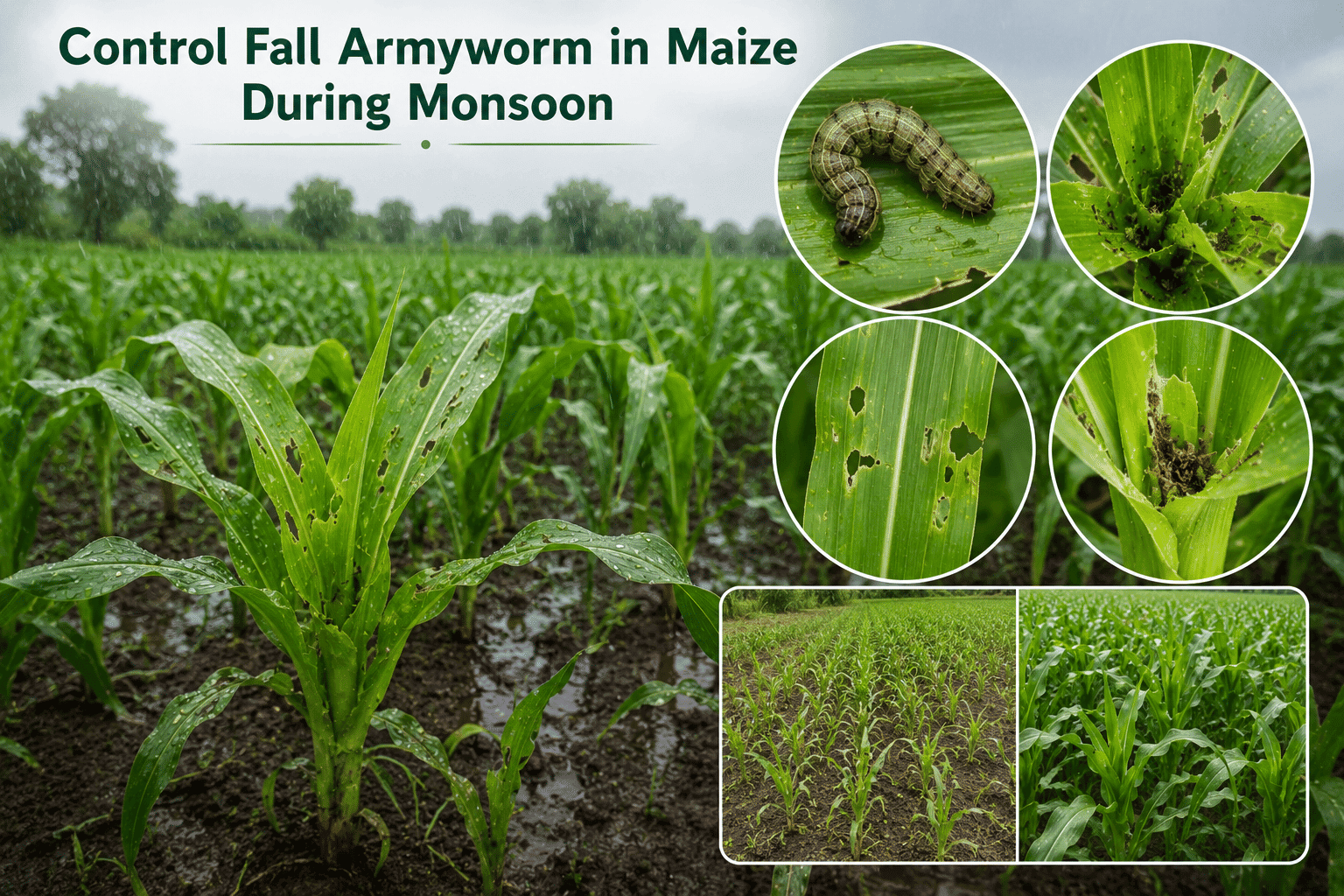
- Small window-like patches on leaves
- Round or irregular holes on leaves
- Scraped leaf surface in young plants
- Brown or greenish sawdust-like waste inside the whorl
- Torn leaves after the whorl opens
- Presence of larvae inside the central whorl
- Severe damage in young plants if control is delayed
A grown larva may show an inverted “Y” mark on the head and dark spots on the body. However, control is easier when larvae are still small. Farmers should not wait for severe damage.
Crop Stage Most Affected
Fall armyworm can attack maize at different stages, but young and vegetative crops are more sensitive.
High attention is needed from:
- Seedling stage
- Early vegetative stage
- Knee-high stage
- Whorl stage
Damage at an early stage can reduce plant growth. If the growing point is damaged badly, the plant may not recover well.
Step-by-Step Management of Fall Armyworm in Maize
1. Start Scouting Early
Start field scouting from 7–10 days after germination. Do not wait until leaves are badly damaged.
Check plants from different parts of the field. Avoid checking only border plants. Walk in a zig-zag pattern and observe the young leaves, underside of leaves, and central whorl.
Look for:
- Egg masses
- Small larvae
- Fresh leaf scraping
- Holes on leaves
- Frass or waste inside the whorl
IRAC India guidance also advises scouting soon after maize seedlings emerge because fall armyworm can produce multiple generations and spread quickly.
2. Remove Egg Masses and Small Larvae
In the early stage, egg masses and small larvae can be removed manually in small fields.
Remove and destroy:
- Egg masses on leaves
- Small larvae on leaf surface
- Affected plant parts where pest is visible
This step helps reduce the next pest population. Manual removal is most useful when infestation is still low.
3. Use Pheromone Traps for Monitoring
Pheromone traps help monitor adult moth activity in the field. They do not give full control, but they help farmers understand pest movement.
Use traps as per local agriculture department, KVK, or agriculture university guidance. Check traps regularly. If moth catch increases and crop symptoms are also seen, increase field scouting.
4. Keep the Field Clean
Field hygiene helps reduce pest hiding places and improves crop monitoring.
Recommended steps:
- Remove weeds from bunds and field borders
- Avoid unnecessary crop residues in the field
- Maintain proper spacing
- Avoid very dense crop growth
- Keep the field well-aerated
A clean field also helps spray reach the crop properly if chemical control becomes necessary.
5. Avoid Excess Nitrogen
Excess nitrogen can make maize plants soft and more attractive to pests. Apply fertilizer based on soil test or local recommendation.
Balanced nutrition is important for crop strength. Do not depend only on urea. Maize needs proper nitrogen, phosphorus, potassium, and micronutrients based on soil condition.
6. Protect Natural Enemies
Many natural enemies help reduce fall armyworm population. These include spiders, ladybird beetles, earwigs, ants, birds, and parasitic wasps.
Avoid unnecessary insecticide spray. Repeated and careless spraying can kill useful insects and may increase pest problems later.
Integrated pest management studies in Indian maize systems also record natural enemies such as spiders, coccinellids, and earwigs while evaluating fall armyworm control practices.
7. Use Need-Based Insecticide Spray
Chemical spray should be used only when fresh damage and live larvae are found in the field.
Use only recommended insecticide molecules registered for fall armyworm in maize. Follow the advice of the local agriculture department, KVK, or agriculture university for correct dose, water volume, and spray interval.
Avoid:
- Using unlabelled chemicals
- Mixing many insecticides together
- Increasing dose without recommendation
- Spraying before rain
- Spraying during strong wind
- Repeating the same molecule again and again
For exact dosage, always follow the product label and local crop advisory.
8. Direct Spray into the Whorl
Fall armyworm larvae usually hide inside the central whorl. Normal top spraying may not reach the pest properly.
For better results:
- Direct the spray toward the whorl
- Use sufficient water for proper coverage
- Spray during morning or evening
- Avoid spraying just before expected rainfall
- Use clean water for spray solution
- Wear protective clothing during spraying
Old damaged leaves will not become normal again after spray. Check for fresh damage after 2–3 days to understand whether the pest is still active.
What to Do After Heavy Rainfall
After heavy rain, inspect the maize field as soon as conditions allow.
Check for:
- Waterlogging
- Fresh leaf damage
- Live larvae inside whorls
- Lodging or weak plants
- New pest movement from nearby fields
Open small drainage channels if water is standing in the field. Waterlogged maize becomes weak and may suffer more from pest and disease pressure.
If spray is needed, choose a rain-free period. Spraying immediately before heavy rain may reduce effectiveness.
Common Mistakes to Avoid
- Waiting until severe leaf damage appears
- Spraying without checking live larvae
- Using higher-than-recommended dose
- Mixing many chemicals without expert advice
- Ignoring egg masses in the early stage
- Applying excess urea
- Spraying only on the upper leaves and not into the whorl
- Not checking the field after rainfall
- Repeating the same insecticide molecule frequently
Early action is more effective and usually less costly than late control.
Can Maize Recover After Fall Armyworm Attack?
Maize can recover if damage is mild and the growing point is safe. If only leaves are damaged, the plant may continue growing after proper management.
Recovery depends on:
- Crop stage
- Level of whorl damage
- Plant health
- Soil moisture condition
- Nutrition status
- Timely pest control
If the central growing point is badly damaged, recovery may be poor. Early detection is the best way to reduce crop loss.
Integrated Management Plan for Farmers
Fall armyworm control should not depend on one spray alone. A combined approach works better.
|
Practical field plan |
|
|
Crop Situation |
Recommended Action |
|
7–10 days after germination |
Start scouting |
|
Egg masses seen |
Remove and destroy manually |
|
Small larvae seen |
Remove where possible and monitor closely |
|
Fresh whorl damage seen |
Check infestation level and take local advice |
|
Pest increasing |
Use recommended need-based control |
|
After rainfall |
Recheck field and avoid spraying before next rain |
|
Repeated attack |
Use integrated management and avoid same insecticide repeatedly |
Safety Precautions During Spray
- Wear gloves, mask, full-sleeve shirt, and long pants
- Do not eat, drink, or smoke during spraying
- Avoid spray drift to nearby crops, water bodies, and animals
- Wash hands, face, and equipment after spraying
- Keep children and animals away from sprayed fields
- Follow the waiting period mentioned on the label
Safe spraying protects the farmer, crop, soil, and environment.
Conclusion
Fall armyworm in maize is easier to manage when detected early. Regular scouting from the seedling stage, removal of egg masses, clean field management, balanced nutrition, and whorl-focused spray help reduce damage.
During monsoon, farmers should check the field after every major rainfall. If fresh damage and live larvae are present, use only locally recommended and registered control measures.