

Introduction
Tomato is a highly profitable vegetable crop, but fruit quality plays a major role in market price. Farmers may get good flowering and fruit setting, but sometimes fruits develop a dark, sunken patch at the bottom end. This problem is commonly known as blossom end rot. Many farmers mistake it for a disease, but it is not caused by fungus, bacteria, or insects. Blossom end rot is a physiological disorder mainly linked with calcium imbalance and irregular water supply in the plant.
This problem usually appears during fruit development, especially when the crop faces moisture stress, high temperature, or uneven irrigation. Once the fruit is affected, that damaged portion does not recover. Therefore, farmers should focus on prevention from the early crop stage.
What is Blossom End Rot in Tomato?
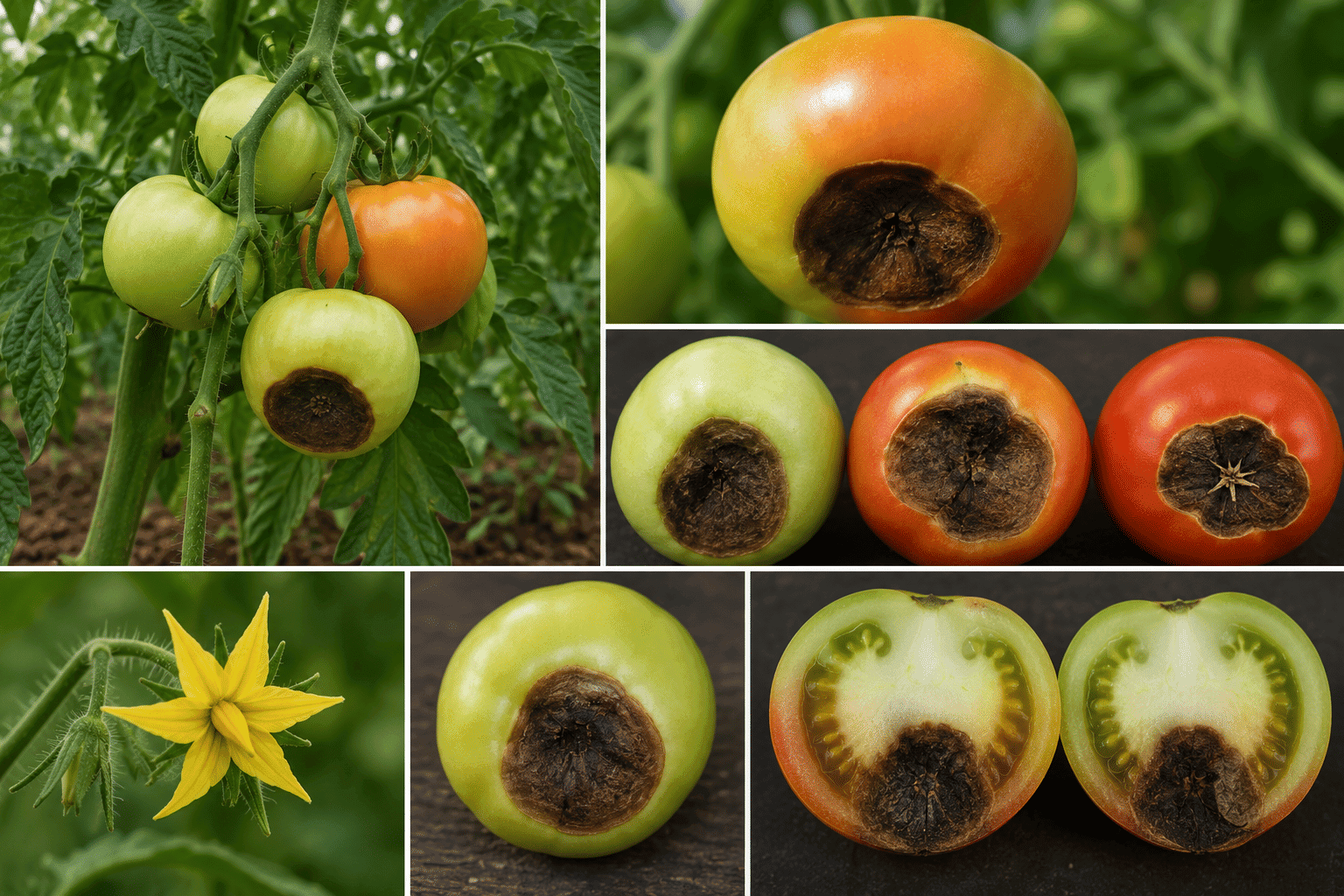
Blossom end rot is a fruit disorder seen at the blossom end of tomato fruits, which is the bottom side opposite the fruit stalk. The affected area first appears as a small watery spot. Later, it becomes dark brown to black, sunken, dry, and leathery.
The main reason is poor calcium movement inside the plant. Calcium is required for strong cell wall formation in developing fruits. Even when calcium is present in the soil, the plant may not absorb or transport it properly if water supply is irregular. Because calcium moves with water inside the plant, any disturbance in moisture movement can lead to blossom end rot.
Symptoms of Blossom End Rot
Farmers can identify blossom end rot easily by observing the lower end of tomato fruits. It usually starts on green developing fruits, but symptoms may become more visible as fruits grow.
Common symptoms include:
- Small water-soaked spot at the blossom end of the fruit
- Brown or black patch at the bottom of tomato
- Sunken and dry affected area
- Leathery texture on damaged portion
- Affected fruits becoming unmarketable
- Rotting of damaged area in humid conditions
- More symptoms during hot and dry periods
- Problem seen mostly on rapidly growing fruits
- Fruits may ripen early but remain poor in quality
In early stages, the spot may be small and light brown. As the fruit increases in size, the affected patch becomes larger and darker. In humid weather, secondary fungi or bacteria may enter the damaged area and cause soft rotting.
Causes of Blossom End Rot in Tomato
Blossom end rot is mainly related to calcium deficiency in developing fruits, but the actual reason is often poor calcium movement rather than lack of calcium in the soil.
Major causes include:
- Irregular irrigation
- Sudden dry and wet soil conditions
- Moisture stress during fruit development
- High temperature and dry winds
- Poor root growth
- Root damage during intercultural operations
- Excess nitrogen fertilizer use
- Excess ammonium-based fertilizers
- High soil salinity
- Very acidic or alkaline soil
- Poor calcium availability in soil
- Heavy fruit load on weak plants
When soil becomes dry, roots cannot absorb enough water and calcium. When soil suddenly becomes too wet after a dry period, plant growth becomes uneven. This irregular movement of water affects calcium supply to fruits, resulting in blossom end rot.
Why Calcium Does Not Reach the Fruit Properly
Calcium moves slowly inside the plant and depends mainly on water flow. Leaves transpire more than fruits, so calcium often moves more toward leaves than fruits. During hot weather, plants lose more water through leaves. If irrigation is not proper, fruits may receive less calcium.
This is why blossom end rot can happen even in fields where the soil has enough calcium. The issue is not always soil calcium deficiency. It is often due to poor water management, weak roots, or fast plant growth caused by excess nitrogen.
Damage and Crop Loss
Blossom end rot directly affects fruit quality. The plant may look healthy, but fruits become unsuitable for market due to black patches at the bottom.
Major losses include:
- Reduced marketable yield
- Poor fruit appearance
- Lower market price
- Fruit rejection by traders
- Increased fruit rotting
- Loss during harvesting and grading
- Reduced farmer profit
In severe cases, many fruits in the first few pickings may be affected. This is especially harmful because early tomato harvest usually gives better market price.
Favorable Conditions for Blossom End Rot
Farmers should be more careful when the crop is under stress. Blossom end rot is commonly seen under the following conditions:
- Hot and dry weather
- Irregular irrigation schedule
- Long gap between irrigations
- Sudden heavy irrigation after dry soil
- Sandy soils with low water-holding capacity
- Poor drainage or root stress
- Excess nitrogen application
- Heavy pruning or sudden vegetative growth
- High salt content in soil or water
- Calcium-deficient soils
Fields with uneven moisture are more prone to this problem. In summer tomato cultivation, the risk is usually higher because water loss from plants is faster.
Field Monitoring
Regular fruit observation helps farmers detect the problem early. Farmers should start checking fruits from the early fruit development stage.
During field inspection:
- Check young fruits at the bottom end.
- Observe whether brown spots are appearing after hot weather.
- Check soil moisture near the root zone.
- Look for signs of plant stress or wilting.
- Observe whether the problem is higher in sandy or dry patches.
- Remove badly affected fruits to avoid secondary rotting.
Early monitoring helps farmers correct irrigation and nutrition before more fruits are affected.
Prevention and Management Tips
Blossom end rot is best managed through prevention. Once a fruit shows symptoms, that fruit cannot become normal again. The main aim should be to protect new fruits.
Maintain Uniform Soil Moisture
Water management is the most important practice.
Farmers should:
- Irrigate regularly based on soil moisture.
- Avoid long dry gaps between irrigations.
- Do not allow sudden drying and flooding of soil.
- Use drip irrigation where possible.
- Apply water near the root zone.
- Avoid over-irrigation and waterlogging.
Uniform moisture helps roots absorb calcium continuously and supply it to developing fruits.
Use Mulching
Mulching helps maintain soil moisture and reduces temperature fluctuation around roots.
Useful mulching practices include:
- Use plastic mulch where available.
- Use dry grass, straw, or crop residue mulch in suitable fields.
- Keep mulch around plants without touching the stem directly.
- Maintain moisture in the root zone during hot weather.
Mulching is especially useful in summer and in light soils.
Balanced Fertilizer Management
Excess fertilizer, especially nitrogen, can increase blossom end rot by promoting fast vegetative growth.
Farmers should:
- Avoid excess urea application.
- Apply fertilizers as per soil test and crop stage.
- Use balanced nitrogen, phosphorus, and potassium.
- Avoid excess ammonium-based fertilizers.
- Apply calcium-containing fertilizers if recommended.
- Maintain proper soil pH for nutrient availability.
Balanced nutrition supports steady plant growth and better fruit development.
Protect the Root System
Healthy roots are necessary for water and calcium uptake.
Farmers should:
- Avoid deep hoeing near the root zone.
- Prevent root injury during weeding.
- Maintain proper drainage.
- Control soil-borne pests and nematodes if present.
- Add well-decomposed organic manure to improve soil structure.
Weak or damaged roots cannot absorb enough water and nutrients, increasing fruit disorders.
Calcium Management
If calcium deficiency is confirmed or the field has a history of blossom end rot, farmers can follow calcium management practices.
- Apply calcium sources as recommended by local experts.
- Use soil amendments based on soil test results.
- Foliar calcium sprays may help reduce new fruit damage when used at early stages.
- Repeat applications only as per recommendation.
- Do not depend only on calcium spray without correcting irrigation.
Calcium spray works better as a preventive support, not as a cure for already damaged fruits.
What Farmers Should Avoid
- Do not wait until many fruits are damaged.
- Do not apply excess urea for quick growth.
- Do not allow plants to suffer from water stress.
- Do not flood the field after long dry periods.
- Do not damage roots during intercultural operations.
- Do not assume it is always a fungal disease.
- Do not spray fungicides unnecessarily for blossom end rot alone.
Correct diagnosis saves money and helps farmers take the right action.
Conclusion
Tomato blossom end rot is a common fruit disorder that reduces marketable yield and fruit quality. It appears as a brown to black sunken patch at the bottom of tomato fruits. The main reason is poor calcium supply to developing fruits, usually caused by irregular irrigation, moisture stress, root damage, excess nitrogen, or poor soil conditions.
Farmers should focus on prevention through uniform irrigation, mulching, balanced fertilizer use, healthy root growth, good drainage, and proper calcium management. Since affected fruits do not recover, early care is very important. By maintaining steady plant growth and proper soil moisture, farmers can reduce blossom end rot, improve fruit quality, and get better market value.