

Introduction
Paddy is one of the most important food crops grown by farmers across India. A healthy paddy crop with good tillering, green leaves, and proper grain filling gives better yield and income. However, paddy is affected by many diseases during the growing season, and bacterial leaf blight is one of the most serious diseases. If it is not identified and managed at the right time, it can spread quickly in the field and cause heavy yield loss.
Bacterial leaf blight mainly affects the leaves of paddy plants. Since leaves prepare food for the plant, severe infection reduces photosynthesis, weakens the crop, and affects grain formation. The disease is more damaging when it appears during the tillering to panicle initiation stage. Farmers should regularly monitor the crop, identify early symptoms, and follow proper management practices to reduce crop loss.
What is Bacterial Leaf Blight in Paddy?
Bacterial leaf blight, commonly called BLB, is a bacterial disease of rice caused by Xanthomonas oryzae pv. oryzae. The bacteria enter the plant through wounds, leaf tips, or natural openings and spread inside the leaf tissues.
Once the disease enters the field, it can spread from infected plants to healthy plants through irrigation water, rain splash, wind-driven rain, and field operations. The disease can spread rapidly under favorable conditions, especially when humidity is high and the crop canopy remains wet for long hours.
Symptoms of Bacterial Leaf Blight
Farmers should observe the crop regularly from the vegetative stage onwards. Early identification helps in preventing severe spread.
Common symptoms include:
- Yellowing and drying from the leaf tip
- Water-soaked streaks on leaf margins
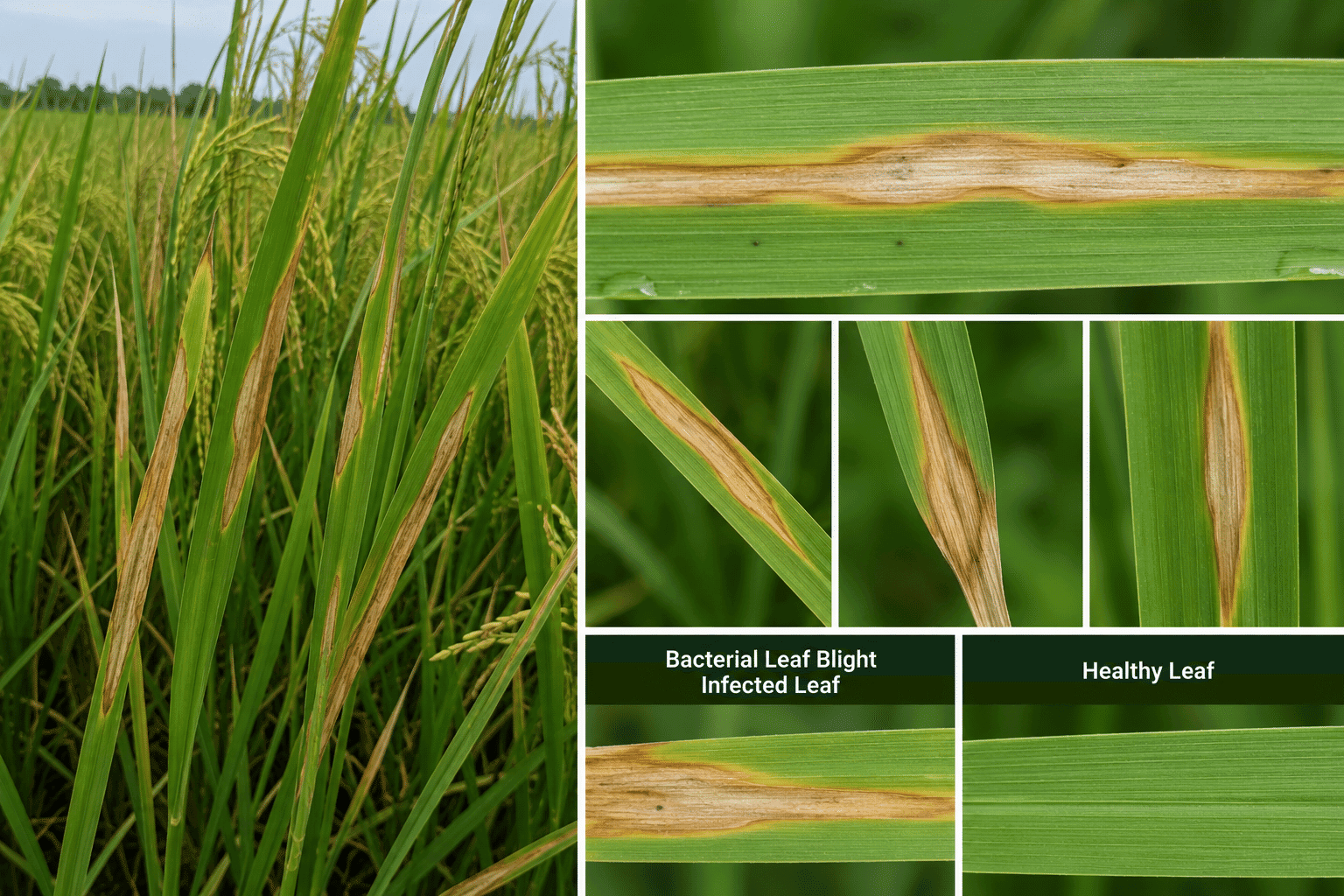
- Long yellow or straw-colored lesions on leaves
- Lesions spreading downward from the tip or edges
- Wavy margins on infected leaf areas
- Leaves turning pale, dry, and whitish in severe cases
- Drying of large portions of leaves
- Reduced tillering and weak plant growth
- Poor grain filling in severe infection
- Wilting of young plants in highly severe cases
In the early stage, symptoms usually begin at the leaf tip or leaf margin. The infected area first appears water-soaked and later turns yellow. As the disease increases, the yellow portion becomes straw-colored and dries. In severe cases, most of the leaf dries, and the field may appear burnt from a distance.
Damage Caused by Bacterial Leaf Blight
Bacterial leaf blight damages paddy mainly by reducing the green leaf area. When leaves dry early, the plant cannot prepare enough food for healthy growth and grain filling.
Major losses caused by this disease include:
- Reduced photosynthesis
- Poor tillering
- Weak crop growth
- Drying of leaves
- Reduced panicle development
- Poor grain filling
- Increased chaffy grains
- Reduced grain weight
- Lower overall yield
If the disease occurs early in the crop stage, yield loss may be high. Infection during the grain-filling stage can also reduce grain quality and final market value.
Causes and Spread of the Disease
Bacterial leaf blight spreads mainly through infected seed, infected crop residues, irrigation water, and rain splash. The bacteria survive in infected plant debris and can enter the next crop if proper field sanitation is not followed.
Major sources of spread include:
- Use of infected seed
- Infected crop residues in the field
- Contaminated irrigation water
- Rain splash and wind-driven rain
- Flood water movement from infected fields
- Injuries caused during field operations
- Excess nitrogen fertilizer application
- Dense crop canopy and poor air movement
The disease spreads faster when infected water moves from one plot to another. Leaf injury due to strong winds, storms, insects, or farm operations also helps bacteria enter the plant easily.
Favorable Conditions for Disease Development
Farmers should be more alert when weather and field conditions favor bacterial leaf blight. The disease becomes severe under:
- Warm and humid weather
- Frequent rainfall
- Strong winds with rain
- Water stagnation in the field
- High humidity
- Dense crop canopy
- Excess nitrogen fertilizer use
- Poor field drainage
- Continuous paddy cultivation
Excess nitrogen makes the crop soft and highly susceptible to disease. Waterlogged fields and continuous moisture also support bacterial spread.
Monitoring and Field Scouting
Regular field monitoring is very important for early disease management. Farmers should inspect the paddy field every week, especially after rainfall, strong winds, or irrigation.
During field inspection:
- Check leaf tips and margins for yellowing
- Observe water-soaked streaks on leaves
- Look for drying leaves in patches
- Inspect different parts of the field, especially low-lying areas
- Check whether symptoms are spreading from one plant to another
- Remove severely infected plant parts if infection is limited
Early detection helps farmers take timely action before the disease spreads widely.
Management Practices for Bacterial Leaf Blight
Integrated disease management gives better control. Since bacterial diseases are difficult to cure after severe infection, farmers should focus more on prevention and early management.
Cultural Control Methods
- Use healthy and disease-free seed for sowing.
- Select resistant or tolerant paddy varieties where available.
- Avoid using seed from infected fields.
- Maintain proper spacing to improve air movement.
- Remove infected crop residues after harvest.
- Avoid continuous paddy cultivation in the same field.
- Keep field bunds clean and weed-free.
- Avoid unnecessary movement in infected fields.
- Improve drainage and avoid water stagnation.
Good field sanitation and proper crop management help reduce disease pressure.
Seed and Nursery Management
Healthy seedlings are very important for reducing disease spread. Farmers should prepare the nursery in a clean area and avoid water from infected fields.
Important practices include:
- Use certified or disease-free seed.
- Treat seed as recommended before sowing.
- Avoid raising nursery near infected paddy fields.
- Remove infected seedlings from the nursery.
- Do not transplant diseased seedlings into the main field.
A healthy nursery helps establish a strong crop and reduces early infection.
Nutrient and Water Management
Balanced fertilizer use plays an important role in disease control. Excess nitrogen should be avoided because it increases soft leaf growth and disease severity.
Farmers should:
- Apply fertilizers as per crop requirement.
- Avoid excess urea application.
- Use potassium in proper quantity to improve crop strength.
- Avoid water stagnation in the field.
- Drain excess water after heavy rainfall.
- Do not allow irrigation water from infected fields to enter healthy fields.
Balanced nutrition and good water management make the crop stronger and reduce disease spread.
Chemical Control Measures
Chemical control for bacterial leaf blight should be followed only when recommended by local agriculture experts. Since the disease is bacterial, ordinary fungicides may not give proper control.
Farmers should follow these points:
- Use only recommended bactericides or copper-based products as advised.
- Spray at the early stage of infection for better results.
- Follow label dosage and instructions carefully.
- Avoid repeated and unnecessary spraying.
- Do not mix chemicals without expert guidance.
- Combine chemical control with cultural and field sanitation practices.
Spraying is more effective when disease is detected early. Once the crop is heavily infected, complete recovery becomes difficult.
Precautions During Spraying
- Spray during morning or evening hours.
- Avoid spraying during strong winds or rainfall.
- Use clean water for spray preparation.
- Ensure proper coverage of leaves.
- Follow recommended dosage only.
- Wear gloves, mask, and protective clothing.
- Keep children and animals away from the sprayed field.
- Wash hands and equipment properly after spraying.
Farmers should always follow safety instructions while handling chemicals.
Preventive Measures for Farmers
Preventive management is the best way to reduce bacterial leaf blight in paddy. Farmers can follow these simple practices:
- Use resistant or tolerant varieties where available.
- Use healthy and treated seed.
- Maintain proper spacing in the main field.
- Avoid excess nitrogen fertilizer.
- Apply balanced nutrients, especially potassium.
- Keep the field clean and remove infected residues.
- Avoid water movement from infected fields.
- Drain excess water during heavy rainfall.
- Monitor the crop regularly after rainy weather.
- Take timely action when early symptoms appear.
Prevention is more effective and economical than trying to control severe disease later.
Conclusion
Bacterial leaf blight is a serious disease of paddy that can cause heavy yield loss if ignored. The disease mainly affects leaves, causing yellowing, water-soaked streaks, drying from the leaf tip, and severe leaf blight. It spreads quickly through infected seed, crop residues, irrigation water, rain splash, and field operations.
Early identification, use of healthy seed, resistant varieties, proper spacing, balanced fertilizer application, good drainage, and field sanitation are very important for effective management. Farmers should avoid excess nitrogen and follow integrated disease management practices instead of depending only on chemicals. Timely action helps protect the paddy crop, improve grain filling, reduce yield loss, and increase farmer profit.