

Introduction
Beans are an important vegetable crop grown by many farmers for regular income. However, leaf eating caterpillars are one of the major pests that can seriously affect bean cultivation. These caterpillars feed aggressively on leaves, flowers, tender shoots, and sometimes young pods. If the infestation is not identified and managed at the early stage, heavy leaf damage can occur within a few days. This reduces plant growth, pod formation, yield, and final market quality. Therefore, farmers should regularly monitor the crop and take timely control measures.
What is Leaf Eating Caterpillar in Beans?
Leaf eating caterpillars are the larval stage of moths. The adult moths lay eggs on bean plants, and after hatching, the young larvae start feeding on the leaves. In the early stage, small larvae scrape the leaf surface and create tiny feeding marks. As they grow bigger, they start eating larger portions of leaves. In severe infestation, the entire leaf may be eaten, and only the leaf veins remain.
This pest mainly attacks during the vegetative stage of the crop, when plants are developing leaves and branches. If not controlled early, the pest can spread quickly in the field under favorable weather conditions.
Identification and Symptoms of Infestation
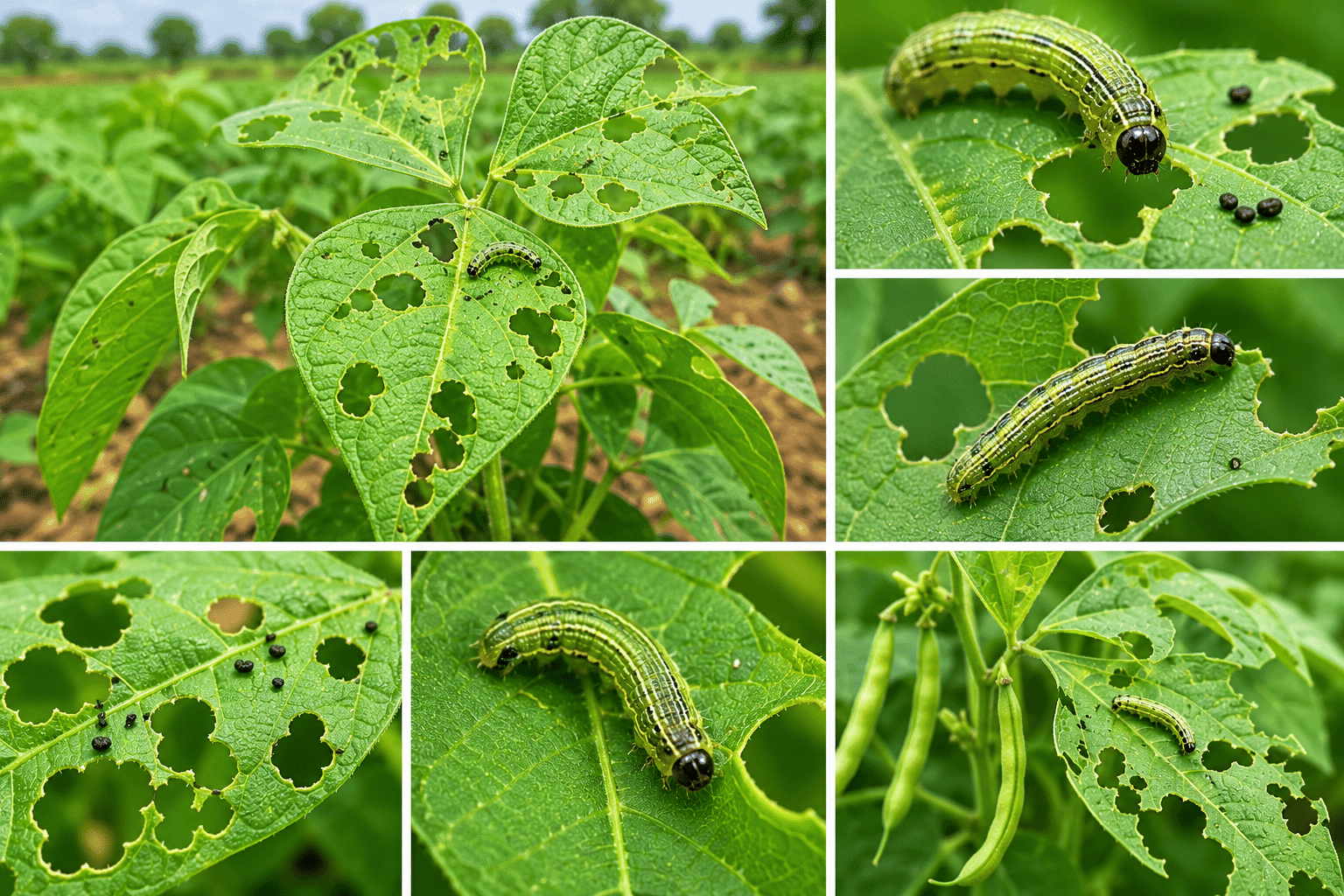
Farmers can identify leaf eating caterpillars by observing the plants closely. The caterpillars may be green, brown, or black in color and are commonly found on leaves or hiding under the leaves during daytime. They are more active during morning and evening hours.
Common signs include:
-
Small holes on tender leaves during early infestation
-
Irregular feeding marks on leaves
-
Scraping of the leaf surface
-
Black fecal pellets on leaves
-
Caterpillars hiding under leaves
-
Presence of moths around the field during evening hours
-
Drying of severely damaged leaves
-
Damage to flowers and tender pods
-
Reduced plant vigor and slow crop growth
Young bean plants are more vulnerable because heavy leaf loss at the early stage directly affects crop establishment and future pod development.
Damage Caused by Leaf Eating Caterpillars
Leaf eating caterpillars reduce the green leaf area of the plant. Since leaves are responsible for photosynthesis, heavy leaf feeding reduces the plant’s ability to prepare food. As a result, plant growth becomes slow and weak.
Severe infestation affects flowering and pod development. Damage to tender pods can reduce market quality and selling price. If infestation is ignored during the vegetative and flowering stages, yield loss can become serious.
Favorable Conditions for Pest Development
Leaf eating caterpillars multiply rapidly under certain field and weather conditions. Farmers should be more alert when these conditions are present:
-
Warm and humid weather
-
Dense crop canopy
-
Excess nitrogen fertilizer use
-
Poor field sanitation
-
Continuous bean cultivation in the same field
-
Cloudy weather
-
Irregular rainfall
Dense crop growth and excessive nitrogen create soft leaves, which attract caterpillars. Weeds and crop residues around the field may also support pest survival.
Monitoring and Field Scouting
Regular crop observation is very important for early control. Farmers should inspect the crop every 3–4 days, especially during the vegetative stage. Leaves, flowers, tender shoots, and young pods should be checked carefully for eggs, young larvae, and fresh feeding marks.
Light traps can be installed in or near the field to monitor adult moth activity. If moth activity increases during evening hours, farmers should inspect the crop more carefully. Small holes, fresh scraping, and black fecal pellets are early warning signs of caterpillar infestation.
Best Control Measures for Leaf Eating Caterpillar
Integrated pest management gives effective and economical control. Farmers should combine cultural, mechanical, biological, and chemical methods for better results.
Cultural Control Methods
-
Keep the field clean by removing weeds and alternate host plants around the field.
-
Avoid excessive nitrogen fertilizer because it promotes soft vegetative growth.
-
Follow crop rotation and avoid growing beans continuously in the same field.
-
Practice deep summer ploughing to expose pupae to sunlight and natural predators.
-
Maintain proper plant spacing to reduce dense canopy and pest buildup.
Mechanical Control Methods
-
Collect and destroy caterpillars and egg masses during early infestation.
-
Remove heavily infested leaves to reduce pest spread.
-
Install bird perches in the field, as birds naturally feed on caterpillars.
-
Destroy crop residues after harvest to reduce carry-over pest population.
Biological Control Methods
Natural enemies and biological agents help reduce caterpillar population safely. Useful biological control options include:
-
Trichogramma parasitoids
-
Predatory birds
-
Spiders
-
Bacillus thuringiensis (Bt) formulations
These methods are safer for beneficial insects, farmers, and the environment. Farmers should avoid unnecessary use of broad-spectrum insecticides so that natural enemies remain active in the field.
Chemical Control Measures
When infestation becomes severe, farmers can use recommended insecticides. Spraying should be done only when necessary and after observing pest intensity in the field. Farmers must always follow the recommended dosage, label instructions, and waiting period before harvest.
It is important to rotate insecticides with different modes of action to avoid resistance development. Repeated use of the same chemical should be avoided.
Precautions During Spraying
-
Spray during morning or evening hours.
-
Ensure proper coverage of both upper and lower leaf surfaces.
-
Avoid spraying during strong winds.
-
Do not spray just before rainfall.
-
Use the recommended dosage only.
-
Wear protective equipment during spraying.
-
Follow the waiting period before harvesting pods.
Preventive Measures for Farmers
Farmers can reduce the risk of infestation by following simple preventive practices:
-
Monitor the crop every 3–4 days during the vegetative stage.
-
Use healthy seed for good crop establishment.
-
Follow timely sowing to avoid peak pest incidence.
-
Maintain field sanitation by removing weeds and crop residues.
-
Encourage natural enemies by avoiding unnecessary chemical sprays.
-
Follow crop rotation to break the pest life cycle.
Conclusion
Leaf eating caterpillars can cause serious damage in bean crops if ignored during the early stage. They reduce leaf area, weaken plant growth, affect flowering, and reduce pod quality and yield. Regular field monitoring, timely identification, field sanitation, balanced fertilizer use, and integrated pest management help in controlling the pest effectively. Farmers should combine cultural, mechanical, biological, and chemical methods instead of depending only on chemical sprays. Timely action protects crop growth, improves pod quality, and increases overall yield and profit.