

Introduction
Chilli is an important cash crop for farmers because it gives good returns in both green and dry chilli markets. For better yield, chilli plants should have healthy branches, good flowering, and proper fruit setting. However, during rainy, cloudy, and highly humid weather, chilli crop can suffer from a serious fungal disease known as Choanephora blight.
Choanephora blight mostly attacks tender plant parts such as young shoots, flowers, flower stalks, and small fruits. The disease spreads very fast when humidity is high and the crop canopy remains wet for long hours. In many fields, farmers first notice flower drying, tip blight, and rotting of tender branches. If the disease is ignored, flowering and fruit setting are badly affected, which directly reduces yield.
What is Choanephora Blight in Chilli?
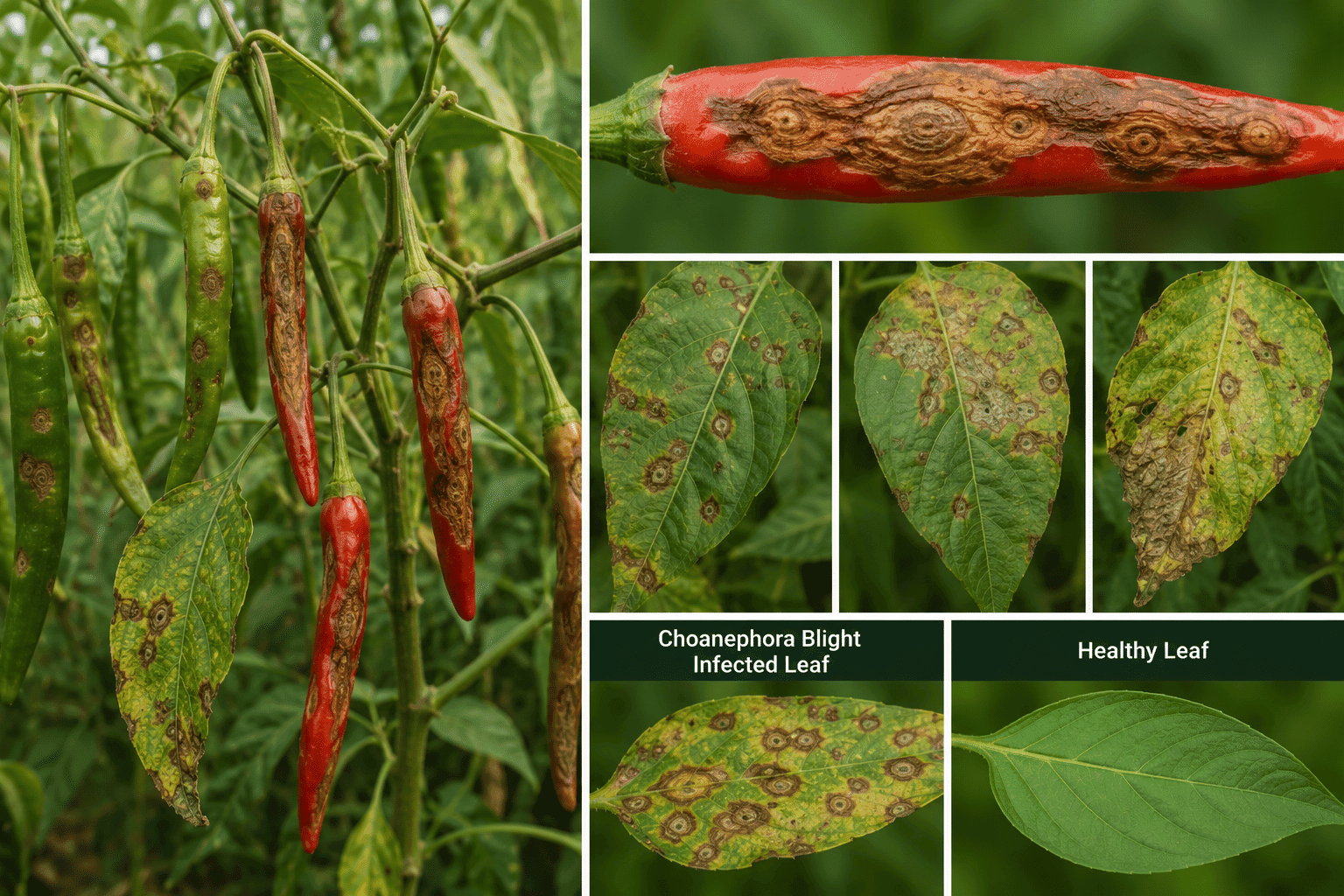
Choanephora blight is a fungal disease commonly seen in chilli during humid and rainy conditions. It is also called wet blight or flower and shoot blight in some areas. The fungus infects soft and tender tissues of the plant. Once infection starts, the affected part becomes water-soaked, soft, and later dries or rots.
This disease is more dangerous during the flowering stage because it can damage flowers before fruit formation. In severe cases, many flowers drop from the plant, young fruits rot, and tender shoots die back from the tip. The disease may spread quickly from one plant to another when the field has dense growth and poor air movement.
Symptoms of Choanephora Blight in Chilli
Farmers should carefully observe chilli plants during cloudy and humid weather. The disease usually starts on flowers, tender shoots, and growing tips.
Common symptoms include:
- Water-soaked spots on flowers, tender shoots, or young fruits
- Sudden drying of flowers and flower stalks
- Flower drop before proper fruit setting
- Soft rotting of young fruits
- Tip drying or dieback of tender branches
- Greyish or whitish fungal growth on infected parts
- Black pin-head like fungal structures on rotten flowers or shoots
- Infected shoots bending or drying from the tip
- Rotten plant parts becoming soft in humid weather
- Dry, dark, and shrivelled affected parts after weather becomes dry
One important identifying sign is the presence of fine fungal growth with tiny black dots on infected flowers or shoots. These black dots are fungal fruiting bodies and are commonly seen when humidity is very high.
Damage Caused by Choanephora Blight
Choanephora blight causes heavy damage mainly by attacking flowers and tender plant parts. Since chilli yield depends on good flowering and fruit setting, flower infection can directly reduce the number of fruits per plant.
Major losses include:
- Poor flowering due to flower blight
- Flower drop before fruit formation
- Reduced fruit setting
- Rotting of small fruits
- Drying of tender shoots
- Weak plant growth
- Reduced number of marketable fruits
- Lower yield during rainy and humid periods
When the disease attacks at the flowering stage, farmers may see healthy-looking plants but very poor fruit setting. This is because flowers get infected and drop before forming fruits.
Why the Disease Increases During Humid Weather
Choanephora blight develops very fast when moisture remains on the plant surface for a long time. Rain, dew, cloudy weather, and dense canopy create ideal conditions for fungal growth.
The disease becomes more severe under:
- High humidity
- Continuous cloudy weather
- Frequent rainfall
- Long leaf and flower wetness
- Dense crop canopy
- Poor air circulation
- Excess nitrogen fertilizer use
- Poor drainage in the field
- Overhead irrigation
- Presence of infected plant debris
Excess nitrogen produces soft and tender growth, which is more easily infected by the fungus. Similarly, closely planted crops remain wet for longer hours, allowing the disease to spread faster.
Monitoring and Field Scouting
Farmers should increase field visits during rainy and humid weather. Waiting until many flowers fall can lead to heavy yield loss.
During field inspection, farmers should:
- Check flowers and flower stalks for drying or rotting
- Observe tender shoots for tip blight
- Look for soft rot on small fruits
- Check infected parts for greyish fungal growth
- Observe black pin-head structures on dead flowers or shoots
- Inspect dense areas of the field where air movement is poor
- Remove suspicious infected parts immediately
Scouting should be done every 2–3 days during humid weather because the disease can spread quickly within a short time.
Control Measures for Choanephora Blight in Chilli
Managing Choanephora blight requires quick action and good field hygiene. Since the disease is strongly linked with humidity, farmers should focus on reducing moisture around the crop and removing infected parts early.
Cultural Control Methods
- Maintain proper spacing between chilli plants.
- Avoid very dense crop growth.
- Remove weeds from the field and bunds.
- Provide proper drainage to avoid water stagnation.
- Avoid excess nitrogen fertilizer application.
- Apply balanced nutrients for strong plant growth.
- Remove infected flowers, shoots, and fruits from the field.
- Do not leave diseased plant parts near the crop.
- Avoid overhead irrigation during humid weather.
- Use drip irrigation where possible.
Good spacing and clean cultivation help air move freely inside the crop. This allows flowers and leaves to dry faster after rain or dew.
Canopy and Moisture Management
During humid weather, canopy management becomes very important. A dense canopy traps moisture and creates a favorable environment for the fungus.
Farmers should:
- Avoid overcrowding of plants.
- Remove unnecessary lower branches if crop growth is too dense.
- Keep the field well-drained.
- Irrigate in the morning instead of evening.
- Avoid water splashing on flowers and fruits.
- Ensure sunlight reaches inside the crop canopy.
Reducing humidity inside the crop is one of the best ways to slow disease spread.
Removal of Infected Parts
This is a very important step in Choanephora blight management. Infected flowers, shoots, and fruits act as a source of further infection.
Farmers should:
- Pluck and destroy infected flowers and fruits.
- Cut and remove blighted shoot tips.
- Collect diseased plant parts in a bag and take them away from the field.
- Avoid throwing infected material on field bunds.
- Clean tools after cutting infected plants.
Removing infected parts early reduces fungal spores in the field and protects healthy flowers.
Biological Management
Biological methods can support disease management by improving plant and soil health. They are more useful when followed regularly and before the disease becomes severe.
Useful biological practices include:
- Application of beneficial microbial formulations
- Use of Trichoderma enriched compost
- Use of well-decomposed farmyard manure
- Improving soil organic matter
- Avoiding unnecessary chemical sprays that disturb beneficial microbes
Biological methods alone may not stop severe infection during heavy humidity, but they help reduce disease pressure when combined with good cultural practices.
Chemical Control Measures
When disease symptoms start appearing and weather remains humid, farmers can use recommended fungicides as advised by local agriculture experts. Spraying should be done early, before the disease spreads heavily.
Farmers should follow these points:
- Use only recommended fungicides for chilli.
- Spray at the first appearance of flower blight or shoot blight.
- Follow label dose and instructions strictly.
- Ensure proper coverage of flowers, tender shoots, and young fruits.
- Rotate fungicides with different modes of action.
- Avoid repeated use of the same fungicide.
- Follow the waiting period before harvesting green chilli.
Chemical control gives better results when infected plant parts are removed before spraying.
Precautions During Spraying
- Spray during morning or evening hours.
- Avoid spraying during rainfall or strong winds.
- Do not spray when flowers are wet with rainwater.
- Use clean water for spray preparation.
- Cover tender shoots, flowers, and fruiting branches properly.
- Do not use higher than recommended dosage.
- Wear gloves, mask, and protective clothing.
- Follow the recommended waiting period before harvest.
Since chilli is harvested frequently, waiting period and residue safety are very important.
Preventive Measures for Farmers
Farmers can reduce Choanephora blight by taking preventive steps before humid weather begins:
- Maintain proper plant spacing from the beginning.
- Keep the field weed-free.
- Avoid excess nitrogen and follow balanced fertilization.
- Provide good drainage in the field.
- Use drip irrigation where possible.
- Remove infected flowers and shoots early.
- Monitor the crop closely during cloudy and rainy weather.
- Avoid leaving infected plant waste in the field.
- Take preventive action when humidity remains high for many days.
Prevention is easier than controlling the disease after it spreads to many plants.
Conclusion
Choanephora blight is a serious disease of chilli during humid and rainy weather. It mainly affects flowers, tender shoots, and young fruits, causing flower drying, fruit rot, shoot blight, and poor fruit setting. The disease spreads quickly when the crop canopy is dense and moisture remains on plant parts for long hours.
Farmers should focus on regular monitoring, proper spacing, good drainage, removal of infected parts, balanced fertilizer use, and timely need-based spraying. Managing humidity inside the crop canopy is the key to reducing this disease. With early action and proper field care, farmers can protect chilli flowering, improve fruit setting, and reduce yield loss.