Zucchini: Planting and Package of Practices
Zucchini can fetch a good price because it reaches the market when cucumber supply is thin. Hotels, salad kitchens and city retail buy it steadily through the cool months. But farmers trying it for the first time often grow it like a gourd, with wide beds and a pandal, and the crop disappoints.
Zucchini is not a gourd. It is a bush plant. Once you treat it as one, the crop becomes simple: close spacing, no support structure, one weeding, and picking every second or third day. This guide takes you through it stage by stage, and every quantity is given per acre as well as per hectare.
Quick answer: Zucchini, also called summer squash or chappan kaddu, is Cucurbita pepo L. It is a bush crop that generally needs no pandal, no trellis and no pruning. Sow 1 to 2 kg seed per acre at 60 to 75 cm between rows and 45 to 50 cm between plants. In the north Indian plains the best window is generally 20 October to 10 November. First picking comes 45 to 60 days after sowing. Pick every 2 to 3 days at 20 to 23 cm fruit length. A well managed winter crop can give 10 to 16 tonnes per acre.
Zucchini Crop at a Glance
Item
Detail
Botanical name
Cucurbita pepo L.
Family
Cucurbitaceae
Other names
Summer squash, courgette, chappan kaddu
Plant type
Annual bush, upright and open, with small tendrils
Support needed
None. Earthing up is enough
Best temperature
18 to 30 degrees Celsius, with 24 to 27 degrees Celsius generally best
Soil
Well drained sandy loam to loam with good organic matter
Seed rate
1 to 2 kg per acre (2.5 to 5 kg per hectare)
Spacing
60 to 75 cm row to row, 45 to 50 cm plant to plant
Plants needed
About 10,000 to 12,000 per acre (25,000 to 30,000 per hectare)
First picking
45 to 60 days after sowing in the open field
Picking interval
Every 2 to 3 days
Total pickings
10 to 12
Yield, winter crop
10 to 16 tonnes per acre (25 to 40 tonnes per hectare)
Yield, spring and summer crop
3 to 4 tonnes per acre (8 to 10 tonnes per hectare)
Zucchini Is a Bush Crop, Not a Vine
This one point decides most of the crop. If you have grown bottle gourd or bitter gourd, four habits need to change.
What you do for gourds
What zucchini needs instead
Build a pandal or trellis
Nothing. Official recommendations state the crop does not need trailing or pruning. Drawing soil up around the base at 20 to 25 days gives it all the support it needs
Beds 1.5 to 2.5 m wide
Beds about 1.25 m wide, so you can fit 10,000 to 12,000 plants on an acre instead of a few thousand
Tie and spread the vines
No training at all. That labour goes into picking every 2 to 3 days, which is where this crop is won or lost
A long season
First picking at 45 to 60 days, and the whole crop finishes in 10 to 12 pickings
If you have read somewhere that zucchini needs a trellis for straight fruit, that advice does not come from Indian official recommendations and may cost you money for no return.
Crop Calendar: What to Do and When
This is the whole crop on one page. Work down the table and you will not miss a step.
Stage
When
What to do
Land preparation
2 to 3 weeks before sowing
Give 2 to 3 ploughings and a harrowing. Mix in 6 to 8 tonnes farmyard manure per acre. Make beds about 1.25 m wide
Seed treatment
On the day of sowing
Treat seed with Captan at 2.5 g per kg or Thiram at 3 g per kg of seed
Basal fertiliser
At bed making
Half the urea, all the single superphosphate and all the muriate of potash
Sowing
Best window 20 October to 10 November in the plains
Sow 2 seeds per hill at 45 to 50 cm, or transplant seedlings 25 to 28 days old
Thinning
Once seedlings have 2 true leaves
Where 2 seeds were sown, keep the stronger plant and remove the weaker one
Weeding, hoeing and earthing up
20 to 25 days after sowing
Do all three in one operation. Draw soil up around the base of each plant
Top dressing
About 30 days after sowing
Apply the remaining half of the urea
Flowering starts
Generally 30 to 40 days after sowing
Under a polyhouse or closed tunnel, hand pollinate between 8 and 10 am. If fruit set is poor, spray boron at 0.3 g per litre
First picking
45 to 60 days after sowing
Pick at 20 to 23 cm length while the skin is still glossy
Regular picking
Every 2 to 3 days
Continue for 10 to 12 pickings in all. Grade by size and pack in plastic crates
Crop closing
After the last picking
Remove and destroy crop residue so pests and diseases do not carry over
Recommended Varieties and Hybrids
Public sector releases for this crop are few, so most of what sells in India is hybrid material. Pick by fruit type first, because green and yellow sell into different channels.
Variety or hybrid
Released by
Fruit
Worth knowing
Kashi Shubhangi
ICAR Indian Institute of Vegetable Research, notified 2019 for Uttar Pradesh
Long, dark green and shiny, 800 to 900 g
Bush type. Resistant to downy mildew. Carries 8 to 10 fruits per plant. Best suited to autumn sowing
Pusa Pasand
ICAR Indian Agricultural Research Institute
Light green and shiny, flattish round, 70 to 80 g
Bush type with good heat tolerance. Suits open field spring sowing and winter growing under polyhouse or low tunnel
Pusa Alankar
ICAR Indian Agricultural Research Institute
Long cylindrical
Open field variety
Punjab Chappan Kadoo-1
Punjab Agricultural University, 1982
Standard summer squash type
Carries field resistance to downy mildew
Green Star, Orelia, Australian Green, Goldy, Champion, Romulus, Adlika, Antier Green
Commercial and imported hybrids named as suitable in official recommendations
Green or yellow, depending on the hybrid
Australian Green is a long cylindrical type
Hybrid seed for both fruit types is available to order.
Green fruit types
Urja Titan Zucchini F1 Hybrid Seeds
Iris Green Hornet F1 Hybrid Zucchini Seeds
Fito Green Star Squash Seeds
Yellow fruit types
Iris Golden Beauty F1 Zucchini Seeds
Clause Orelia F1 Yellow Zucchini Seeds
NS 9881 Zucchini Long Yellow Seeds
Climate and Soil
Factor
What the crop wants
Temperature
18 to 30 degrees Celsius. Growth and fruit set are generally best at 24 to 27 degrees Celsius
Frost
Sensitive. Either finish the crop before frost sets in, or cover it with a tunnel through the cold weeks
Heat
Sets fruit poorly in heat. This is the main reason a summer crop yields far less than a winter crop
Soil type
Sandy loam to loam are generally ideal. Avoid heavy soils that hold water
Drainage
More important than fertility here. Standing water invites collar rot and root rot
Organic matter
Soils rich in organic matter are preferred
Soil pH
Official recommendations for this crop do not print a pH range. Get your soil tested rather than working from a figure found online
A soil test is free under the Soil Health Card Scheme, you can check your card status online, and this explains why soil pH matters once you have the reading.
Sowing Season
Month of sowing is the biggest single lever on this crop. A winter crop can give 10 to 16 tonnes per acre. The same variety sown for spring and summer may give only 3 to 4 tonnes. Zucchini in the plains is really a cool season crop that happens to carry a summer name.
Where and how you are growing
Sowing window
North Indian plains, main winter crop
September to November. Best results are generally reported from 20 October to 10 November
North Indian plains, spring crop
First fortnight of February, or late January to 10 February
Punjab, open field
Mid January to March
Punjab, under protection
October to November
Plains, open field, heat tolerant varieties
Third week of February to first week of March
Plains, low cost polyhouse
Third week of October to first week of November
Plains, plastic low tunnel
Last week of December to first week of January
Hills
No official package of practices exists for this crop in the hills. Early spring planting generally does better than late. Treat your first season as a trial on a small area
Land Preparation
Step
What to do
Ploughing
2 to 3 ploughings followed by a harrowing, until the soil is in fine tilth
Organic manure
Mix in 6 to 8 tonnes well rotted farmyard manure per acre (15 to 20 tonnes per hectare) before bed making
Bed width
About 1.25 m wide beds, with hills on both sides
Raised beds
For flood or furrow irrigation, use raised beds 80 to 90 cm wide with 7 to 10 cm margins so water does not reach the stem base
Mulch
Optional but useful. Cover raised beds with black plastic mulch film before sowing
Pits
Not needed. The 60 cm pit system belongs to pumpkin and the vine gourds, not to zucchini
Get the manure properly rotted before it goes in. This covers how to compost organic manure if you are building your own supply.
Seed Rate and Spacing
Item
Per acre
Per hectare
Seed rate
1 to 2 kg
2.5 to 5 kg
Plants needed
10,000 to 12,000
25,000 to 30,000
Row to row
60 to 75 cm
60 to 75 cm
Plant to plant
45 to 50 cm
45 to 50 cm
For large fruited varieties
90 cm between rows, 60 cm between plants
90 cm between rows, 60 cm between plants
Use the wider 90 by 60 cm spacing for a big framed variety such as Kashi Shubhangi, which carries 800 to 900 g fruits. For normal green hybrids, the closer spacing generally gives better returns per acre.
Seed Treatment and Sowing
Do not skip the seed treatment. Zucchini is sown into cool soil in its best season, germination is slower than in warm weather, and that is exactly when seed and seedling rots take their cut.
Step
What to do
Seed treatment
Captan at 2.5 g per kg of seed, or Thiram at 3 g per kg of seed. A lower rate of 2 g per kg is also recommended
Direct sowing
Sow 2 seeds per hill on the prepared bed. Thin to one plant per hill once the seedlings have 2 true leaves
Nursery in polybags
Raise seedlings in half kg polybags. Plant out at about 25 days, when they have 2 true leaves
Nursery in plug trays
Use 1.5 inch cells with cocopeat, vermiculite and perlite mixed 3:1:1. One seed per cell. Transplant at 28 days, one seedling per hill
When to choose a nursery
When you are sowing into cold weather, or fitting the crop into a tight rotation and need to save field time
For the reasoning behind the dressing step, see best seed treatment practices before sowing. For a biological option, Trichoderma as a bio fungal agent explains how it is used.
Manures and Fertilisers
Here is one workable schedule in fertiliser bags rather than nutrient figures, so you can take it straight to the field.
When
Urea
Single superphosphate
Muriate of potash
At land preparation
45 kg per acre
125 kg per acre
25 kg per acre
About 30 days after sowing
45 kg per acre
Nil
Nil
Total per acre
90 kg
125 kg
25 kg
That supplies roughly 40 kg nitrogen, 20 kg phosphorus and 15 kg potash per acre, which works out to about 100:50:40 per hectare. Add the 6 to 8 tonnes of farmyard manure per acre at land preparation. Your soil test should decide whether you move up or down within this range.
Extra feed
Rate
When
Water soluble 19:19:19
4 g per litre, as a foliar spray
Twice, at 25 and 35 days after sowing
Borax, soil applied
1 g per hill
At planting
Boron, foliar spray
0.3 g per litre, which is 0.03 per cent
Two sprays, 30 days apart
Drip fertigation
Water soluble 19:19:19 in 8 to 10 splits
Generally twice a week
Boron is the one micronutrient named specifically for this crop, and it is worth taking seriously. Zucchini is picked immature over and over, so fruit set has to keep happening week after week. Boron shortage generally shows up as poor set and misshapen fruit. For more, see micronutrients in flowering and fruit set and integrated nutrient management.
Irrigation
System
How often
Note
Flood or furrow
First irrigation right after sowing, then every 6 to 7 days
About 9 to 10 irrigations over the whole crop
Drip, cool months
Every third day, generally for 45 to 60 minutes
Suits the main winter crop
Drip fertigation
Generally twice a week
Water soluble fertiliser in 8 to 10 splits
Any system
Little and often, never flooding
Water standing around the stem base invites collar rot and root rot
No official source names a single critical irrigation stage for this crop, so the safest rule is steady moisture without waterlogging. Drip handles both at once, and drip irrigation for vegetables covers the layout and the costing.
Earthing Up and Plant Care
This replaces the trellising section you would find in a gourd guide. There are only three things to do, and none needs a structure.
Practice
When
Why it matters
Earthing up
Once, at 20 to 25 days after sowing or planting
The plant carries heavy fruit on a short thick stem. Soil drawn up around the base keeps it upright. Treated as essential
Hoeing and weeding
2 to 3 times in all, the first along with earthing up
Once the canopy closes, working between plants damages leaves and fruit, so finish interculture early
Pruning and leaf removal
Do not do it
Pruning is specifically not recommended. Removing leaves exposes fruit and cuts the leaf area feeding a fast fruit fill
Flowering and Pollination
Zucchini carries male and female flowers separately on the same plant, so pollen has to be carried from one to the other. In an open field, bees and other insects do this for you. Under a polyhouse or a closed tunnel they cannot get in, and this is where many first protected crops fail.
Situation
What to do
Open field
Nothing. Insects pollinate. Avoid spraying insecticide during morning flowering hours
Polyhouse or closed tunnel
Hand pollinate. Official recommendations state hand pollination is needed for this crop
How to hand pollinate
Work on freshly opened flowers between 8 and 10 in the morning. The flowers are large and single, so this is workable at field scale
When the cover comes off
Once frost risk passes, generally late February, remove the polythene so insects take over the job
If fruit set is poor
Check boron first, then temperature. The crop sets badly in heat
If set is weak across the field, this guide to improving flowering and fruit setting goes through the common causes.
Weed Control and Mulching
No weedicide is recommended for this crop in official packages of practices. Weed control here is mulch plus timely interculture, and the mulch does more than suppress weeds.
Option
What it does
Black plastic mulch film
Suppresses weeds and keeps soil moisture. Laid on raised beds before sowing
Silver or reflective mulch film
Suppresses weeds and may also reduce aphid numbers, which lowers virus risk
Manual weeding with hoeing
One operation at 20 to 25 days, combined with earthing up. Then 1 to 2 more as needed
Organic mulch
Dried leaves or crop residue spread 6 to 7 cm thick can work where film is not available
Weedicide
None recommended for this crop
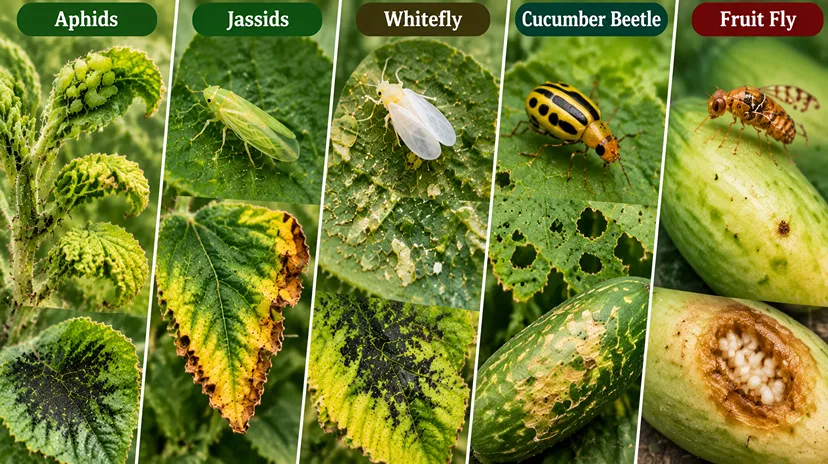
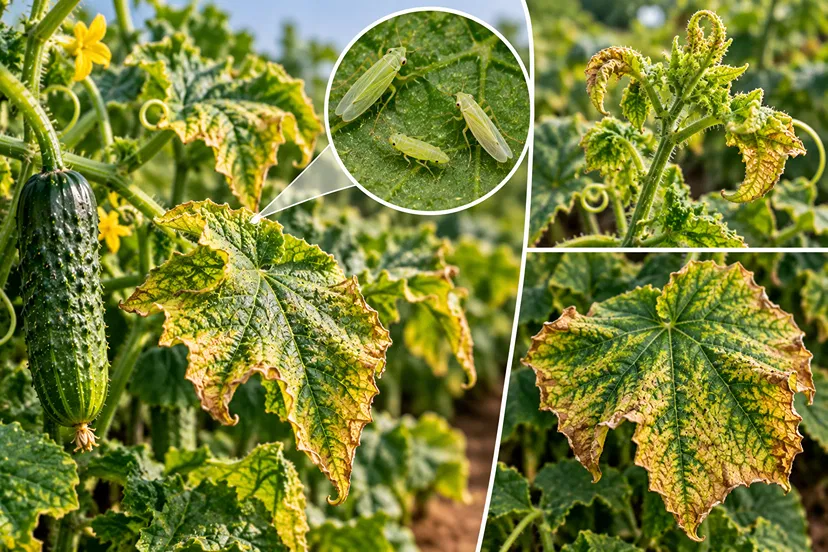
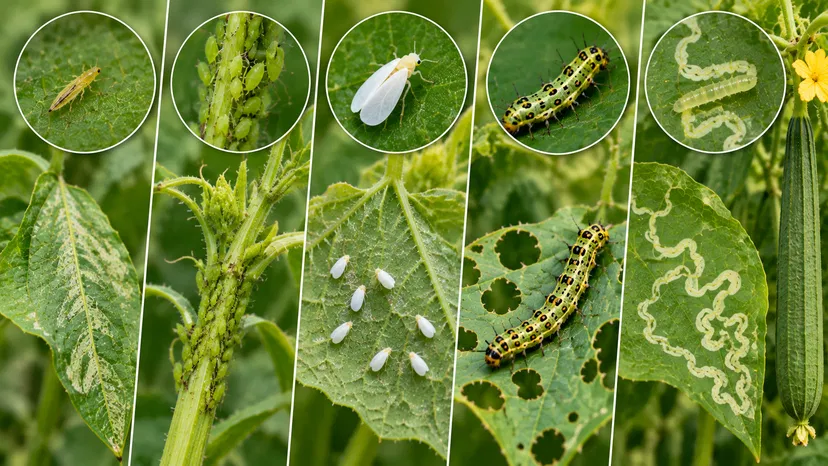
Pest Management
Only two pests are named specifically for this crop in official recommendations. The rest in this table are cucurbit pests that may also appear on zucchini, and that is marked in the table.
Pest
Scientific name
What you see
What generally helps
Leaf miner, named for this crop
Not named in official recommendations
Pale winding tunnels inside the leaf
Neem seed kernel extract at 4 per cent, weekly. Dimethoate 30 EC at 1 ml per litre may also be used
Aphids, named for this crop
Not named in official recommendations
Colonies on shoot tips and leaf undersides, sticky leaves, curling, virus spread
Reflective mulch may lower numbers. Clear weeds on bunds and channels. Keep nitrogen in check
Whitefly and the viruses it carries
Not named in official recommendations
Tiny white flies rising when the canopy is disturbed, mottled new leaves
Imidacloprid at 0.3 ml per litre. Neem extract sprays may also help
Mites, cucurbit pest
Tetranychus species
Dull bronzed leaf undersides, fine webbing, stippled leaves
Spiromesifen at 1.5 ml per litre
Red pumpkin beetle, cucurbit pest
Aulacophora foveicollis
Round holes chewed in young leaves soon after germination
Dust dung ash 3 to 4 times at weekly intervals after germination. November sowing generally avoids the worst damage period
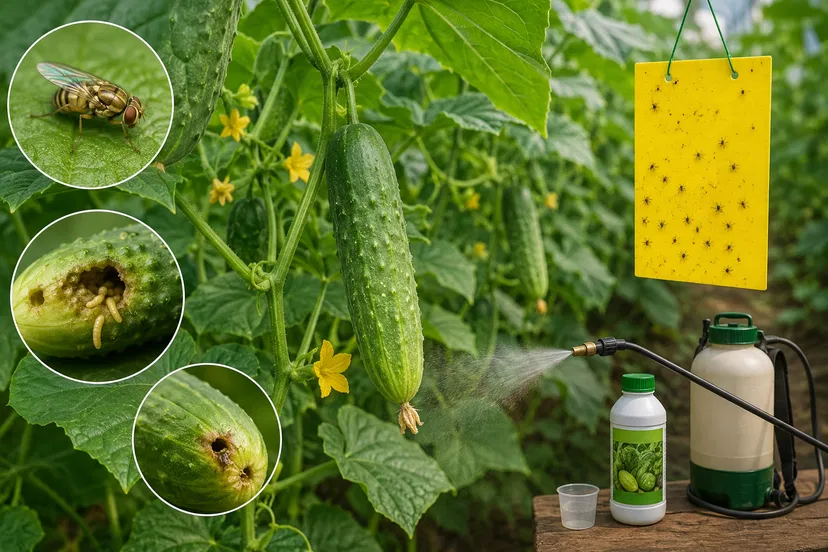
Fruit fly, cucurbit pest
Bactrocera cucurbitae
Puncture marks on young fruit, oozing, maggots and rot inside
Traps at 16 per acre, recharged every 25 to 30 days. Bait sprays on maize trap rows 8 to 10 m apart. Bury affected fruit
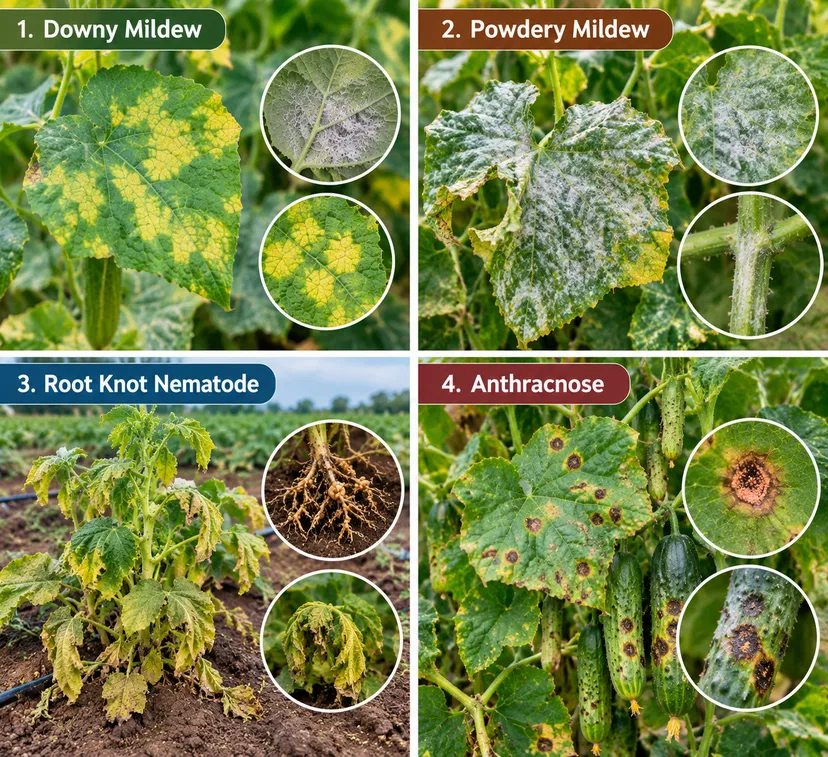
Root knot nematode, cucurbit pest
Meloidogyne incognita
Stunting, patchy wilting, knots and galls on roots
Summer cultivation to expose soil to sun. Rotate with rice, wheat or oat. In affected structures, apply mustard cake and neem cake at 400 kg per acre each with farmyard manure, ten days before sowing
For the shared cucurbit pests, the detail in 8 common cucurbit pests and how to control them applies here too. Fruit fly is covered in strategies for managing fruit flies and whitefly in this whitefly control guide.
Disease Management
Disease
Pathogen
What you see
What generally helps
Powdery mildew, named for this crop
Sphaerotheca fuliginea on cucurbits
White talcum like patches on the upper leaf surface, spreading until leaves yellow and dry
Dinocap at 1.0 to 1.5 ml per litre, or Carbendazim at 0.5 to 1.0 g per litre, or Tridemorph at 1.0 g per litre
Downy mildew
Pseudoperonospora cubensis
Angular yellow patches on the upper surface, bounded by veins, with greyish growth underneath in humid weather
Choose a resistant variety. Both Kashi Shubhangi and Punjab Chappan Kadoo-1 carry resistance. Clear old cucurbit crop residue. Avoid flood irrigation
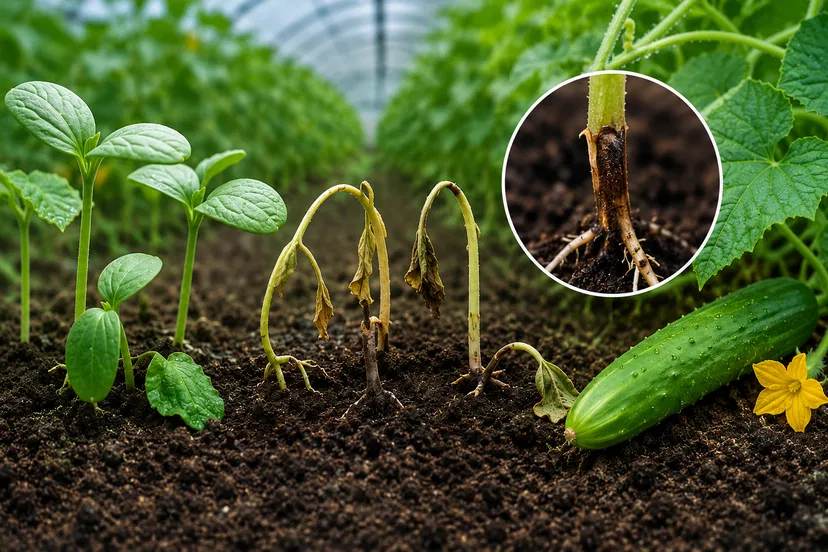
Collar rot
Rhizoctonia solani
Darkening and girdling at the soil line, sudden collapse of a healthy looking plant
Use disease free seed, raised beds and controlled irrigation
Root and stem rot
Pythium butleri
Soft watery rot of seedlings and stem base in wet soil
Avoid flood irrigation. Keep water off the stem base
Alternaria blight
Alternaria cucumerina
Brown spots with concentric rings on leaves, early leaf fall
No specific control is given in official cucurbit recommendations. Field hygiene and residue removal may help
Mosaic, viral
Not named in official recommendations
Mottled light and dark green leaves, distortion, stunting, poor fruit
Use seed from healthy plants. Remove affected plants early. Control aphids, which spread it
For deeper coverage of the two mildews, see powdery mildew of cucurbits and downy mildew in cucurbits. For the virus side, cucumber mosaic virus symptoms and management describes the pattern you will recognise.
One rule to remember. Official recommendations state that no synthetic plant protection chemical should be used in the fifteen days before harvesting. On a crop you pick every 2 to 3 days for 10 to 12 pickings, that window arrives early and then stays. Plan your protection before picking starts, not during it. The sequencing is covered in integrated pest management in vegetables.
Growing Zucchini Under Cover
A polyhouse or low tunnel crop can put zucchini into the market in the coldest weeks, when the price is generally at its best.
Item
Polyhouse
Plastic low tunnel
Sowing window
Mid October to mid February
End November to mid April
Planting material
28 day old plug tray seedlings at 2 leaf stage, one per hill
Same
Pollination
Hand pollinate between 8 and 10 am
Hand pollinate while covered. Remove the cover around late February so insects take over
First picking
40 to 42 days after sowing
50 to 55 days after sowing
Tunnel size
Not applicable
About 1.0 m high, 1.5 m base width, hoops about 2 m apart, rows about 1.5 m apart
Film
As per structure
Transparent film of 25 to 50 micron, 2 m wide. Remove once the crop reaches tunnel height
Harvesting: When and at What Size
Harvest timing matters more on zucchini than on almost any other vegetable. Pick late and you have an unsaleable marrow instead of a salad grade fruit.
Days after the flower opens
Length
Weight
Suitable for
9 days
About 20 cm
About 200 g
Best salad grade. This is the target
12 days
About 24 cm
About 350 g
Still acceptable. This is the upper limit
15 days or more
Longer
Heavier
Not fit for the fresh market. Skin turns hard and seeds show. Can be used for cooking
Harvest point
Detail
First picking
45 to 60 days after sowing in the open field. Some varieties may take up to 80 days depending on season
Fruit ready after set
Generally about 7 days after the fruit sets
Picking interval
Every 2 to 3 days
Total pickings
10 to 12
How to judge by eye
Skin should still be shiny or glossy. Do not let fruit become large, hard or seedy
Target size
20 to 23 cm long, 4.0 to 4.5 cm across, 200 to 325 g
Plan your labour around that 2 to 3 day interval before you sow. An acre needs somebody walking it twice a week for six to eight weeks. Without that, the crop turns itself into marrows and the price falls away.
Post-Harvest Handling
Step
What to do
Grading
Grade by size right after picking
Packing
Use plastic crates with fillers. Avoid gunny bags, which cause bruising and injury
Why it matters
Zucchini skin is thin and immature. A bruise that would not mark a bottle gourd will downgrade a zucchini
Storage
Official recommendations for this crop give no storage temperature or humidity. In practice the crop is moved fast rather than stored
Best practice
Reach the market the same day wherever possible
Yield You Can Expect
Crop
Per acre
Per hectare
Winter crop, well managed
10 to 16 tonnes
25 to 40 tonnes
Winter crop, high yielding variety under good conditions
Up to 24 tonnes
Up to 60 tonnes
Spring and summer crop
3 to 4 tonnes
8 to 10 tonnes
Polyhouse crop
About 10 tonnes
About 24 tonnes
Per plant
3.5 to 4.0 kg, from 10 to 12 fruits
Same
Treat the upper figures as what a well managed winter crop of a high yielding variety may reach, not as a planning number for your first season. The gap between the winter crop and the summer crop is the biggest yield lever on this page, and it costs nothing except choosing the right sowing month.
Official Resources for Farmers
Farmers Portal, state wise package of practices
ICAR Indian Institute of Vegetable Research
ICAR Indian Agricultural Research Institute
Package of Practices for Vegetable Crops
Indian Council of Agricultural Research, for notified variety records
National Horticulture Board, for protected cultivation schemes and subsidy
Vikaspedia crop production, for crop information in regional languages
Kisan Call Centre, toll free 1800 180 1551, for advice in your own language
e-NAM, to check mandi prices before you commit an area
PM Kisan, for income support scheme status
Check with your state department for locally recommended varieties, local sowing dates and any subsidy on mulch film or protected structures.
State
Official portal
Uttar Pradesh
Department of Horticulture and Food Processing
Punjab
Department of Agriculture and Farmers Welfare
Haryana
Department of Horticulture
Bihar
Department of Agriculture
Rajasthan
Raj Kisan
Himachal Pradesh
Department of Agriculture
Uttarakhand
Department of Agriculture
Maharashtra
Maha DBT Farmer Scheme Portal
Andhra Pradesh
AP Agrisnet
Telangana
Department of Agriculture
Tamil Nadu
Department of Horticulture
Kerala
State Horticulture Mission
Odisha
Department of Agriculture
Frequently Asked Questions
Does zucchini need a pandal or trellis?
No. Zucchini is a bush crop and generally needs no support structure. Drawing soil up around the base at 20 to 25 days is enough.
What is the seed rate for zucchini per acre?
About 1 to 2 kg per acre, which is 2.5 to 5 kg per hectare. Use the higher end for wider spacing.
What spacing should I keep?
Generally 60 to 75 cm between rows and 45 to 50 cm between plants. Go to 90 by 60 cm for large fruited varieties.
Which month is best for sowing zucchini in north India?
The window from 20 October to 10 November generally gives the best results. A winter crop can yield three to four times a summer crop.
How many days does zucchini take to harvest?
First picking comes 45 to 60 days after sowing in the open field, and 40 to 42 days under a polyhouse. Then pick every 2 to 3 days.
At what size should zucchini be picked?
At 20 to 23 cm long and 200 to 325 g, while the skin is still glossy. Fruit left beyond 15 days after flowering is generally not fit for the fresh market.
Do I need to hand pollinate zucchini?
Only under a polyhouse or closed tunnel, where insects cannot reach the flowers. Do it between 8 and 10 in the morning.
Related Reading
7 High-Demand Exotic Vegetables for Indian Farmers
Bottle Gourd: Planting and Package of Practices
8 Common Cucurbit Pests: Identification and Control Guide
Best Seed Treatment Practices Before Sowing
Drip Irrigation for Indian Farms
Integrated Pest Management in Vegetables
All Cultivation Practices Guides
Disclaimer: Recommended varieties, sowing dates, nutrient doses and plant protection measures for zucchini can vary by state, soil and season, and the figures here are drawn from official recommendations that sometimes differ between regions. Confirm with your state department of agriculture or horticulture, your nearest Krishi Vigyan Kendra, or the Kisan Call Centre on 1800 180 1551 before acting. Always read and follow the approved label on any plant protection product and observe the stated waiting period before harvest, which matters especially on a crop picked every two to three days.