Integrated Disease Management (IDM) in Beans: A Complete Guide for Farmers
Bean diseases rarely announce themselves in time. Anthracnose and the bacterial blights ride in on the seed and show up as sunken pod spots or scorched leaves when the crop is already flowering; rust and powdery mildew arrive with a change in weather and can strip a French bean row in two weeks; and the root rots, wilts and mosaic viruses take out plants one patch at a time until the stand is thin. Because beans are picked every two or three days and eaten fresh, there is little room for a chemical rescue late in the crop.
This guide covers the major diseases of French bean, lablab (avare) and vegetable cowpea in India: how to recognise each one, the weather and the mistakes that bring it on, and the mix of clean seed, resistant varieties, seed treatment, bio-agents, field hygiene and the few registered fungicides and bactericides that keeps losses small, with the doses recommended by national and state institutes. The insect pests, including the whitefly and aphids that carry the viruses, are covered in our IPM in beans guide.
How Bean Disease Control Is Built
Four facts shape disease control in beans. First, most of the serious diseases are seed-borne: anthracnose, halo blight, common bacterial blight, bean common mosaic and the root rot fungi all travel in or on the seed, so clean seed and seed treatment do more than any spray. Second, most of them also survive on crop debris in the soil for about two years, which is why a two to three year rotation with cereals is written into every official package. Third, very few fungicides carry a central registered recommendation on beans: carbendazim on cowpea for anthracnose, leaf spot, collar rot and powdery mildew; sulphur formulations on beans and cowpea for powdery mildew and rust; lime sulphur on bean for rust; captan as a nursery drench on beans for damping-off; streptomycin plus tetracycline on beans for halo blight; and Trichoderma viride on cowpea and pulses for root rot. Mancozeb, copper oxychloride, chlorothalonil and the triazoles that appear in state leaflets have no bean claim and are used on local advice only. Fourth, there is a resistant variety for the three diseases that matter most: Arka Anoop for rust and bacterial blight, Arka Arjun for yellow mosaic in French bean, and Kashi Kanchan for yellow mosaic and leaf spot in cowpea. The official disease pages are on the state agricultural university's beans disease page.
Major Diseases of Beans at a Glance
DiseaseWhat you seeHow it spreadsWeather it likes
Anthracnose (Colletotrichum lindemuthianum)Black sunken spots with red-brown or orange margins on pods, stems and leaf veins; salmon-pink spore ooze in the spotsSeed; debris in soil for two years; rain splashCool, wet weather
Rust (Uromyces appendiculatus)Raised red-brown pustules under the leaves, later on stems and pods; leaves yellow and dropWind-blown spores; debris and old pandal polesHumid weather with dew
Angular leaf spot (Phaeoisariopsis griseola) and Cercospora leaf spot (Cercospora spp.)Angular red-brown spots bounded by veins; irregular tan spots with red-brown margins on lower leaves; heavy leaf dropSeed; debrisLong rainy spells, 24 to 29 degrees
Powdery mildew (Erysiphe polygoni)White powdery patches on leaves, lower leaves first; new growth twisted; pods dwarfedWind and rainWarm days, cool nights; late-season crops
Halo blight (Pseudomonas syringae pv. phaseolicola)Small brown leaf spots each ringed by a light green-yellow halo; long red stem lesions; greasy pod spotsSeed; splashing water; wet foliage handlingCool, damp weather
Common bacterial blight (Xanthomonas axonopodis pv. phaseoli)Leaf edges brown and scorched with yellow border, leaves drop quickly; pod spots without haloSeed; splashing water; debris for two yearsWarm, wet weather
Bean common mosaic and aphid-borne mosaicSharp light and dark green patches, puckered and curled leaves, stunted plantsSeed; aphidsDry spells when aphids build
Yellow mosaic (whitefly-borne)Scattered yellow spots on young leaves, then yellow and green patches, whole leaves yellow; few podsWhiteflyWarm dry weather
Root rot, damping-off, collar rot (Rhizoctonia, Pythium, Fusarium solani)Seed fails to come up; seedlings topple; red-brown sunken stem spots at soil line; roots black, bark peelsSoil; seed; wet low spotsCold wet soil at sowing; poor drainage
Fusarium wilt (Fusarium oxysporum)Leaves on one side yellow and droop; stem base swells and cracks; brick-red inside the split stemSoilPoorly drained, repeatedly cropped fields
White mould (Sclerotinia sclerotiorum)Soft watery spots on stems and pods covered with white cottony growth; pods turn to a soft massSoil; dense canopyCool moist weather
Ashy stem blight, dry root rot (Macrophomina phaseolina)Black sunken cankers with rings at the stem base; sudden wilting in patches; fibrous rootsSoil; debrisDry spells after rain; cowpea and lablab
Disease by Disease: What to Do and When
1. Anthracnose
Anthracnose is the disease behind the black sunken pod spots that make French beans unsaleable. The fungus comes in on the seed, infects the cotyledons and stem of the seedling, and in cool wet weather spreads by splash to pods and leaves, where the spots show a red-brown to orange margin and a pinkish spore ooze in the centre. On the underside of the leaf the veins blacken. In cowpea the same disease blights seedlings soon after germination and defoliates the crop at flowering.
Use certified disease-free seed; never save seed from a field that had anthracnose.
Treat seed with carbendazim 2 g per kg (or thiram 3 g per kg) 24 hours before sowing, or Trichoderma 4 g per kg; keep a 24-hour gap if both are used.
Keep beans out of an infected field for two to three years; collect and destroy debris after harvest; avoid overhead irrigation and working in the crop while it is wet.
Carbendazim 50 WP is the registered recommendation on cowpea for anthracnose at 120 g per acre (300 g per hectare) in about 240 litres, 0.5 g per litre, repeated at 8 to 10 day gaps; Crystal Bavistin prints this cowpea dose. Mancozeb 2 to 2.5 g per litre and chlorothalonil 2 g per litre in state packages for French bean carry no bean claim and are used on local advice.
Lablab varieties Kapasi, JNP-4 and Katargam are listed as anthracnose resistant in the national package.
The disease on other crops and the fungicide groups that work on it are covered in our post on anthracnose control in fruits and vegetables.
2. Rust
Rust shows first as small raised red-brown pustules on the underside of older leaves, which rub off as a rusty powder on the finger. In humid weather with night dew the pustules cover both leaf surfaces, stems and pods, the leaves yellow and drop, and a bush bean crop can lose its canopy in a fortnight. The spores blow in on the wind and overwinter on debris and on last season's pandal poles, so a pole bean field that had rust will generally see it again.
Grow a resistant variety where rust is a yearly problem: Arka Anoop (bush, 70 to 75 days) and Arka Sukomal (pole) are bred rust resistant; Contender, Pant Anupama, Pusa Parvati, Arka Komal and Arka Suvidha are susceptible. Arka Prasidhi is the rust-resistant pole lablab.
Rotate out of beans for a season where rust was severe; burn or bury debris and replace or clean pandal poles.
Start sulphur at the first pustules: sulphur 80 WG at 0.75 to 1 kg per acre (1.875 to 2.5 kg per hectare) or wettable sulphur 2 g per litre, or sulphur 85 dust at 6 to 8 kg per acre, repeated weekly in humid weather; sulphur 85 DP carries the registered rust claim on beans and cowpea.
Lime sulphur 22 SC is the registered recommendation on bean for rust at a 1 per cent solution (10 ml per litre); none of the lime sulphur packs on the site currently names beans.
Mancozeb 3 g per litre is the state alternative for cowpea rust but has no bean claim.
Symptoms at each stage and the spray timing are in our post on bean rust disease.
3. Angular leaf spot and Cercospora leaf spot
Both leaf spots favour long rainy spells. Angular leaf spot gives red-brown spots bounded by the leaf veins, mostly on the lower surface; Cercospora gives irregular tan to grey spots with red-brown margins that run together on the lower leaves and cause heavy leaf drop at flowering and podding. Both are carried on seed and debris. Healthy seed, a two to three year rotation and debris removal are the base; carbendazim 50 WP at 0.5 to 1 g per litre is the registered cowpea leaf spot recommendation (120 g per acre), with mancozeb 2.5 to 3 g per litre as the state alternative without a bean claim. In cowpea, Kashi Kanchan, Kashi Gauri and Kashi Unnati are bred resistant to the Cercospora leaf spot fungus.
4. Powdery mildew
Powdery mildew is a late-season disease of beans: white powdery patches on the lower leaves first, then stems and pods, with new growth curled and pods dwarfed. It builds in warm days and cool nights and spreads by wind and rain. Wide spacing, debris removal and rotation reduce it; the spray is sulphur, started when the first patches are seen and not applied to very young plants or in hot afternoons.
Sulphur 80 WG at 0.75 to 1 kg per acre is the registered cowpea recommendation; Katyayani Sulfotop 80 prints 750 to 1,000 g per acre for cowpea; sulphur 40 SC at 2.3 to 3 kg per acre and sulphur 85 dust at 6 to 8 kg per acre carry the beans claim.
Carbendazim 50 WP at 0.5 g per litre, 120 to 140 g per acre, is registered on cowpea and cluster bean for powdery mildew and appears in the lablab package.
Dinocap, still printed in some older leaflets for powdery mildew, was banned in 2023 and should not be used.
Why this disease flares in winter vegetables is explained in our powdery mildew in winter crops post.
5. Halo blight and common bacterial blight
The two bacterial blights look alike at a distance and are managed the same way. Halo blight gives small brown leaf spots each surrounded by a pale green-yellow halo, long reddish lesions on the stem and greasy spots on the pods, and comes in cool damp weather; common blight gives leaf edges that brown and scorch with a yellow border, leaves that drop quickly and pod spots without the halo, and comes in warm wet weather. Both originate in infected seed, spread with splashing water and on wet hands and tools, and survive on debris for two years.
Buy fresh certified seed every year; soak seed in a streptomycin plus tetracycline solution at 0.5 g per litre for 30 minutes before sowing.
Grow Arka Anoop where bacterial blight is regular; it is bred resistant to both rust and bacterial blight.
Avoid overhead irrigation, do not handle or weed the crop while the foliage is wet, and keep beans to one year in three on the same land.
Streptomycin sulphate 90 per cent plus tetracycline 10 per cent is the registered recommendation on beans for halo blight at 100 to 150 ppm (1 to 1.5 g in 10 litres), three sprays at 7-day gaps starting 10 days after the first leaves open; Katyayani Kmycin and Tagmycin both list beans for halo blight.
Copper oxychloride 2 g per litre with the bactericide is the state recommendation for cowpea bacterial blight; copper carries no bean claim, so it stays on local advice.
6. Mosaic viruses: bean common mosaic, aphid-borne mosaic and yellow mosaic
Three viruses mottle beans and none can be cured. Bean common mosaic and cowpea aphid-borne mosaic come in the seed and are spread by aphids: sharply defined light and dark green patches, puckered curled leaves and stunted plants. Yellow mosaic is carried by whitefly: scattered yellow spots on young leaves that spread to whole leaves, with few flowers and pods, and it is the disease that limits summer and kharif beans in the plains and lablab in the south. The viruses cannot be told apart by eye, but the management is the same.
Grow resistant varieties: Arka Arjun (French bean) is bred resistant to yellow mosaic; Kashi Kanchan, Kashi Gauri and Kashi Unnati (cowpea) are resistant and Kashi Shyamal and Kashi Sudha tolerant; Kashi Harittima (lablab) is moderately resistant to dolichos yellow mosaic.
Use fresh certified seed; never save seed from a mosaic-affected field.
Rogue infected plants as soon as they are seen, up to 45 days after sowing, and keep the bunds free of volunteer legumes and weeds that carry the viruses.
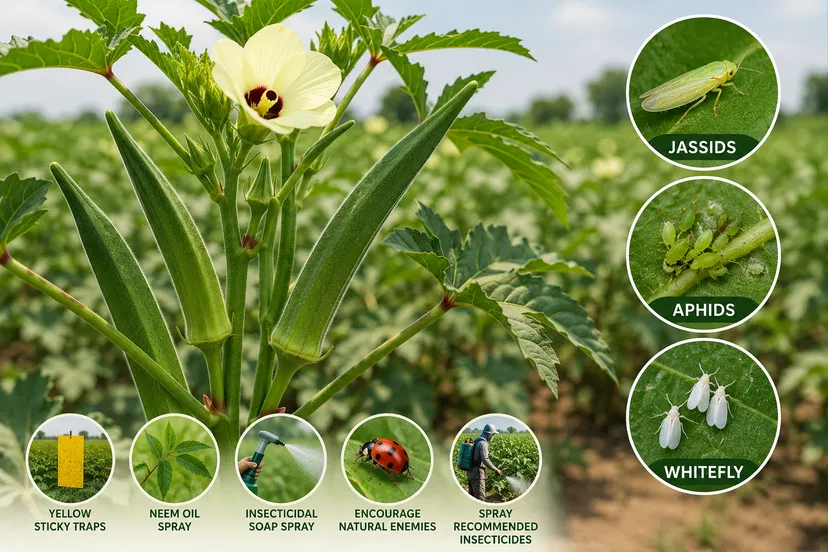
Hang yellow sticky traps at 4 to 5 per acre from sowing and spray neem oil 3 ml per litre around 30 days to keep whitefly and aphid numbers down; dimethoate in older leaflets is not recommended on green beans close to picking.
How whitefly spreads these viruses across crops is in our post on whitefly-transmitted crop diseases.
7. Root rot, damping-off, collar rot and Rhizoctonia blight
The soil fungi decide the plant stand. In cold wet soil the seed rots before it comes up, seedlings topple at the soil line, and surviving plants show red-brown sunken spots on the stem just above the soil, yellow leaves and black roots with peeling bark. In cowpea the Rhizoctonia root rot shows mainly at podding. Low poorly drained fields, sowing before the soil warms, root injury, nematodes and beans after beans or peas on the same land all bring it on.
Sow on raised beds or ridges after the soil has warmed, and avoid fields where beans or peas were grown last season.
Treat seed with Trichoderma viride 1 per cent WP at 4 to 5 g per kg, the registered recommendation on cowpea and pulses for root rot, or carbendazim 2 g per kg; EBS Trichoderma Viride lists beans and pulses for seed and soil use.
Apply Trichoderma or Pseudomonas at 1 kg per acre (2.5 kg per hectare) mixed with 25 to 60 kg FYM at sowing or 30 days after, with neem cake 60 kg per acre; the registered cowpea soil dose is 2.5 kg per hectare with 62.5 kg FYM.
Captan 75 WP is the registered nursery drench on beans for damping-off at 0.25 per cent (2.5 g per litre); carbendazim 1 g per litre as a spot drench is the state recommendation for root rot.
Manage nematodes where they are present; damaged roots let the rot fungi in.
How to raise a healthy bio-agent population before sowing is in our post on Trichoderma for farmers.
8. Fusarium wilt
Fusarium wilt is a problem of vegetable cowpea and lablab in repeatedly cropped, poorly drained land. Leaves on one side of the plant yellow, lose turgor and droop, the stem base swells and cracks, and the split stem shows a brick-red stain while the roots look sound. Drainage, debris destruction and rotation come first; seed treatment with Trichoderma viride 4 g per kg; Trichoderma 400 g per acre mixed with 20 kg FYM and 60 kg neem cake in the soil; carbendazim 50 WP 1 g per litre as a drench on local advice. Vellayani Jyothika is the wilt-tolerant trailing cowpea from Kerala.
Our post on root rot and wilt management covers the soil-borne cycle that applies to beans.
9. White mould and ashy stem blight
White mould comes in cool moist weather in a dense, over-fertilised canopy: soft watery spots on stems, leaves and pods that merge, girdle the stem and turn pods into a soft mass under white cottony growth. There is no registered chemical on beans; wider spacing between rows, moderate nitrogen and removal of affected plants are the control. Ashy stem blight, the Macrophomina dry root rot of cowpea and lablab, shows as black sunken cankers with concentric rings at the stem base and sudden wilting in patches after a dry spell following rain. Summer ploughing, debris burial, balanced FYM, Trichoderma or Pseudomonas seed treatment at 4 to 10 g per kg, neem cake 8 to 20 kg per acre and a carbendazim drench at 15 days on local advice are the package.
Registered Fungicides and Bactericides on Beans
ProductCrop and diseaseDose per hectare (per acre)WaterProducts listing the crop
Carbendazim 50% WPCowpea: anthracnose, leaf spot, collar rot, powdery mildew300 g (120 g), 0.5 g per litre600 litresBavistin
Carbendazim 50% WPCluster bean: powdery mildew350 g (140 g)750 litresBavistin
Sulphur 80% WGCowpea, guar, pea: powdery mildew1.875 to 2.5 kg (0.75 to 1 kg)750 to 1,000 litresKatyayani Sulfotop 80, Sulfex Gold
Sulphur 80% WPCowpea, moong, urd: powdery mildew3.13 kg (1.25 kg)750 to 1,000 litresNo listing found
Sulphur 40% SCBeans: powdery mildew5.65 to 7.5 kg (2.3 to 3 kg)750 to 1,000 litresNo listing found
Sulphur 85% DPBeans (cowpea, moong, urd): powdery mildew, rust15 to 20 kg (6 to 8 kg) dustDustingNo listing found
Lime sulphur 22% SCBean: rust1 per cent solution, 10 ml per litreAs neededNo listing names beans
Captan 75% WPBeans: damping-off (nursery)0.25 per cent drench, 2.5 kg1,000 litresNo listing names beans
Streptomycin sulphate 90% + tetracycline HCl 10% SPBeans: halo blight100 to 150 ppm (1 to 1.5 g in 10 litres); 3 sprays at 7-day gaps from 10 days after leaf emergenceAs neededKmycin, Tagmycin
Trichoderma viride 1% WPCowpea, pulses: root rot4 to 5 g per kg seed; soil 2.5 kg (1 kg) with 62.5 kg FYMSeed and soilEBS Trichoderma Viride, Katyayani Tyson
No waiting period is printed against these claims; keep at least a week between any chemical spray and the next picking. No claim at all exists under the names French bean, rajmash, dolichos or lablab; the beans and cowpea claims above are what the central list carries. Per-acre figures are conversions of the per-hectare doses.
Old Recommendations and What Is Still Allowed
Chemical in older bean leafletsUse it was advised forStatus today
Benomyl 50 WPAnthracnose, powdery mildewBanned since 2018
Dinocap (Karathane)Powdery mildewBanned since 2023
Carbendazim 50 WPSeed treatment, anthracnose, leaf spot, mildewRegistered; cowpea and cluster bean claims stand
Mancozeb 75 WPAnthracnose, rust, leaf spotRegistered on other crops; no bean claim; state recommendation on local advice
Copper oxychloride, Bordeaux mixtureBacterial blights, anthracnoseRegistered on other crops; no bean claim
Chlorothalonil, thiram, hexaconazole, propiconazole, tebuconazoleRust, leaf spots, seed treatmentRegistered on other crops; no bean claim
Dimethoate, methyl demetonAphid and whitefly vectors of mosaicRegistered on other crops; dimethoate claims on raw-eaten vegetables withdrawn in 2023; avoid near picking
The banned and restricted list is kept on the national spices institute's banned pesticides page.
The cowpea disease pages with the state doses are on the Kerala agricultural university's cowpea disease page, and the lablab package on the national plant health institute's lablab page.
Seed and Soil Treatment: The Half of IDM That Costs Least
TreatmentDoseDiseases it covers
Carbendazim or thiram seed treatment2 g per kg seed, 24 hours before sowingAnthracnose, leaf spots, seed rot, Rhizoctonia blight
Trichoderma viride seed treatment4 to 5 g per kg seed (10 ml per kg for liquid packs)Root rot, collar rot, wilt, dry root rot
Pseudomonas fluorescens seed treatment10 g per kg seedRoot rot, dry root rot, stem canker
Streptomycin plus tetracycline seed soak0.5 g per litre, 30 minutesHalo blight, common bacterial blight
Rhizobium600 g per hectare (one packet per 10 kg seed), applied after bio-agents and 24 hours after any fungicideNodulation and vigour
Trichoderma or Pseudomonas in soil1 kg per acre mixed with 25 to 60 kg FYM at sowing or 30 days afterRoot rot, wilt
Neem cake60 kg per acre with the basal dose (8 to 20 kg per acre in dry root rot patches)Root rot complex, nematodes
Mycorrhiza and humic substancesTapas VAM SP with the basal dose; Tapas HumiQ with the first irrigationRoot growth that stands up to the soil fungi
Fungicide and bio-agents are incompatible on the same seed at the same time; treat with the fungicide first, dry, and apply the bio-agent and Rhizobium 24 hours later. Step-by-step seed treatment is in our post on seed treatment practices before sowing.
Cultural Practices That Carry the Programme
Buy new seed every year. Anthracnose, both blights and bean common mosaic come in the seed; saved seed from a diseased field carries all of them to the next crop.
Rotate for two to three years. Cereals break the anthracnose, blight, leaf spot and root rot cycles; beans after beans or peas is the commonest cause of a root rot patch.
Sow on time, on raised beds. October to November in the plains, February to March and August to September in the hills, and after the soil has warmed; 5 to 7 cm deep in lines at the recommended spacing so the canopy dries fast.
Water at the base. Furrow or drip irrigation keeps foliage dry; overhead watering spreads anthracnose and the bacterial blights by splash.
Stay out of a wet crop. Bacteria and anthracnose spores travel on wet hands, clothes and tools; weed and pick after the dew has dried.
Feed in balance. Excess nitrogen gives the dense canopy that white mould and powdery mildew need; FYM 10 t per acre, the recommended NPK and a potash top-up at flowering keep the plant firm.
Clean up. Collect and burn or bury debris after the last picking, weed the bunds, and clean or replace pandal poles before the next crop.
Choose the variety for the problem. Arka Anoop for rust and bacterial blight, Arka Arjun for yellow mosaic, Arka Sukomal for rust in pole beans, Kashi Kanchan for mosaic and leaf spot in cowpea, Arka Prasidhi for rust and Kashi Harittima for mosaic in lablab. The full package is in our French bean cultivation guide.
Beans Disease Calendar
StageDiseases to expectWhat to do
Before sowingRoot rot fungi, wilt, debris-borne anthracnose and blightsSummer ploughing; rotation; raised beds; FYM with Trichoderma and neem cake; certified seed; seed treatment
Emergence to 3 weeksDamping-off, collar rot, Rhizoctonia blight, seedling anthracnose, early mosaicAvoid waterlogging; captan or carbendazim drench in patches; rogue mosaic seedlings; sticky traps for aphid and whitefly
Vegetative (3 to 5 weeks)Halo blight, common blight, angular and Cercospora leaf spots, yellow mosaicStreptomycin plus tetracycline sprays from 10 days after leaf emergence where blight is seen; carbendazim on cowpea for leaf spot; keep foliage dry; rogue mosaic plants; neem oil on whitefly
FloweringRust, anthracnose, powdery mildew startingSulphur at the first rust pustules or mildew patches; carbendazim on cowpea for anthracnose; Trichoderma soil application at 30 days
Pod filling and pickingAnthracnose and blight pod spots, rust, powdery mildew, white mould, Fusarium wilt in cowpeaSprays only with a week or more to the next picking; remove white mould plants; pick when dry
After harvestCarry-over on debris, poles and volunteer plantsBurn or bury residues; clean poles; weed the bunds; rotate to a cereal
Products for Beans Disease Management
Halo blight and bacterial blight
Katyayani Kmycin
Tropical Agro Tagmycin
Anthracnose, leaf spot, collar rot and powdery mildew
Crystal Bavistin
Powdery mildew and rust
Katyayani Sulfotop 80
Sumitomo Sulfex Gold
Biological seed and soil treatment
EBS Trichoderma Viride
EBS Trichoderma Harzianum
Katyayani Tyson (Trichoderma viride 1.5% WP)
Katyayani Striker Powder (Pseudomonas fluorescens 1% WP)
EBS Bacillus Subtilis
Captan, lime sulphur, copper oxychloride and mancozeb packs on the site do not name beans; use them on local advice at the doses above. More options are under bactericides and bio fungicides.
How these pieces fit together across crops is explained in our integrated disease management guide; the Pseudomonas side of the soil programme is in our Pseudomonas fluorescens post.
Conclusion
Bean disease control is won before the crop comes up. Fresh certified seed of a resistant variety, treated with a fungicide and then a bio-agent, sown on raised beds in a rotated field with Trichoderma and neem cake in the basal dose, removes most of the anthracnose, blight, mosaic and root rot risk at a cost of a few rupees per kilogram of seed. After that the programme is dry foliage, a clean field, a weekly walk, and the registered sprays used early and sparingly: sulphur at the first rust or mildew, streptomycin plus tetracycline at the first halo blight, carbendazim on cowpea for anthracnose and leaf spot, each with a week or more to the next picking. With benomyl and dinocap gone and most of the broad-spectrum fungicides never registered on beans, the farmer who starts with the seed is the one who finishes with a full stand, clean pods and a harvest that is safe to pick every third day.
Frequently Asked Questions
1. What are the major diseases of beans?
Anthracnose, rust, angular and Cercospora leaf spots, powdery mildew, halo blight, common bacterial blight, bean common mosaic, yellow mosaic, root rot and damping-off, Fusarium wilt, white mould and ashy stem blight.
2. Why do my bean pods have black sunken spots?
Generally anthracnose, a seed-borne fungus favoured by cool wet weather; use certified seed, treat it with carbendazim 2 g per kg and rotate out of beans for two years.
3. Which spray is registered for halo blight in beans?
Streptomycin sulphate plus tetracycline at 100 to 150 ppm (1 to 1.5 g in 10 litres), three sprays a week apart from 10 days after the first leaves open.
4. How do I control rust in French bean?
Grow Arka Anoop or Arka Sukomal, clean debris and poles, and spray sulphur 80 WG at 0.75 to 1 kg per acre or lime sulphur 1 per cent at the first pustules.
5. Which fungicide is registered on cowpea for anthracnose and leaf spot?
Carbendazim 50 WP at 120 g per acre (0.5 g per litre), repeated at 8 to 10 day gaps; it also covers collar rot and powdery mildew on cowpea.
6. Can yellow mosaic in beans be cured?
No. Rogue affected plants early, control whitefly with sticky traps and neem oil, and grow Arka Arjun or Kashi Kanchan, which are bred resistant.
7. What seed treatment prevents root rot in beans?
Trichoderma viride 4 to 5 g per kg seed, or carbendazim 2 g per kg followed by Trichoderma 24 hours later, with Trichoderma and neem cake in the soil.
8. Is mancozeb registered on beans?
No. Mancozeb is registered on other crops; state leaflets recommend it on beans, so use it only on local advice and keep a week before picking.
Disclaimer: Disease details and doses here follow national and state institute recommendations and the registered label claims on beans and cowpea; several fungicides named in state packages carry no bean registration and are used on local advice. Follow the pack, keep a safe gap before picking, and consult a local agricultural officer before use.