Introduction
Punjab and Haryana are major rice-growing states of north India. During monsoon, farmers face challenges such as declining groundwater, delayed monsoon, blast, bacterial blight, sheath blight, lodging, and rising cultivation cost. In such conditions, choosing the right paddy variety is one of the most important decisions before sowing.
Short- and medium-duration varieties are becoming more important because they help save irrigation water, reduce crop duration, and clear the field earlier for wheat sowing.
What to Look for While Choosing a Paddy Variety
A variety that performs well in one field may not perform the same in another. Before selecting seed, farmers should check:
- Crop duration: short, medium, or long
- Suitability for transplanted rice or direct-seeded rice
- Disease tolerance, especially blast and bacterial blight
- Lodging tolerance
- Yield stability under local conditions
- Grain quality and market demand
- Water availability
- Sowing or transplanting date
- Local university or KVK recommendation
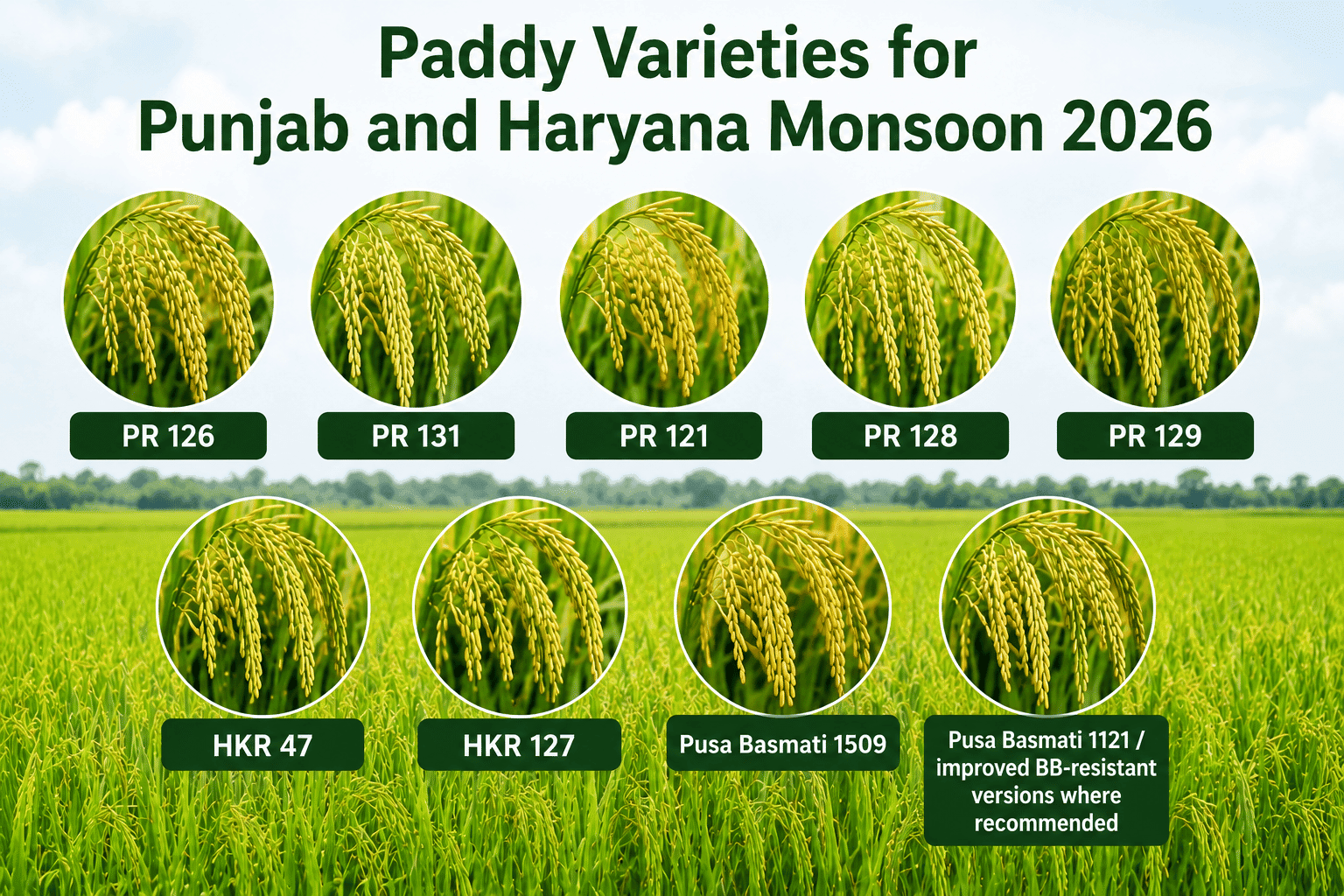
9 Paddy Varieties for Punjab and Haryana Monsoon 2026
Always confirm seed availability and local recommendation from PAU, CCSHAU, KVK, or the state agriculture department before purchase.
|
Sr. No. |
Variety |
Category |
Key Strength |
|
1 |
PR 126 |
Non-basmati |
Short duration, water-saving, popular in Punjab |
|
2 |
PR 131 |
Non-basmati |
Good yield potential and suitable for Punjab conditions |
|
3 |
PR 121 |
Non-basmati |
Stable performance and wide adaptability |
|
4 |
PR 128 |
Non-basmati |
Medium duration and good field performance |
|
5 |
PR 129 |
Non-basmati |
Suitable for timely sowing and resource-saving systems |
|
6 |
HKR 47 |
Non-basmati |
Released from Haryana rice research system; suited to Haryana belt |
|
7 |
HKR 127 |
Non-basmati |
Suitable for Haryana rice-growing conditions |
|
8 |
Pusa Basmati 1509 |
Basmati |
Early maturing basmati; suitable for basmati-growing region |
|
9 |
Pusa Basmati 1121 / improved BB-resistant versions where recommended |
Basmati |
Premium long-grain basmati with strong market demand |
Water-Saving Tip: Prefer Short- and Medium-Duration Varieties
Groundwater decline is a serious issue in Punjab and Haryana. Short-duration varieties such as PR 126 and Pusa Basmati 1509 can help reduce the crop’s field duration and irrigation requirement compared with long-duration varieties.
Benefits of short-duration varieties:
- Lower irrigation requirement
- Less pumping cost
- Early field clearance for wheat
- Less exposure to late-season pest and disease pressure
- Better fit in rice–wheat cropping system
Basmati vs Non-Basmati: Which One Should Farmers Choose?
Basmati Varieties
Basmati can give better price when grain quality, aroma, and market demand are favourable. However, it needs careful management.
- Higher market price potential
- Export-oriented demand
- Sensitive to excessive nitrogen
- Requires careful pest and disease management
- Quality can reduce if harvested or dried improperly
- Price risk is higher than MSP-backed non-basmati paddy
Non-Basmati Varieties
Non-basmati varieties are preferred by many farmers for yield stability and procurement support.
- More stable yield under normal management
- MSP procurement support in many areas
- Easier crop management
- Lower market price risk
- Suitable for farmers prioritising assured sale
Final Thoughts
For Punjab and Haryana monsoon 2026, farmers should focus on locally recommended, short- or medium-duration varieties that suit water availability, sowing date, and market plan.
A wise paddy variety choice saves water, improves crop planning, and reduces risk.