Whiteflies (Bemisia tabaci) are among the most damaging sucking pests in Indian agriculture. They reduce yields directly by sucking sap and indirectly by spreading viruses such as cotton leaf curl virus and tomato yellow leaf curl virus. Once an outbreak begins, controlling them is difficult, so prevention and early action are key.
How to Identify Whiteflies
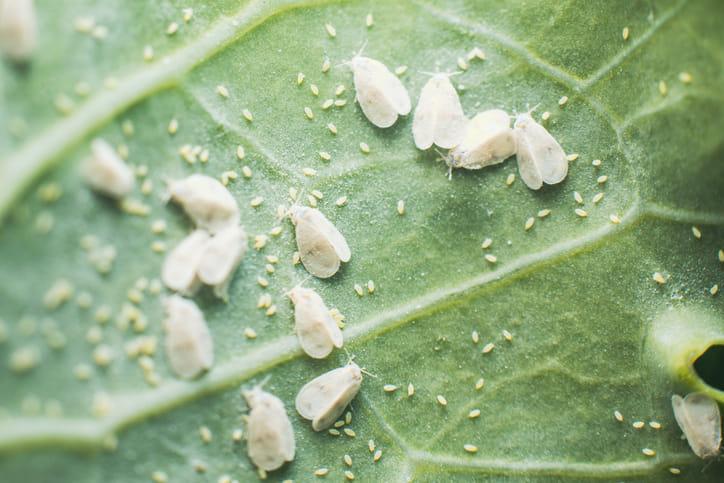
Adult whiteflies are tiny, about 1 to 1.5 mm long, with white waxy wings. They are usually found on the under-surface of young leaves. When disturbed, they fly up in a small cloud. Nymphs are flat, oval, scale-like, and stuck to the lower side of leaves.
Damage Symptoms
- Yellowing and curling of leaves, especially top young leaves.
- Sticky honeydew on leaves followed by black sooty mould.
- Stunted plant growth.
- Cotton leaf curl, chilli leaf curl, tomato yellow leaf curl virus symptoms.
Crops Most Affected in India
- Cotton (major host, especially in North India).
- Tomato, chilli, brinjal, okra.
- Cucurbits like bottle gourd, ridge gourd.
- Pulses, soybean, and sunflower.
- Tobacco and ornamentals.
Why Whitefly Outbreaks Happen
- Excess nitrogen fertilizer producing soft lush leaves.
- Continuous use of the same insecticide leading to resistance.
- Lack of crop rotation; same crop repeated year after year.
- Weedy fields acting as alternate hosts.
- Hot, dry weather extending whitefly breeding.
Monitoring and Early Detection
Install 8 to 12 yellow sticky traps per acre at canopy height. Count whiteflies on 3 to 5 leaves from each of 10 plants twice a week. Action is needed when there are more than 6 to 8 adult whiteflies per leaf in cotton, or when the first virus symptom appears in vegetables. Always confirm the current Economic Threshold Level (ETL) for your crop and region with the local KVK.
Step 1: Cultural and Preventive Practices
- Plant only recommended resistant or tolerant varieties.
- Use clean, virus-free seedlings; reject discoloured ones.
- Maintain proper plant spacing for airflow.
- Remove and destroy weeds and volunteer plants that host whiteflies.
- Avoid excess nitrogen; use balanced fertilization with potassium and zinc.
- Rotate crops; do not follow cotton with cotton or tomato with tomato continuously.
Step 2: Mechanical Control
- Yellow sticky traps (8 to 12 per acre) catch adults and reduce egg laying.
- Reflective silver or yellow mulch in nursery beds repels whiteflies.
- Remove and burn heavily infested leaves and virus-affected plants.
Step 3: Biological Control
- Release Chrysoperla (green lacewing) eggs/larvae early in the season.
- Encourage Encarsia formosa where available (greenhouse use).
- Use Verticillium lecanii or Beauveria bassiana bio-fungicide sprays in humid weather.
- Protect native predators by avoiding broad-spectrum insecticides early in the season.
Step 4: Botanical and Organic Sprays
- Neem oil (1500 ppm or 10000 ppm) at 3 to 5 ml per litre.
- Neem seed kernel extract (NSKE) at 5 percent.
- Pongamia oil for early infestations.
- Soap-water solution for vegetables.
Step 5: Chemical Control (Above ETL Only)
Use insecticides only when monitoring shows that pest pressure has crossed the ETL. Always follow label instructions, dose, and pre-harvest interval. Examples of insecticide groups used against whiteflies in India (confirm current registration for your crop):
- Diafenthiuron 50 WP.
- Spiromesifen 22.9 SC.
- Pyriproxyfen 10 EC (insect growth regulator).
- Flonicamid 50 WG.
- Buprofezin (for nymph stages).
Rotate insecticide groups every 2 to 3 sprays. Avoid repeated use of synthetic pyrethroids alone, which can flare whitefly numbers further. Do not mix multiple insecticides unless the label permits.
Whitefly and Virus Management
Once a plant is infected with cotton leaf curl or chilli leaf curl virus, no spray can cure it. The best strategy is to reduce whitefly numbers early in the crop, remove virus-affected plants immediately, and grow recommended tolerant varieties.
Quick Action Checklist
- Install yellow sticky traps at sowing or planting.
- Inspect fields twice a week.
- Start neem oil sprays at first whitefly sighting.
- Move to recommended insecticides only after ETL is crossed.
- Rotate chemical groups.
- Maintain balanced fertilization and good field hygiene.
Conclusion
Whiteflies thrive on monoculture, excess nitrogen, and chemical overuse. The most effective whitefly control comes from prevention, early monitoring, and integrated management. Always consult your local agriculture extension officer or KVK before choosing an insecticide and strictly follow label instructions and safety practices.