

Introduction
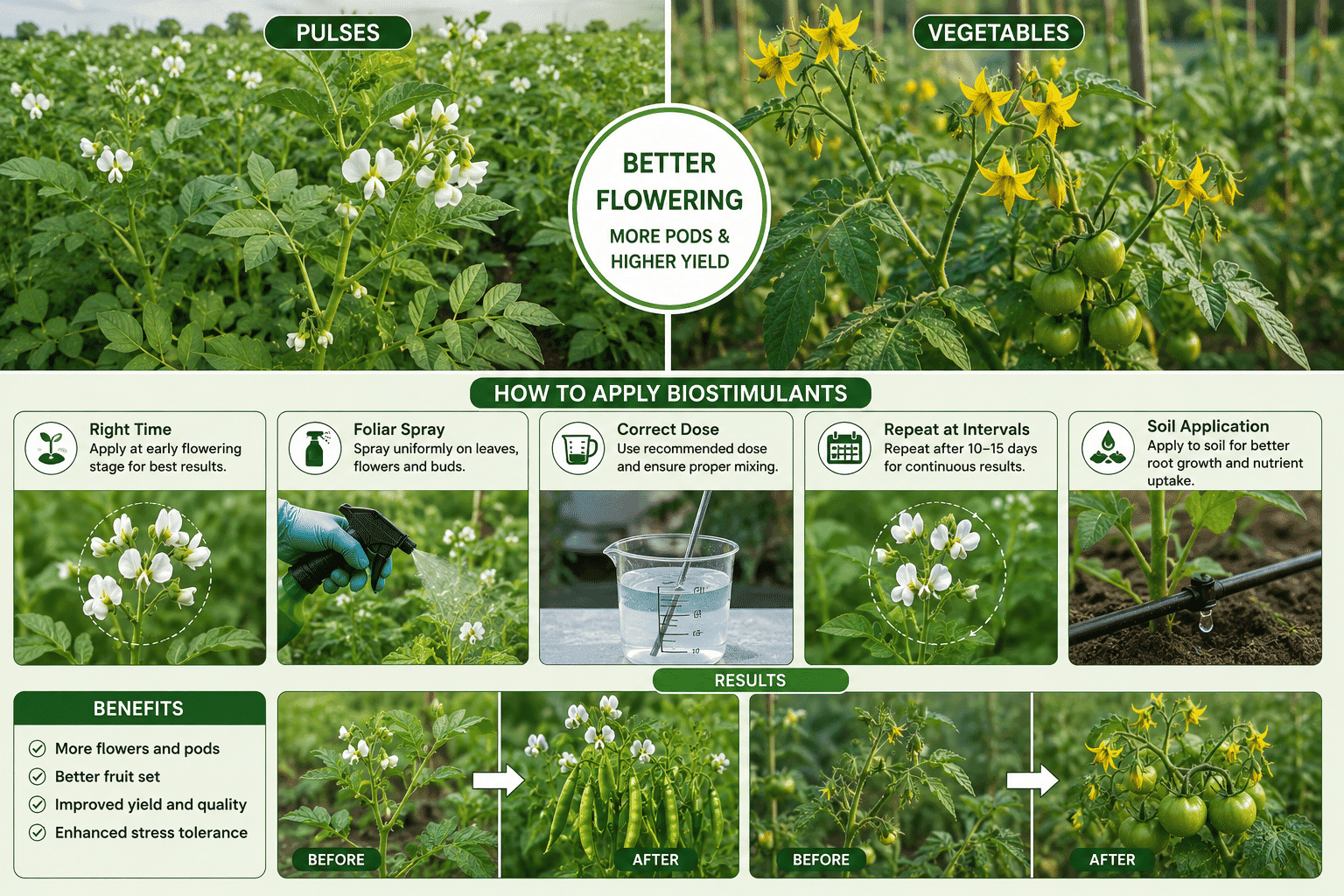
Flowering is a sensitive stage in pulses and vegetables. At this stage, the crop needs proper nutrition, moisture, sunlight, and stress-free growth. If the crop faces heat, water stress, nutrient deficiency, pest attack, or disease, flower drop may increase.
Biostimulants are commonly used to support plant growth, flowering, stress tolerance, and nutrient use efficiency. But they should be applied correctly. Wrong timing, wrong mixing, poor spray coverage, or use during crop stress can reduce their benefit.
For best results, biostimulants should be used as a supportive input, not as a replacement for fertilizers, irrigation, pest control, or disease management.
What are Biostimulants?
Biostimulants are substances or microorganisms that help improve plant processes such as nutrient uptake, stress tolerance, crop quality, and growth. They are different from normal fertilizers because their main role is not only to supply nutrients.
A widely used scientific definition says plant biostimulants are substances or microorganisms applied to plants to improve nutrient efficiency, abiotic stress tolerance, or crop quality traits, regardless of nutrient content.
Common types of biostimulants include:
- Seaweed-based extracts
- Amino acid-based formulations
- Humic acid and fulvic acid products
- Protein hydrolysates
- Beneficial microbial products
- Organic acid-based products
- Botanical or natural extract-based products
Exact composition varies by product. Farmers should always read the label before use.
Why Flowering Drops in Pulses and Vegetables
Flower drop is not always due to lack of biostimulant. Many field factors can affect flowering.
Common reasons for flower drop
- High temperature
- Moisture stress
- Waterlogging
- Poor pollination
- Nutrient imbalance
- Boron or micronutrient deficiency
- Excess nitrogen
- Pest attack
- Fungal or bacterial diseases
- Cloudy weather
- Poor root growth
- Spray injury due to wrong chemical mixing
In pulses, flowering and pod-setting stages are highly sensitive to moisture stress and nutrient deficiency. In vegetables, flowering may reduce during heat, irregular irrigation, or pest pressure.
Biostimulants may support the crop during flowering, but they cannot correct all these problems alone.
Crops Where Biostimulants are Commonly Used
Biostimulants are used in many pulse and vegetable crops.
Pulses
- Red gram
- Green gram
- Black gram
- Bengal gram
- Cowpea
- Field bean
- Soybean
Vegetables
- Tomato
- Chilli
- Brinjal
- Okra
- Cucumber
- Bitter gourd
- Bottle gourd
- Beans
- Capsicum
- Cabbage and cauliflower
Application timing may change depending on crop duration, variety, season, and local growing condition.
Best Crop Stage to Apply Biostimulants
Biostimulants should be applied before the crop enters heavy stress. They work better when the plant is active and healthy.
Important stages in pulses
- Vegetative stage before flowering
- Pre-flowering stage
- Flowering stage
- Pod initiation stage
Important stages in vegetables
- Vegetative growth stage
- Pre-flowering stage
- First flowering stage
- Fruit-setting stage
- After stress recovery, if crop is still healthy
For flowering support, the pre-flowering stage is usually the most important. This is when the crop prepares for flower formation.
Step-by-Step Method to Apply Biostimulants Correctly
1. Identify the Crop Stage First
Do not apply biostimulant randomly. First check whether the crop has reached the correct stage.
For pulses, application is generally useful before flowering and during early pod setting. For fruiting vegetables, application is useful before flowering and during early fruit setting.
Avoid application when the crop is too young, severely wilted, waterlogged, or heavily diseased.
2. Check the Crop Condition
Before spraying, walk through the field and check the crop condition.
Observe:
- Leaf colour
- Plant growth
- Flowering stage
- Soil moisture
- Pest damage
- Disease symptoms
- Root health
- Flower drop level
- Weather condition
If the crop is under severe stress, first correct the main issue. For example, if the field is waterlogged, drain the water first. If sucking pests are active, manage them as per local advisory.
Biostimulant application works better when basic crop health is maintained.
3. Choose the Right Type of Biostimulant
Different biostimulants are used for different purposes.
|
Crop Need |
Suitable Biostimulant Type |
|
Flowering support |
Seaweed extract, amino acid-based products, micronutrient-linked products as per label |
|
Stress recovery |
Amino acid, seaweed extract, humic or fulvic acid products |
|
Root growth support |
Humic acid, fulvic acid, microbial biostimulants |
|
Nutrient uptake support |
Humic substances, microbial products, amino acid products |
|
General crop vigour |
Seaweed-based or amino acid-based products |
Use only approved and labelled products. Avoid local unlabelled mixtures.
4. Follow Label Dose Strictly
Do not increase the dose thinking flowering will increase more. High dose can cause leaf burn, flower drop, or wastage of money.
Follow:
- Product label dose
- Recommended water volume
- Correct spray interval
- Crop-specific instruction
- Local agriculture officer or KVK guidance
If the label is unclear or the product is not properly registered, avoid using it.
Do not depend on shopkeeper advice alone for dose. Confirm from the label or local agriculture expert.
5. Use Clean Water for Spray Solution
Poor water quality can reduce spray effectiveness.
Use clean water for preparing spray solution. Avoid muddy water, saline water, or water with high suspended particles.
Before mixing, check:
- Spray tank cleanliness
- Water clarity
- No leftover pesticide in the tank
- No old spray solution remaining
- No blocked nozzle
A dirty tank can damage flowers and leaves.
6. Do a Small Compatibility Test Before Mixing
Many farmers mix biostimulants with insecticides, fungicides, micronutrients, or fertilizers. This can be risky.
Before tank mixing, check label compatibility. If compatibility is not mentioned, avoid mixing.
A simple jar test can help:
- Take small quantity of water in a transparent bottle
- Add products in the same order planned for tank mixing
- Shake gently
- Wait for 15–20 minutes
- Check for curdling, heating, sediment, foam, or separation
If any reaction is seen, do not mix.
For flowering crops, it is safer to spray biostimulants separately unless the label clearly allows mixing.
7. Spray During Morning or Evening
Spray timing is very important.
Best time:
- Early morning
- Late evening
- When temperature is moderate
- When wind is low
- When rain is not expected soon
Avoid spraying:
- During strong sunlight
- During high temperature
- During strong wind
- Just before rainfall
- When leaves are dusty
- When crop is wilted
- During full heat stress
Spraying during harsh sunlight may cause leaf injury and poor absorption.
8. Ensure Proper Spray Coverage
Biostimulants should reach the leaf surface properly. Poor coverage gives poor results.
Follow these steps:
- Use a clean sprayer
- Use a fine mist nozzle
- Cover both upper and lower leaf surfaces
- Avoid over-wetting flowers
- Spray uniformly across the field
- Do not leave border areas
- Do not spray only on top leaves
In vegetables, avoid heavy dripping spray on open flowers because it may affect flower quality and pollination.
9. Avoid Spray During Peak Flower Opening
In crops where pollination is active, avoid spraying during peak flower opening hours. This is important in vegetables like gourds, cucurbits, beans, and okra where pollinators may visit flowers.
Spray early morning before strong bee activity or late evening after pollinator movement reduces.
Do not spray any product unnecessarily when bees are active in the field.
10. Repeat Only as Per Recommendation
Biostimulants are not daily-use products. Repeated spraying without need can increase cost and may disturb crop balance.
Follow only the recommended spray schedule. If the crop response is poor, do not immediately repeat the spray. First check whether the real problem is water stress, pest attack, disease, nutrient deficiency, or weather.
Application Method: Foliar Spray or Soil Application?
Biostimulants can be applied by different methods depending on product type.
Foliar Spray
Foliar spray is commonly used for flowering and stress support.
Suitable for:
- Pre-flowering stage
- Flowering support
- Stress recovery
- Quick plant response
- Vegetable crops under active growth
Soil Application or Drip Application
Some biostimulants are used through soil or drip for root development and nutrient uptake support.
Suitable for:
- Root growth
- Soil biological activity
- Nutrient availability
- Early crop establishment
- Drip-irrigated vegetable crops
Use the method mentioned on the label. Do not use a foliar-only product through drip unless recommended.
Correct Timing in Pulses
Pulses need careful management during flowering and pod formation. Flower drop may occur due to heat, drought, cloudy weather, and nutrient imbalance.
Suggested application window
|
Crop Stage |
Biostimulant Use |
|
Early vegetative stage |
Root and vegetative support, if crop is weak |
|
Pre-flowering stage |
Most important stage for flowering support |
|
Flowering stage |
Use only as per label and crop condition |
|
Pod initiation stage |
Support pod setting and stress recovery |
|
Severe stress stage |
First correct water, pest, or disease issue |
Correct Timing in Vegetables
Vegetables have continuous flowering and fruiting in many crops. Biostimulants should be timed to support active growth, not forced onto a stressed crop.
Suggested application window
|
Crop Type |
Important Stage |
|
Tomato, chilli, brinjal |
Pre-flowering and early fruit setting |
|
Okra |
Before flowering and during early picking stage |
|
Cucurbits |
Vine growth, pre-flowering, early fruit setting |
|
Beans |
Pre-flowering and pod initiation |
|
Cabbage, cauliflower |
Vegetative growth and curd/head formation as per crop need |
|
Leafy vegetables |
Active vegetative growth, not close to harvest unless label permits |
For flowering vegetables, avoid unnecessary spray during active pollinator movement.
How Biostimulants Support Flowering
Biostimulants may support flowering indirectly by improving plant condition. They do not create flowers by magic.
They may help through:
- Better nutrient uptake
- Improved root activity
- Better stress tolerance
- Improved plant metabolism
- Reduced stress impact
- Better crop vigour
- Support during flowering and fruit setting
Plant biostimulants are considered complementary to mineral fertilizers because they can support nutrient availability, assimilation, translocation, and use, but they do not replace balanced fertilization.
Biostimulants are Not a Substitute for Fertilizer
This is an important point.
If the crop has nitrogen, phosphorus, potassium, sulphur, boron, zinc, or other nutrient deficiency, biostimulant alone will not solve the problem.
Good flowering depends on:
- Healthy seed or seedling
- Proper spacing
- Balanced fertilizer
- Good root growth
- Correct irrigation
- Pest and disease control
- Pollination
- Weather condition
- Timely biostimulant use, if required
Use biostimulants as part of integrated crop management.
Common Mistakes Farmers Should Avoid
- Applying biostimulants without checking crop stage
- Using high dose for faster flowering
- Mixing with many pesticides or fertilizers
- Spraying during hot afternoon
- Spraying before rainfall
- Using unlabelled products
- Expecting results in severely stressed crops
- Ignoring pest and disease problems
- Applying on waterlogged crops
- Repeating spray too frequently
- Treating biostimulants as fertilizer replacement
Correct use is more important than repeated use.
What to Do if Flower Drop Continues
If flower drop continues even after biostimulant use, check the real reason.
Field checklist
|
Problem Seen |
Possible Reason |
Action |
|
Flower drop during heat |
High temperature stress |
Maintain irrigation and reduce crop stress |
|
Flower drop after heavy rain |
Waterlogging or poor pollination |
Drain water and monitor roots |
|
Yellow leaves with flower drop |
Nutrient deficiency or root issue |
Check soil, roots, and local nutrient advisory |
|
Sticky leaves or curling |
Sucking pest attack |
Check for thrips, aphids, whitefly, mites |
|
Spots or wilting |
Disease infection |
Take diagnosis-based control |
|
Good flowering but poor fruit set |
Pollination issue |
Avoid harmful sprays during pollinator activity |
|
Excess vegetative growth |
Too much nitrogen |
Correct fertilizer balance |
Do not repeat biostimulant spray without identifying the cause.
Safety Precautions During Application
- Wear gloves, mask, full-sleeve shirt, and long pants
- Use clean sprayer and clean water
- Do not spray during strong wind
- Avoid spray drift to nearby crops
- Do not eat, drink, or smoke during spraying
- Wash hands, face, and equipment after spraying
- Store products away from children, animals, food, and seed
- Follow label instructions and waiting period, if mentioned
Even natural or organic-origin products should be handled carefully.
Storage and Handling of Biostimulants
Improper storage can reduce product quality.
Follow these steps:
- Keep container tightly closed
- Store in a cool and dry place
- Avoid direct sunlight
- Do not mix leftover solution for next day use
- Do not use expired product
- Shake liquid products before use if label advises
- Keep original label intact
- Do not transfer into drinking water bottles
Poor storage may reduce product performance.
Farmer’s Simple Action Plan
|
Stage |
Action |
|
Before flowering |
Check crop health and moisture |
|
Pre-flowering |
Apply suitable biostimulant as per label |
|
Flowering |
Avoid stress, pest attack, and wrong spray timing |
|
Fruit or pod setting |
Support crop only if needed and recommended |
|
After stress |
Correct water, disease, or pest issue first |
|
Before repeat spray |
Check crop response and real cause of flower drop |
Conclusion
Biostimulants can support better flowering in pulses and vegetables when used at the right crop stage and under suitable field conditions. The most useful timing is generally before flowering and during early reproductive growth.
For better results, apply biostimulants as per label dose, use clean water, avoid hot afternoon spraying, do not mix products without compatibility, and correct pest, disease, moisture, and nutrient problems first.