

Introduction
Tomato is one of India's most important vegetable crops, grown extensively during both rabi and kharif seasons in states like Karnataka, Tamil Nadu, Andhra Pradesh, and Uttar Pradesh. However, one physiological problem frequently frustrates tomato farmers: fruit cracking. Fruit cracking occurs when the fruit skin splits or cracks, usually as the fruit matures, and can result in 20-50% crop loss in severe cases. Unlike fungal diseases or pest damage, fruit cracking is a non-pathogenic disorder caused by environmental stress, particularly inconsistent water availability. Despite having no disease or pest involved, fruit cracking costs farmers significantly because cracked fruits cannot be sold in fresh markets, only to processors at much lower prices. This comprehensive guide explains why tomato fruits crack and gives you practical, proven strategies to prevent cracking and maximize your harvest quality and market value.
What is Tomato Fruit Cracking?
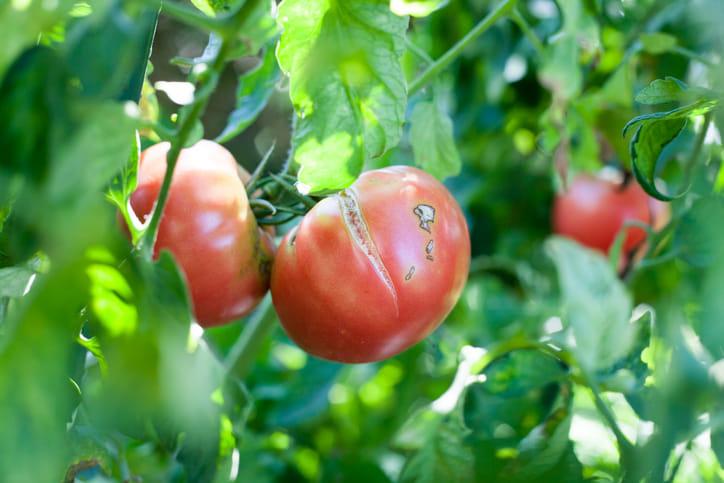
Tomato fruit cracking is a physiological disorder (not a disease) in which the fruit skin splits, usually in a radial pattern from the stem end, or in concentric circles around the fruit. The problem occurs when fruit tissues expand too rapidly due to inconsistent water availability. When soil is dry for several days followed by heavy rain or overwatering, the fruit rapidly absorbs water and expands. The outer skin cannot accommodate this expansion and cracks or splits. This disorder becomes more pronounced during the kharif season when rainfall is unpredictable and humidity is high.
Fruit cracking is entirely preventable through proper water management and variety selection. The key is understanding that consistency in soil moisture is far more important than the total amount of water applied. Even well-irrigated fields can experience cracking if watering is irregular.
Symptoms
Learn to identify fruit cracking and distinguish it from disease or pest damage:
- Radial cracking: Cracks extend from the stem end outward like spokes on a wheel, the most common pattern
- Concentric cracking: Circular rings of cracks appear around the fruit shoulder, resembling target or bullseye pattern
- Cracks appear when fruit is at the breaker stage (green turning to yellow/pink) or when fully colored
- Cracks expose inner fruit tissue; if you observe the crack, you see no fungal growth or insect damage—just exposed pulp
- Fruit remains attached to plant; it does not drop prematurely
- Crack edges are clean, not rotted or discolored with fungal growth
- Multiple fruits on same plant show cracking simultaneously, not just one or two fruits
- Whole plant appearance: Plant foliage appears healthy with no spots or wilting
- Yield and quality impact: Cracked fruits become unmarketable for fresh sale, resulting in 20-50% loss of market value
Farmer Tip: Check your field during the ripening stage (when fruits are turning color) especially after heavy rain or a long dry period. If you see clean cracks with no discoloration, it's fruit cracking, not disease.
Favorable Conditions
These environmental and management conditions favor fruit cracking:
- Inconsistent soil moisture: Alternating dry and wet periods create rapid fruit expansion and contraction
- Heavy or sudden rainfall after prolonged dry period: Water is absorbed rapidly, causing fruit to expand faster than skin can stretch
- High humidity: Humid conditions reduce fruit skin transpiration, increasing internal water pressure
- Nutrient imbalance: High nitrogen promotes soft fruit tissues that crack more easily
- Potassium or calcium deficiency: These elements strengthen fruit skin; their deficiency increases cracking tendency
- Susceptible varieties: Thin-skinned varieties and large-fruited types are more prone to cracking
- Overhead irrigation during fruiting stage: Keeps soil excessively wet and prevents consistent moisture
- Poor drainage: Waterlogged soil creates alternating wet-dry cycles
- Shallow root systems: Shallow soil or hardpan layer limits water exploration, making plants sensitive to water fluctuations
Preventive Measures
Prevention is far easier and cheaper than trying to cure existing cracking. These are your most important management strategies:
- Consistent irrigation: Water your field deeply but evenly, maintaining consistent soil moisture throughout the fruiting stage. Drip irrigation is ideal for this.
- Avoid overhead irrigation: Use drip or furrow irrigation during fruiting to prevent excessive soil wetting and allow controlled water application.
- Plan watering around monsoon: During kharif, time your irrigation to complement rainfall, not add to it. Reduce or skip irrigation during heavy rain periods.
- Improve field drainage: Ensure your field has good drainage to prevent waterlogging. Create proper furrows to direct excess rainwater away.
- Choose crack-resistant varieties: Use improved tomato varieties known for crack resistance, such as Pusa Hybrid-1, Rishitej, Rohini, or similar varieties suited to your region.
- Balanced fertilization: Apply recommended NPK ratio (12:32:16 or based on soil test) to avoid excess nitrogen. Avoid excess potassium too.
- Calcium supply: Ensure adequate calcium through gypsum application (250-500 kg/ha) to strengthen fruit skin.
- Mulching: Apply organic mulch (5 cm) around plants to maintain consistent soil moisture and prevent rapid drying.
- Deep ploughing: Prepare soil well, incorporating organic matter to improve water retention and root penetration. This helps roots access consistent moisture.
- Shade management: Avoid over-pruning foliage, which exposes fruits to direct sun and causes rapid water loss and stress.
Management Practices
Since fruit cracking is a physiological disorder, not a disease, there's no biological or chemical 'cure.' The only effective management is through proper environmental control, particularly water management. Once fruit begins cracking, those fruits cannot be healed. Your focus must be preventing cracking on future fruits through consistent practices.
Mechanical and Cultural Control
Your primary strategy is maintaining consistent soil moisture and managing environment:
- Daily field monitoring during fruiting: Check soil moisture daily by inserting a finger 10 cm into soil. Soil should feel moist but not waterlogged.
- Irrigation scheduling: Water lightly but frequently (every 2-3 days during dry period, less during rainy season) to maintain even moisture.
- Harvest cracked fruits early: Once cracking is observed, harvest affected fruits immediately to encourage plant to set more fruit and prevent disease entry through cracks.
- Pruning for leaf cover: Maintain sufficient foliage to shade developing fruits and reduce stress from intense sun.
- Weather monitoring: Track rainfall forecasts and adjust irrigation plan accordingly during kharif season.
- Cover soaked fruits after rain: If you predict heavy rain, consider covering plants with shade cloth immediately before rain to reduce sudden water absorption.
Nutritional Management
Proper nutrition strengthens fruit skin and reduces cracking tendency. Recommended products:
Product Name | Technical Content | Dosage |
Gypsum (Calcium Sulphate) | Calcium sulphate 23% Ca | 250-500 kg/ha soil application |
Calcium Nitrate Foliar Spray | Calcium nitrate 15-16% Ca | 10-15 g/L water, spray every 10 days |
Potassium Sulphate | Potassium sulphate 50% K₂O | 10-15 g/plant at fruit setting stage |
Borax (Boron source) | Borax 11% boron | 0.5-1 g/L water, foliar spray |
Potassium Chloride | Potassium chloride 60% K₂O | 40-50 kg/ha as basal application |
Best Time to Take Action
- Before planting: Select crack-resistant varieties and prepare soil with adequate organic matter and gypsum.
- At flowering: Begin calcium and potassium application to strengthen developing fruits.
- During fruit set and development: Implement consistent irrigation schedule and monitor soil moisture daily.
- During ripening: Be most vigilant about water consistency as fruits are expanding rapidly and most susceptible to cracking.
- After heavy rain: Scout field immediately and harvest any fruits showing early cracks before they enlarge.
Common Mistakes Farmers Should Avoid
- Using overhead irrigation during fruiting: Heavy water spray creates uneven soil wetting and rapid fruit expansion. Switch to drip irrigation.
- Allowing soil to dry completely: Followed by heavy watering creates the worst scenario for cracking. Water frequently but lightly.
- Ignoring post-rain scouting: After heavy monsoon rain, fruit takes in water rapidly. Scout immediately and harvest cracking fruits before they enlarge.
- Over-applying nitrogen: Excess nitrogen produces soft fruits more prone to cracking. Follow recommended fertilizer rates.
- Neglecting calcium supply: Calcium strengthens fruit skin. Don't skip gypsum application or calcium foliar sprays.
- Using susceptible varieties without management: If you grow thin-skinned varieties, you must be extra careful with water management.
- Pruning too much foliage: Foliage protects fruit from sun stress and rapid water loss. Maintain adequate leaf cover.
Conclusion
Tomato fruit cracking is one of the most preventable crop problems, yet it continues to cause significant losses for farmers who don't understand its causes. The key insight is that cracking is not a disease or pest attack—it's a physiological response to environmental stress, specifically inconsistent water availability. This means that no fungicide or pesticide will help, but proper water management absolutely will. The most important strategy is maintaining consistent soil moisture throughout the fruiting and ripening stage, achieved best through drip irrigation and regular monitoring. Combine this with crack-resistant variety selection, proper nutrition (especially calcium and potassium), and regular field scouting, and you can reduce cracking losses to nearly zero. During the kharif season when rainfall is unpredictable, this consistency becomes even more important—you must adjust your irrigation to complement rainfall and prevent both waterlogging and excessive drying. Investment in good drainage and reliable irrigation systems pays dividends by protecting your crop quality and market value. With these proven strategies in place, your tomato harvest will be high-quality, crack-free, and command premium prices in fresh markets.
Note: The information contained herein is for informational purposes only. Nothing herein shall be construed to be financial or legal advice. Viewers are advised to do their own research before making any decisions.