

Introduction
Paddy blast is one of the most serious fungal diseases in rice. It can affect the crop from nursery stage to grain formation stage. If not managed early, it can spread quickly and damage leaves, nodes, panicles, and the neck region of the plant.
The disease is caused by the fungus Pyricularia oryzae, also known as Magnaporthe oryzae. TNAU notes that blast can attack all above-ground parts of the rice plant, including leaves, leaf collar, culm, nodes, neck, and panicle.
Paddy blast management depends on early identification, balanced nitrogen use, proper water management, field hygiene, resistant varieties, and need-based fungicide application.
What is Paddy Blast Disease?
Paddy blast is a fungal disease that spreads through spores. These spores can move through wind, rain splash, crop residues, infected seeds, and nearby infected fields.
The disease can appear in different forms:
- Leaf blast
- Collar blast
- Node blast
- Neck blast
- Panicle blast
Leaf blast damages the leaves and reduces photosynthesis. Neck blast is more serious because it affects the panicle neck and can reduce grain filling.
Why Paddy Blast Spreads Fast
Paddy blast spreads faster when weather and crop conditions favour fungal growth.
Common favourable conditions
- Cloudy weather
- High humidity
- Frequent rain showers
- Long dew period on leaves
- Cool day temperature in some regions
- Excess nitrogen application
- Dense crop growth
- Water stress or irregular irrigation
- Use of susceptible varieties
- Infected crop residues in the field.
Symptoms of Paddy Blast Disease
Blast symptoms vary depending on the plant part affected.
1. Leaf Blast Symptoms
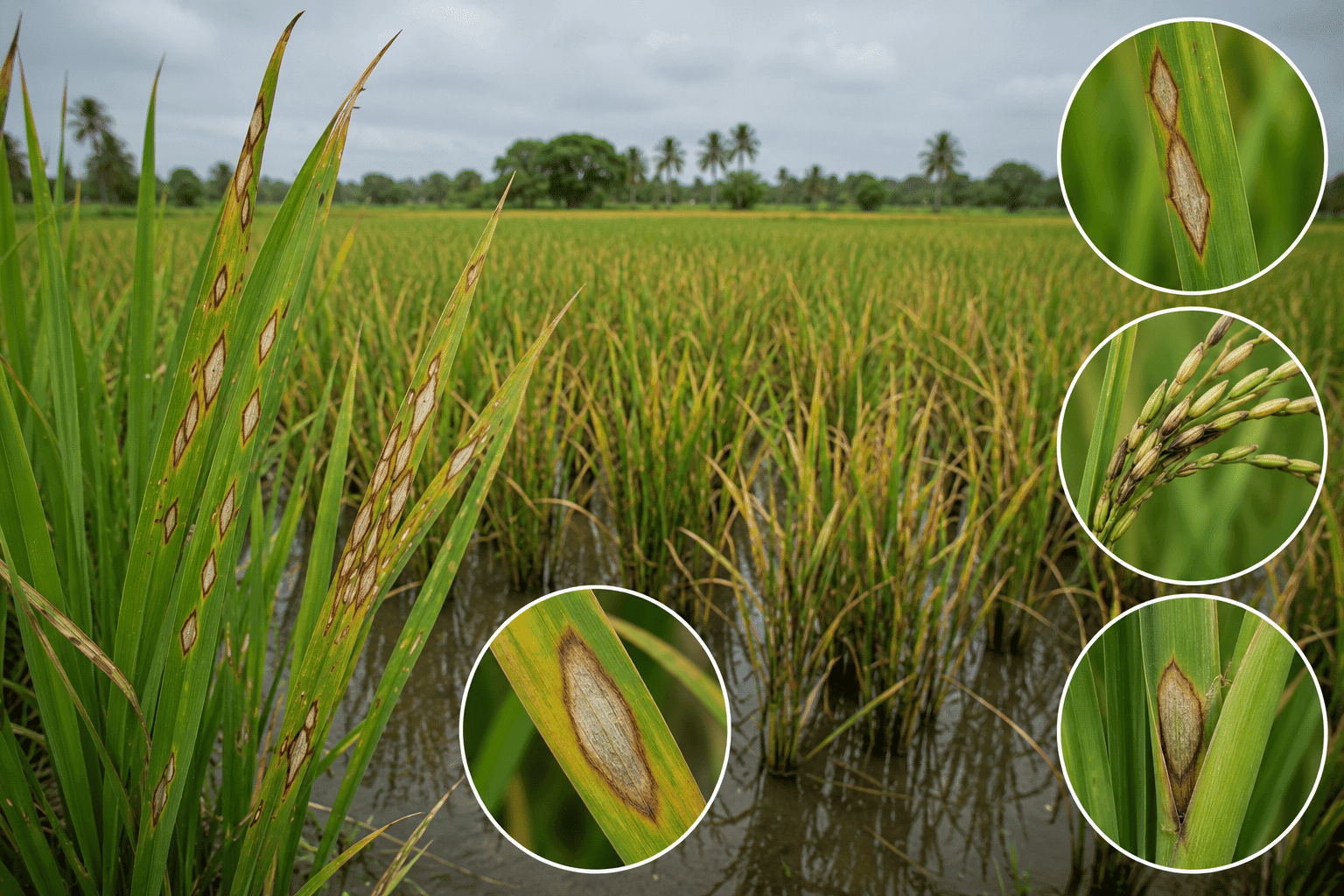
Leaf blast is usually seen as spots on leaves. In the beginning, small specks appear. Later, they become spindle-shaped spots.
Typical symptoms include:
- Small grey-green or whitish spots
- Brown border around the spot
- Spindle-shaped lesions
- Ash-coloured centre in older spots
- Drying of leaves in severe infection
- Burnt appearance in badly affected patches
2. Collar Blast Symptoms
Collar blast affects the joint where the leaf blade meets the leaf sheath.
Symptoms include:
- Brown or black infection at the leaf collar
- Drying of the affected leaf
- Weakening of the infected plant part
This stage should not be ignored because it indicates active disease pressure in the field.
3. Node Blast Symptoms
Node blast affects the nodes of the rice plant.
Symptoms include:
- Blackening of nodes
- Weak stem at infected nodes
- Breaking of the plant in severe cases
- Poor movement of nutrients to upper plant parts
4. Neck Blast Symptoms
Neck blast is one of the most damaging forms of paddy blast.
Symptoms include:
- Brown or black infection at the panicle neck
- Weak panicle neck
- White or chaffy grains
- Poor grain filling
- Panicle bending or breaking
- Partial or complete drying of panicle
Neck blast causes more economic loss than leaf blast because it directly affects grain formation.
Difference Between Leaf Blast and Neck Blast
|
Type of Blast |
Where It Appears |
Main Risk |
|
Leaf blast |
Leaves |
Reduces green leaf area |
|
Collar blast |
Leaf collar |
Weakens leaf attachment |
|
Node blast |
Stem nodes |
Causes stem weakness |
|
Neck blast |
Panicle neck |
Reduces grain filling |
|
Panicle blast |
Panicle branches |
Causes chaffy grains |
Leaf blast should be controlled early because it can indicate high disease pressure before heading. Neck blast should be prevented before panicle emergence and flowering.
Crop Stage Most at Risk
Paddy blast can occur at several crop stages.
High-risk stages include:
- Nursery stage
- Tillering stage
- Active vegetative stage
- Panicle initiation stage
- Booting stage
- Heading and flowering stage
Special attention is needed from tillering to heading stage because disease spread at this period can affect yield.
Farmer’s Action Plan to Stop Paddy Blast Spread
1. Start Field Scouting Early
Begin regular scouting from nursery and early vegetative stage. Check the field at least twice a week during cloudy, humid, or rainy weather.
Inspect:
- Nursery seedlings
- Field borders
- Low-lying patches
- Dense crop areas
- Areas with excess nitrogen growth
- Plants near previously infected patches
Do not check only the healthy-looking portion of the field. Blast often starts in small patches.
2. Identify Fresh Leaf Spots
Fresh blast spots are more important than old dry spots. Look for small grey-green or whitish spots with brown margins.
If spots are increasing within a few days, disease is active.
Action required:
- Mark the affected patch
- Check nearby plants
- Avoid moving infected plant material
- Reduce further nitrogen application temporarily
- Take local expert advice for need-based control
3. Avoid Excess Nitrogen
Excess nitrogen is one of the common reasons for blast spread. It makes the crop soft, dense, and more favourable for disease.
Follow these steps:
- Apply nitrogen in split doses
- Avoid heavy urea application at one time
- Do not apply extra urea when blast symptoms are visible
- Follow soil test or local fertilizer recommendation
- Maintain balance with phosphorus and potassium
General rice blast management guidance recommends regulated nitrogen use in disease-prone areas.
4. Maintain Proper Water Management
Water stress can increase blast risk, especially in upland and poorly irrigated conditions. At the same time, poor drainage and unhealthy crop conditions can also increase disease problems.
Recommended field steps:
- Avoid long dry spells during sensitive stages
- Maintain suitable water level as per local rice system
- Do not allow severe moisture stress
- Ensure drainage during excess rainfall
- Avoid irregular irrigation where possible
Water management should be based on soil type, rice variety, and local rainfall condition.
5. Remove Heavily Infected Nursery Patches
If blast appears in the nursery, do not transplant heavily infected seedlings.
Use healthy seedlings for transplanting. Remove and destroy badly infected nursery patches. This reduces the chance of disease entering the main field.
For future crops, use healthy seed and locally recommended seed treatment in disease-prone areas.
6. Use Resistant or Tolerant Varieties
In blast-prone areas, variety selection is very important. Resistant or tolerant varieties reduce disease risk, especially where blast appears every season.
Avoid using highly susceptible varieties in fields where blast has appeared repeatedly.
7. Maintain Proper Spacing
Dense planting increases humidity inside the crop canopy. This supports disease spread and makes spray coverage difficult.
Follow recommended spacing for your rice-growing system. Avoid very close planting, especially in blast-prone areas.
Proper spacing helps:
- Improve air movement
- Reduce leaf wetness period
- Improve sunlight entry
- Support better spray coverage
- Reduce disease spread
8. Remove Crop Residues and Volunteer Plants
Blast fungus can survive on infected crop residues and some grasses. Field hygiene helps reduce disease carryover.
Recommended steps:
- Remove or properly decompose infected straw
- Avoid leaving infected stubbles unmanaged
- Control volunteer rice plants
- Manage weeds and grasses on bunds
- Clean nursery area before sowing
An IPM approach for rice blast includes resistant varieties, balanced nitrogen, water management, seed treatment, and removal of crop residues.
9. Use Need-Based Fungicide Application
Fungicide use should be based on crop stage, disease severity, weather condition, and local advisory.
Use only recommended fungicides for paddy blast as advised by the local agriculture department, KVK, or state agriculture university. Follow the product label for dose, water volume, spray interval, and waiting period.
Avoid:
- Spraying without disease symptoms or risk
- Mixing multiple fungicides without advice
- Using higher-than-recommended dose
- Repeating the same fungicide group many times
- Spraying during strong wind
- Spraying just before rainfall
- Using unlabelled products
Fungicide works best when used at the early stage of disease or as a preventive measure at high-risk crop stages. It cannot fully recover severely damaged panicles.
10. Protect the Crop Before Neck Blast
Neck blast is difficult to manage after symptoms appear. Preventive management before heading is important in disease-prone fields.
High attention is needed at:
- Panicle initiation
- Booting stage
- Heading stage
- Flowering stage
What to Do When Blast is First Seen in the Field
Use this immediate action plan:
|
Field Observation |
Action Required |
|
Few leaf spots in one patch |
Mark the area and monitor closely |
|
Spots increasing after cloudy weather |
Check nearby plants and consult local advisory |
|
Heavy nitrogen growth |
Stop extra nitrogen temporarily |
|
Nursery infection |
Avoid transplanting infected seedlings |
|
Leaf blast before heading |
Take preventive advice for neck blast |
|
Neck infection seen |
Protect remaining healthy panicles with expert guidance |
|
Disease every year |
Shift to tolerant variety and improve seed treatment |
Management During Rainy and Humid Weather
During continuous cloudy weather, paddy blast can spread quickly.
Follow these steps:
- Increase scouting frequency
- Avoid extra nitrogen application
- Keep field bunds clean
- Monitor dense patches closely
- Watch for leaf spots after dew-heavy mornings
- Avoid unnecessary plant movement from infected patches
- Take timely advisory before disease reaches panicle stage
If fungicide spray is needed, choose a period when rain is not expected soon.
Common Mistakes to Avoid
- Ignoring early leaf spots
- Applying extra urea after seeing yellowing or weak growth
- Transplanting infected nursery seedlings
- Waiting until neck blast appears
- Spraying without proper diagnosis
- Using the same fungicide repeatedly
- Keeping crop too dense
- Leaving infected residues in the field
- Not monitoring the field during cloudy weather
- Spraying just before rainfall
Early management is more effective than late treatment.
Can Paddy Recover After Blast?
Recovery depends on disease stage and severity.
Crop may recover better if:
- Infection is limited to few leaves
- Disease is detected early
- Crop is still vegetative
- Balanced nutrition is maintained
- Weather becomes less favourable for disease
- Need-based control is taken on time
Recovery is difficult if:
- Neck blast has already developed
- Panicle neck is blackened
- Grains have become chaffy
- Large patches are severely infected
- Disease continues during heading and flowering
Leaf blast can be managed if detected early. Neck blast prevention is more important because damaged panicles cannot fill grains properly.
Preventive Steps for Next Paddy Crop
Blast prevention should begin before sowing.
Recommended preventive practices
- Use healthy seed
- Select tolerant or resistant varieties in blast-prone areas
- Treat seed as per local recommendation
- Avoid dense nursery sowing
- Do not transplant infected seedlings
- Follow balanced fertilizer schedule
- Avoid excess nitrogen
- Maintain proper spacing
- Manage water properly
- Remove infected residues after harvest
- Monitor fields during cloudy and humid weather
These steps reduce disease pressure and improve crop strength.
Safety Precautions During Fungicide Spray
- Wear gloves, mask, full-sleeve shirt, and long pants
- Do not eat, drink, or smoke during spraying
- Avoid spray drift to fish ponds, water bodies, and nearby crops
- Keep children and animals away from sprayed fields
- Wash hands, face, and equipment after spraying
- Follow the waiting period mentioned on the product label
- Store chemicals safely away from food and animal feed
Safe spraying protects the farmer, crop, and environment.
Conclusion
Paddy blast spreads quickly under humid, cloudy, and rainy conditions. Early leaf spot detection is the most important step to stop the disease before it reaches the neck and panicle stage.
Farmers should regularly scout the field, avoid excess nitrogen, maintain proper water management, use healthy seedlings, follow proper spacing, and remove infected residues. Fungicide should be used only as per local recommendation and at the right crop stage.