

Introduction
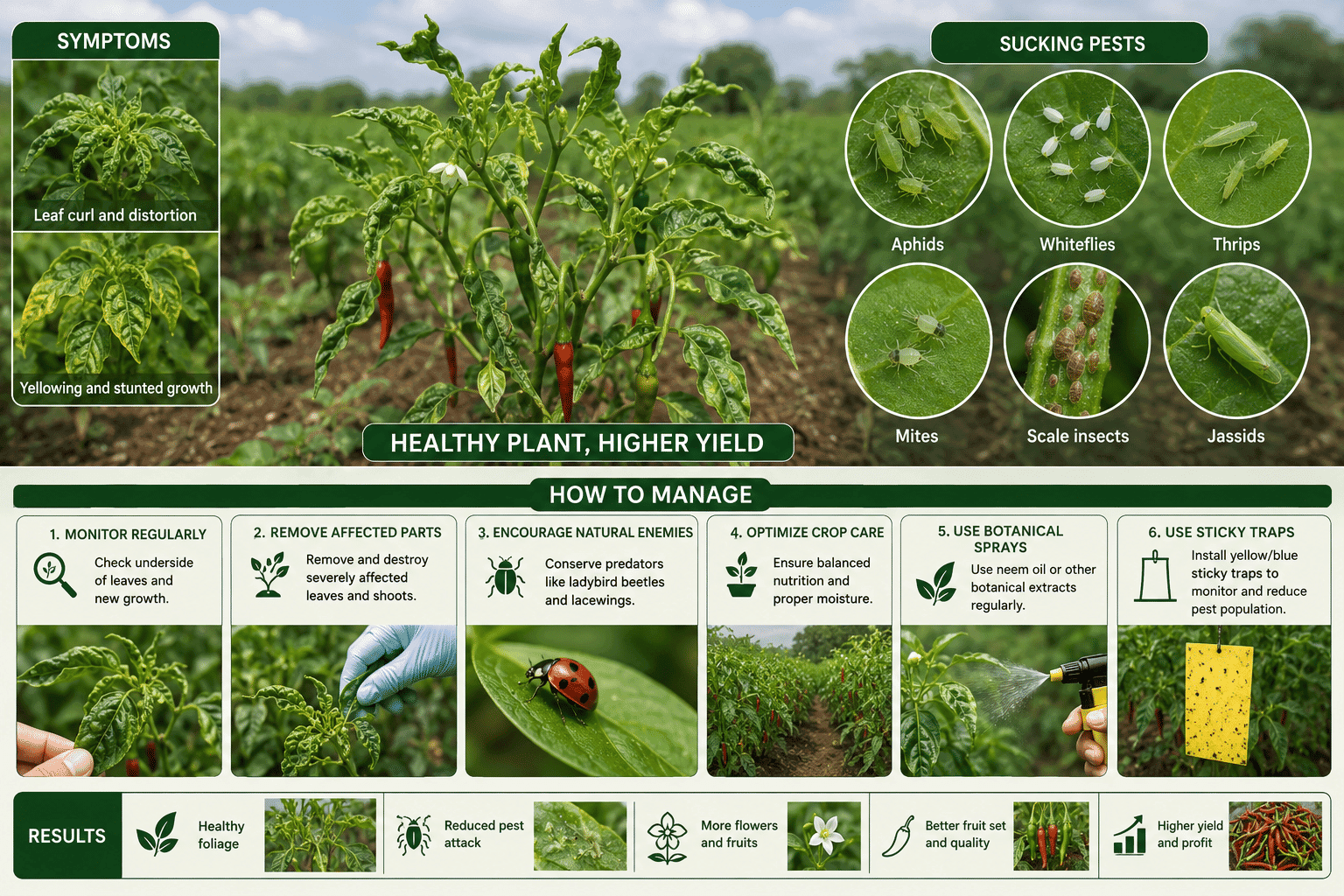
Leaf curl is one of the common problems in chilli during monsoon. Farmers usually notice curled leaves, small leaves, yellowing, stunted growth, flower drop, and poor fruit setting.
Leaf curl in chilli may happen due to two main reasons:
- Sucking pests such as thrips, mites, aphids, and whiteflies
- Viral diseases spread by sucking pests, especially whiteflies
Correct identification is important because virus-infected plants cannot be cured. But early removal of infected plants, control of sucking pests, clean cultivation, and need-based spray can reduce further spread.
What is Leaf Curl in Chilli?
Leaf curl means abnormal curling, twisting, crinkling, or bunching of chilli leaves. It is not one single disease. It is a symptom that may be caused by pests, virus, nutrient stress, herbicide injury, or weather stress.
In most chilli fields, leaf curl is commonly linked with sucking pests and viral infection.
Main causes of leaf curl
- Thrips feeding
- Mite feeding
- Aphid attack
- Whitefly attack
- Chilli leaf curl virus
- Mixed pest and virus infection
- Moisture stress
- Nutrient imbalance
- Wrong pesticide mixing
During monsoon, humid weather, tender new growth, and pest movement from nearby crops can increase the problem.
Major Sucking Pests in Chilli
1. Thrips
Thrips are very small insects that feed on tender leaves, buds, flowers, and young fruits.
Damage symptoms
- Leaves curl upward
- Leaf surface becomes crinkled
- Young leaves become narrow
- Buds become brittle
- Flower drop may increase
- Plant growth becomes stunted
- Fruit setting may reduce
2. Mites
Mites are very tiny pests and are difficult to see without close inspection. Yellow mite is an important pest in chilli.
Damage symptoms
- Leaves curl downward or become boat-shaped
- Young leaves become shiny, thick, or leathery
- Leaf size becomes small
- Growing tips become distorted
- Plants look stunted
- Flowering and fruiting may reduce
Mite damage is often confused with viral leaf curl. Close checking of the growing tips is needed.
3. Aphids
Aphids are small, soft-bodied insects that suck sap from tender plant parts.
Damage symptoms
- Leaf curling
- Yellowing of leaves
- Sticky honeydew on leaves
- Sooty mould growth on honeydew
- Weak plant growth
- Virus spread in some cases
Aphids are usually found in groups on tender shoots and underside of leaves.
4. Whiteflies
Whiteflies are small white flying insects usually seen on the underside of leaves. They are important because they can transmit chilli leaf curl virus.
Damage symptoms
- Yellowing of leaves
- Leaf curling
- Sticky honeydew
- Sooty mould
- Weak plant growth
- Virus spread
- Stunted plants with small leaves
Scientific literature describes chilli leaf curl disease as mainly caused by whitefly-transmitted begomoviruses, including chilli leaf curl virus.
Difference Between Pest Curl and Virus Curl
Correct diagnosis helps avoid wrong treatment.
|
Symptom |
Sucking Pest Damage |
Viral Leaf Curl |
|
Leaf curling |
May be upward or downward |
Severe curling, twisting, bunching |
|
Plant growth |
May recover after pest control if damage is mild |
Usually remains stunted |
|
New leaves |
May become normal after pest reduction |
New leaves often remain curled |
|
Pest presence |
Thrips, mites, aphids, or whiteflies visible on close checking |
Whiteflies may be present, but virus remains in plant |
|
Spread pattern |
May appear in patches or across tender growth |
Often starts in infected plants and spreads through vectors |
|
Cure possible |
Pest can be managed |
Infected plant cannot be cured |
If a plant is severely virus-infected, spraying will not make it normal again. The aim should be to stop further spread.
Why Leaf Curl and Sucking Pests Increase During Monsoon
Monsoon creates favourable conditions for tender crop growth and pest spread.
Risk increases when:
- Chilli crop has soft new growth
- Field has weeds and alternate hosts
- Nearby fields have infected chilli or vegetable crops
- Whiteflies and thrips are active
- Crop is dense and humid
- Drainage is poor
- Excess nitrogen is applied
- Farmers spray without proper pest identification
- Virus-infected plants are left in the field
Crop Stage Most at Risk
Chilli can suffer from leaf curl and sucking pests at different stages.
High-risk stages include:
- Nursery stage
- Early transplanting stage
- Vegetative growth stage
- Flowering stage
- Fruit-setting stage
Early infection is more harmful because plants remain stunted and fruiting is badly affected. Nursery and early field stage management are very important.
Symptoms to Check in the Field
On Leaves
- Upward curling
- Downward curling
- Crinkling
- Yellowing
- Small leaves
- Thickened leaves
- Shiny or leathery leaves
- Mosaic or mottling
- Bunchy top growth
On Shoots
- Stunted growing tips
- Short internodes
- Distorted new leaves
- Weak branch growth
On Flowers and Fruits
- Bud drying
- Flower drop
- Poor fruit setting
- Small or deformed fruits
- Reduced fruit quality
On Plants
- Uneven growth
- Stunted patches
- Yellow and curled plants
- Poor canopy development
Step-by-Step Management of Leaf Curl and Sucking Pests
1. Start Monitoring from Nursery Stage
Leaf curl management should start before transplanting. Inspect nursery plants regularly.
Check for:
- Whiteflies
- Thrips
- Aphids
- Mites
- Curled leaves
- Yellowing
- Stunted seedlings
- Virus-like symptoms
Do not transplant infected or badly curled seedlings. Removing infected seedlings early reduces field spread.
- Use Healthy Seedlings for Transplanting
Use only healthy and pest-free seedlings. Transplanting infected seedlings can bring the problem into the main field.
Avoid seedlings showing:
- Severe leaf curl
- Yellow mosaic
- Bunchy top
- Stunted growth
- Heavy pest infestation
- Deformed new leaves
Healthy seedlings are the first step in chilli leaf curl management.
3. Remove Severely Virus-Infected Plants Early
Virus-infected plants do not recover completely. If only a few plants show severe leaf curl and stunting, remove them early and destroy them away from the field.
Remove plants showing:
- Severe curling
- Small and bunchy leaves
- Strong yellowing or mosaic
- Stunted growth
- No normal new growth
- Heavy whitefly presence
Do not leave removed plants on field bunds. They can act as a source of infection.
4. Control Weeds and Alternate Hosts
Many sucking pests survive on weeds and nearby host plants. During monsoon, weeds grow fast and support pest multiplication.
Recommended actions:
- Remove weeds from field bunds
- Keep nursery area clean
- Avoid weed growth near irrigation channels
- Remove volunteer chilli or solanaceous plants
- Keep field borders clean
Field sanitation reduces pest hiding places and virus sources.
5. Use Yellow Sticky Traps
Yellow sticky traps help monitor and reduce flying sucking pests such as whiteflies and aphids.
Use them as per local agriculture department or KVK guidance. Place traps slightly above crop canopy and check them regularly.
Sticky traps are useful for monitoring but should not be treated as complete control.
6. Use Blue Sticky Traps for Thrips Monitoring
Blue sticky traps are commonly used for thrips monitoring. They help detect early thrips activity in the field.
Trap observations should be combined with leaf and flower inspection. Do not depend only on traps for decision-making.
7. Avoid Excess Nitrogen
Excess nitrogen creates soft and lush growth. This can attract sucking pests and increase pest pressure.
Follow balanced fertilizer application as per soil test or local recommendation.
Avoid:
- Heavy urea application at one time
- Extra nitrogen during pest attack
- Fertilizer use without crop stage planning
- Ignoring potassium and micronutrients
Balanced nutrition helps improve crop strength.
8. Maintain Proper Spacing and Air Movement
Dense chilli crop creates humid conditions and makes pest monitoring difficult.
Follow recommended spacing for your region and variety. Proper spacing improves air movement, sunlight entry, and spray coverage.
This is especially important during monsoon when humidity remains high.
9. Improve Drainage During Monsoon
Waterlogging weakens chilli roots and increases crop stress. Stressed plants are more affected by pests and diseases.
After heavy rain:
- Remove standing water
- Open furrows between rows
- Keep drains clean
- Avoid working in very wet soil
- Check root health in affected patches
Good drainage supports plant recovery and reduces stress-related leaf curling.
10. Protect Natural Enemies
Chilli fields may have natural enemies such as ladybird beetles, lacewings, spiders, predatory bugs, and parasitoids.
Avoid unnecessary broad-spectrum insecticide sprays. These sprays may kill beneficial insects and lead to pest resurgence.
Use need-based control only after field scouting.
Need-Based Spray Management
Chemical spray should be used only after identifying the pest and checking infestation level. Use only recommended and registered insecticides or miticides as advised by the local agriculture department, KVK, or state agriculture university.
Important points
- Use insecticide for insects such as thrips, aphids, and whiteflies
- Use miticide or locally recommended acaricide for mites, if needed
- Do not use the same chemical group repeatedly
- Do not mix many products without advice
- Follow label dose and water volume
- Spray during morning or evening
- Avoid spraying before rain
- Cover the underside of leaves properly
- Follow waiting period before harvest
Spraying cannot cure virus-infected plants. It can only reduce vector population and protect healthy plants.
Correct Spray Technique for Sucking Pests
Sucking pests usually stay on tender shoots, young leaves, flowers, and underside of leaves. Poor coverage gives poor control.
Follow these steps:
- Use a clean sprayer
- Use clean water
- Spray fine mist
- Cover underside of leaves
- Focus on growing tips
- Avoid spray runoff
- Avoid hot afternoon spraying
- Do not spray during strong wind
- Do not spray just before rainfall
For chilli, proper coverage is more important than simply increasing dose.
Pest-Specific Field Action Plan
|
Pest or Problem |
Main Symptom |
Field Action |
|
Thrips |
Upward leaf curling, crinkling, flower drop |
Monitor tender leaves and flowers; use blue sticky traps; take need-based control |
|
Mites |
Downward curling, shiny small leaves, distorted tips |
Inspect growing tips closely; use recommended mite control if needed |
|
Aphids |
Leaf curling, sticky honeydew, colonies on shoots |
Monitor underside of leaves; conserve natural enemies; use need-based control |
|
Whiteflies |
Yellowing, honeydew, virus spread |
Use yellow traps, remove infected plants, manage vectors early |
|
Viral leaf curl |
Severe curling, bunchy top, stunting |
Remove infected plants early; control whitefly and other vectors |
|
Water stress |
Curling with wilting |
Correct irrigation or drainage first |
What to Do When Leaf Curl is First Seen
Use this immediate action plan:
- Check whether pests are present on leaves and shoots
- Inspect underside of leaves for whiteflies and aphids
- Check tender leaves and flowers for thrips
- Check growing tips for mites
- Identify whether the plant shows virus-like stunting
- Remove severely infected plants if only a few are affected
- Install or check sticky traps
- Stop unnecessary nitrogen application
- Improve drainage if the field is wet
- Take local advisory for need-based spray
This step-by-step approach reduces wrong pesticide use.
Management During Monsoon
Monsoon management should focus on drainage, regular scouting, and pest prevention.
Important field practices
- Scout the crop twice a week
- Check tender growth after rainfall
- Keep field bunds weed-free
- Maintain good drainage
- Avoid excess nitrogen
- Remove virus-infected plants early
- Use sticky traps for monitoring
- Avoid spraying just before rain
- Protect natural enemies
- Follow local pest advisories
During continuous cloudy weather, pest and disease monitoring should be increased.
Common Mistakes to Avoid
- Treating all leaf curl as virus
- Treating all leaf curl as pest damage
- Spraying without checking the underside of leaves
- Ignoring mites because they are too small to see easily
- Leaving virus-infected plants in the field
- Applying excess urea
- Mixing many pesticides together
- Using the same insecticide repeatedly
- Spraying during hot afternoon
- Spraying just before rainfall
- Ignoring nursery-stage infection
- Depending only on chemical control
Correct identification is the most important step.
Can Chilli Recover from Leaf Curl?
Recovery depends on the cause.
Crop may recover if:
- Curling is due to mild pest feeding
- Pest is controlled early
- New leaves start growing normally
- Root health is good
- Nutrient and water stress are corrected
Recovery is poor if:
- Plant is infected with leaf curl virus
- Plant is severely stunted
- New leaves remain small and curled
- Infection started at nursery or early stage
- Large number of plants are infected
Virus-infected plants usually do not become fully normal. Remove early infected plants to protect the rest of the crop.
Preventive Steps for Next Chilli Crop
Prevention is better than late control.
Recommended practices
- Use healthy seedlings
- Keep nursery insect-proof where possible
- Remove infected seedlings before transplanting
- Keep nursery and field weed-free
- Follow crop rotation
- Avoid planting near old infected chilli fields
- Use yellow and blue sticky traps
- Maintain proper spacing
- Avoid excess nitrogen
- Ensure good drainage
- Monitor sucking pests from early stage
- Remove severely infected plants early
- Follow need-based pesticide use
Chilli leaf curl management needs regular monitoring from nursery to fruiting stage.
Safety Precautions During Spray
- Wear gloves, mask, full-sleeve shirt, and long pants
- Do not eat, drink, or smoke during spraying
- Avoid spray drift to nearby crops and water bodies
- Keep children and animals away from sprayed fields
- Wash hands, face, and equipment after spraying
- Follow label waiting period before harvesting chillies
- Store pesticides away from food, seed, and animal feed
- Do not use unlabelled or locally mixed chemicals
Safe spraying protects both farmer and crop.
Conclusion
Leaf curl in chilli during monsoon can be caused by sucking pests, virus infection, or crop stress. The first step is correct identification. Thrips, mites, aphids, and whiteflies should be checked on tender leaves, shoots, flowers, and the underside of leaves.
Effective management includes healthy seedlings, early removal of virus-infected plants, weed control, sticky traps, balanced fertilizer, proper spacing, drainage, protection of natural enemies, and need-based spray.