

Introduction
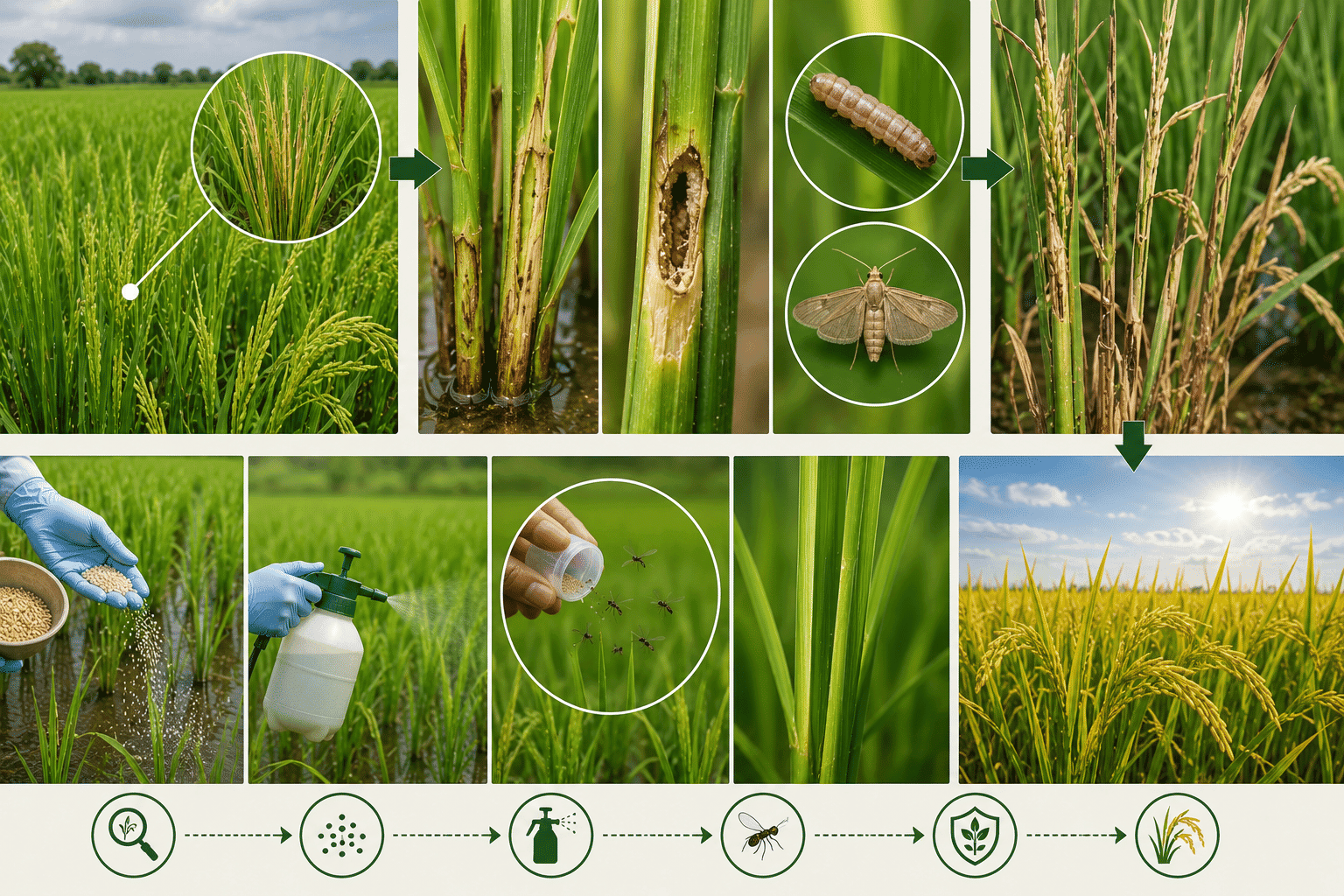
Stem borer is one of the important pests of paddy. It damages the crop by entering inside the stem and feeding on the inner tissue. Because the larva remains hidden inside the plant, damage is often noticed only after symptoms appear.
The two common field symptoms are dead heart during the vegetative stage and white earhead during the reproductive stage.
Effective management depends on early scouting, correct identification, egg mass removal, balanced nitrogen use, field sanitation, light or pheromone trap monitoring where advised, and need-based insecticide application.
What is Paddy Stem Borer?
Paddy stem borer is a caterpillar pest. The adult moth lays eggs on rice leaves. After hatching, the larvae enter the stem and feed inside.
Once the larva enters the stem, contact spray may not reach it properly. This is why early detection is important.
The most common stem borer in many rice-growing areas is yellow stem borer, but other stem borer species may also occur depending on region.
Why Stem Borer Damage is Serious
Stem borer directly damages the tiller or panicle-bearing stem.
At vegetative stage, the central shoot dries and becomes dead heart. At panicle stage, the panicle becomes white, empty, or poorly filled. IRRI notes that stem borer damage is seen as deadhearts in vegetative stages and whiteheads in reproductive stages, and stems can be pulled and dissected to confirm larvae or pupae.
This pest is serious because:
- Larvae feed inside the stem
- Early damage reduces healthy tillers
- Late damage causes white earheads
- Affected panicles may not fill grains
- Damage may look similar to other problems
- Late-stage control becomes difficult
Visual Symptoms of Stem Borer in Paddy
1. Egg Mass Near Leaf Tip
Stem borer egg masses are often seen near the tip of leaves. They may appear as flat, oval, creamy-white egg masses covered with buff-coloured hairs.
TNAU mentions brown-coloured egg masses near the leaf tip as an important sign of yellow stem borer activity.
How to check:
Look at the upper leaves, especially near the tip. Check both field borders and inner crop areas.
2. Dead Heart at Vegetative Stage
Dead heart is the drying of the central shoot during the vegetative or tillering stage.
Field signs
- Central shoot turns yellow or brown
- Middle leaf dries first
- Outer leaves may remain green
- Affected tiller can be pulled easily
- Inside stem may show feeding damage
- Larva or frass may be found inside
This symptom usually appears when the larva cuts the growing point inside the stem.
3. Small Holes on Stem or Tiller
Larvae enter the stem through small holes. These holes may be difficult to see from a distance.
Field signs
- Tiny entry holes on stem or tiller
- Drying of central shoot
- Frass or waste material near damaged area
- Internal tunnelling when stem is split
IRRI lists tiny holes on stems and tillers, and frass inside damaged stems, as stem borer damage symptoms.
4. White Earhead at Reproductive Stage
White earhead appears when stem borer attacks at panicle initiation, booting, or heading stage.
Field signs
- Panicle turns whitish
- Earhead remains empty or poorly filled
- Panicle dries while nearby leaves may remain green
- Affected panicle can be pulled easily
- Grains may become chaffy
This damage is more serious because it directly affects grain formation.
5. Easy Pulling of Affected Shoot or Panicle
Both dead heart and white earhead can often be pulled easily by hand. This is a simple field test.
Pull test
- Hold the dried central shoot or white panicle
- Pull gently upward
- If it comes out easily, split the stem
- Check for larva, pupa, frass, or internal feeding
This helps separate stem borer damage from nutrient deficiency or normal drying.
Difference Between Stem Borer and Similar Problems
Dead heart and white earhead can be confused with other issues. Correct diagnosis is important before taking control action.
|
Symptom Seen |
Possible Cause |
How to Confirm |
|
Central shoot dries |
Stem borer |
Pull central shoot and check larva or feeding inside |
|
Panicle turns white |
Stem borer or neck blast |
Pull panicle and inspect stem; check neck infection |
|
Plant cut near base |
Rodent damage |
Look for cut tillers and rat burrows |
|
Whole patch yellowing |
Nutrient or water issue |
Check roots, soil moisture, and uniformity |
|
Panicle empty |
Stem borer, neck blast, poor pollination |
Check panicle neck, stem, and grains |
Crop Stage Most at Risk
Stem borer can damage paddy at different crop stages.
High-risk stages include:
- Nursery stage
- Tillering stage
- Active vegetative stage
- Panicle initiation stage
- Booting stage
- Heading stage
The symptom changes with crop stage.
|
Crop Stage |
Main Symptom |
|
Nursery and early tillering |
Dead seedlings or damaged shoots |
|
Tillering stage |
Dead heart |
|
Panicle initiation to booting |
Hidden stem damage |
|
Heading stage |
White earhead |
|
Grain filling stage |
Chaffy grains and poor panicle filling |
Regular scouting from tillering onwards is important.
Step-by-Step Field Scouting Method
1. Walk in a Zig-Zag Pattern
Do not check only the field border. Walk across the field in a zig-zag pattern and observe different patches.
Check:
- Low-lying areas
- Dense crop patches
- Field borders
- Areas near light sources
- Previous pest-prone patches
2. Check 5–10 Spots in the Field
Select plants from different areas. Look for egg masses, dead hearts, white earheads, and moth activity.
At each spot, observe a few hills carefully.
3. Pull and Split Affected Tillers
If dead heart or white earhead is seen, pull the affected shoot gently.
Then split the stem and check for:
- Larva
- Pupa
- Feeding tunnel
- Frass
- Hollow stem
- Cut growing point
This confirms whether the damage is due to stem borer.
4. Check Egg Masses
Look for egg masses on leaves. Early removal helps reduce the next larval population.
Focus on:
- Leaf tips
- Upper leaves
- Border plants
- Dense patches
5. Record Damage Level
Count affected tillers or white earheads in different spots. This helps decide whether control is needed.
Do not spray only after seeing one or two old damaged shoots. Check for active pest signs and fresh symptoms.
Step-by-Step Management of Stem Borer in Paddy
1. Use Healthy Seedlings and Avoid Infested Nursery
Do not transplant seedlings from a nursery with heavy stem borer damage.
If egg masses or damaged seedlings are present in the nursery, remove affected plants and take local expert advice before transplanting.
Healthy seedlings reduce early pest carryover into the main field.
2. Clip Seedling Leaf Tips Before Transplanting
In some traditional transplanted paddy systems, clipping the top portion of seedling leaves before transplanting can help remove egg masses present near leaf tips.
This practice should be done carefully and only where locally recommended. Avoid excessive clipping, as it can stress seedlings.
3. Remove and Destroy Egg Masses
Egg mass removal is useful when infestation is still low.
Recommended action:
- Check leaves during field scouting
- Remove egg masses by hand where possible
- Destroy them away from the field
- Do not drop egg masses into standing water near the crop
This reduces larvae before they enter the stem.
4. Maintain Balanced Fertilizer Use
Excess nitrogen can increase soft growth and make the crop more favourable for pests. Apply nitrogen in split doses as per local recommendation.
Avoid:
- Heavy urea application at one time
- Extra nitrogen after pest damage
- Fertilizer application without checking crop stage
- Ignoring potassium and other nutrients
Balanced nutrition helps the crop tolerate stress better.
5. Maintain Proper Spacing
Dense planting increases humidity and makes scouting difficult. It also reduces spray coverage if treatment is needed.
Follow spacing recommended for your rice-growing method and variety.
Proper spacing helps:
- Improve air movement
- Reduce pest hiding areas
- Make scouting easier
- Improve spray reach
- Support healthy tillering
6. Manage Water Properly
Water management should support healthy crop growth. Avoid severe water stress, especially during sensitive stages.
In stem borer-prone fields, follow local irrigation guidance. Do not keep the field unmanaged with excessive weeds and stagnant water.
Water level practices may vary by region, soil, and rice system.
7. Use Light Traps or Pheromone Traps Where Recommended
Light traps and pheromone traps can help monitor adult moth activity. They are useful as warning tools, not as complete control by themselves.
Use traps as per local agriculture department, KVK, or state agriculture university guidance.
Trap observations should be combined with field scouting and egg mass checks.
8. Conserve Natural Enemies
Rice fields have many useful natural enemies, such as spiders, dragonflies, parasitoids, and predatory insects.
Avoid unnecessary insecticide spray. Repeated broad-spectrum sprays can kill natural enemies and may increase pest problems later.
Use chemical control only when scouting shows active infestation and local advisory recommends action.
9. Use Need-Based Insecticide Application
Use insecticide only when stem borer damage is active and reaches the local economic threshold level.
Use only recommended and registered insecticide molecules for paddy stem borer as advised by the local agriculture department, KVK, or state agriculture university.
Follow:
- Product label dose
- Recommended water volume
- Correct application method
- Waiting period
- Safety precautions
- Local threshold-based advisory
Avoid:
- Spraying without confirmation
- Using unlabelled products
- Mixing many chemicals
- Increasing dose on your own
- Spraying before rainfall
- Repeating the same molecule continuously
Since larvae remain inside the stem, late spray may not give expected results. Timely action is important.
10. Remove Stubbles After Harvest
Stem borer larvae or pupae can survive in rice stubbles and crop residues. Post-harvest sanitation helps reduce next season’s pest pressure.
Recommended steps:
- Harvest close to ground where locally suitable
- Remove or destroy infested stubbles
- Plough after harvest where possible
- Avoid leaving ratoon rice in pest-prone fields
- Manage volunteer rice plants
- Clean bunds and field borders
Plantix guidance also mentions harvesting at ground level, removing stubbles and plant debris, and ploughing or flooding after harvest to reduce remaining larvae.
Visual Field Guide: What to Look For
|
What You See |
Crop Stage |
Likely Meaning |
Action |
|
Egg mass near leaf tip |
Nursery to tillering |
Moth activity present |
Remove and destroy egg masses |
|
Central shoot drying |
Tillering |
Dead heart due to stem borer |
Pull and split stem to confirm |
|
Tiny hole on tiller |
Vegetative stage |
Larval entry point |
Check nearby tillers |
|
Frass inside stem |
Any stage |
Internal feeding |
Confirm active damage |
|
White empty panicle |
Heading stage |
White earhead |
Pull and inspect stem |
|
Affected shoot pulls easily |
Any stage |
Stem internal damage |
Split stem and check larva |
|
Large patch affected |
Any stage |
Active pest spread possible |
Take local expert advice |
What to Do When First Damage is Seen
Use this immediate action plan:
- Mark the affected patch
- Pull and split affected tillers
- Confirm larva or internal feeding
- Check for egg masses on nearby plants
- Remove egg masses where possible
- Check if damage is increasing
- Avoid unnecessary nitrogen application
- Take local advisory for threshold-based control
- Monitor again after 3–5 days
Early confirmation prevents wrong treatment.
Management During Kharif and Humid Weather
During Kharif, paddy fields may have high humidity, cloudy weather, and continuous crop growth. These conditions can support pest activity in many areas.
Follow these steps:
- Scout regularly from tillering stage
- Check egg masses near leaf tips
- Monitor dead hearts after transplanting
- Watch white earheads near heading stage
- Avoid excess nitrogen
- Keep bunds clean
- Avoid unnecessary sprays
- Follow local pest alerts
Stem borer management should be planned before the crop reaches heading stage. White earhead damage cannot be reversed.
Common Mistakes to Avoid
- Ignoring egg masses in the early stage
- Checking only leaves and not stems
- Confusing white earhead with neck blast
- Spraying without confirming active infestation
- Applying extra urea after pest damage
- Using high pesticide dose
- Mixing multiple insecticides without advice
- Leaving stubbles after harvest
- Not monitoring during panicle initiation and heading
- Waiting until white earheads are widespread
Early scouting is more useful than late spraying.
Can Paddy Recover After Stem Borer Damage?
Recovery depends on crop stage.
At vegetative stage, the crop may produce new tillers if damage is low and the crop is healthy. However, the affected dead heart tiller does not recover.
At reproductive stage, white earheads do not recover because the panicle is already damaged. The aim should be to protect remaining healthy tillers and panicles.
Recovery depends on:
- Crop stage
- Number of affected tillers
- Pest activity level
- Crop vigour
- Nutrition status
- Water management
- Timely control action
Preventive Steps for Next Paddy Crop
Stem borer prevention should begin before transplanting and continue after harvest.
Recommended preventive practices
- Use healthy seedlings
- Avoid infested nursery seedlings
- Remove egg masses where possible
- Follow recommended spacing
- Apply nitrogen in balanced split doses
- Keep bunds and field borders clean
- Monitor moth activity with traps where recommended
- Protect natural enemies
- Use need-based insecticide only
- Remove stubbles and crop residues after harvest
- Avoid ratoon rice in heavily infested areas
These steps reduce pest carryover and support better crop health.
Safety Precautions During Insecticide Use
- Wear gloves, mask, full-sleeve shirt, and long pants
- Do not eat, drink, or smoke during spraying
- Avoid spray drift to fish ponds and water bodies
- Keep children and animals away from treated fields
- Wash hands, face, and equipment after spraying
- Follow label waiting period before harvest
- Store pesticides away from food, seed, and animal feed
Safe application protects the farmer, crop, and environment.
Conclusion
Stem borer in paddy should be identified early through egg mass checking, dead heart observation, and stem splitting. The main visible symptoms are dead heart during vegetative growth and white earhead during the reproductive stage.
Effective management includes healthy seedlings, egg mass removal, balanced nitrogen, proper spacing, field sanitation, trap-based monitoring where advised, and need-based insecticide application. Late-stage white earhead damage cannot be reversed, so early scouting is the most important step.