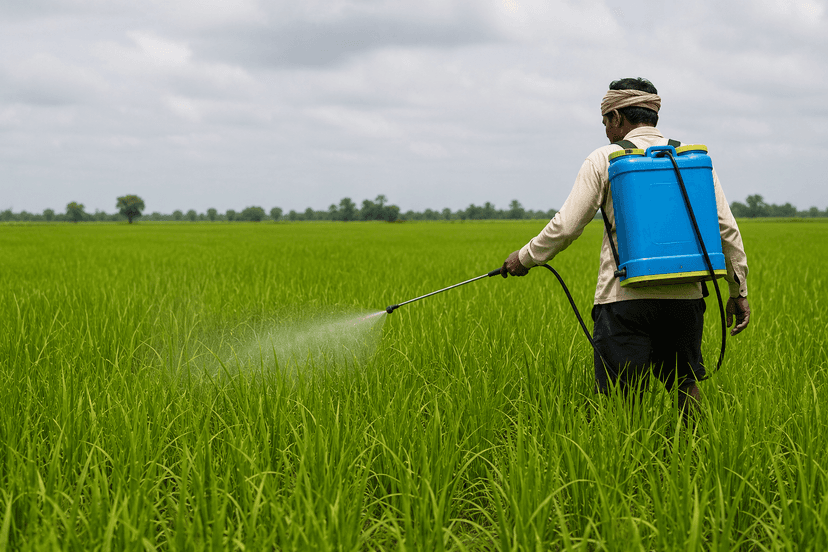
Weeds reduce crop growth by competing for sunlight, nutrients, water and space. For small and medium farmers, the challenge is to control weeds without overspending on crop protection. This guide compares practical herbicides under ₹500 from the provided product list and explains where each option fits in Indian farming conditions.
A budget herbicide helps only when it matches the crop, weed type and weed stage. Always read the label, use the recommended dose and consult a local agriculture expert before spraying.
1. Bayer Roundup Herbicide - Glyphosate 41% SL
Roundup is a non-selective systemic herbicide. It is useful where the aim is to control emerged weeds before crop establishment, in non-crop areas, along bunds, borders and plantation situations where the label permits.
Because it is non-selective, it can damage almost any green crop tissue. Do not spray it over standing crops unless the label specifically allows directed use. In paddy, use only as a pre-plant knockdown where permitted and keep sufficient gap before transplanting or sowing as mentioned on the label.
- Best for: emerged annual and perennial weeds in non-crop/pre-plant situations.
- Avoid: windy conditions, drift to nearby vegetables, pulses, cotton, sugarcane or orchards.
- Water and timing: spray on actively growing weeds with clean water and adequate coverage.
2. Sumitomo Glycel Herbicide - Glyphosate 41% SL
Glycel also contains glyphosate 41% SL and works systemically through the leaves. It is a budget option for broad-spectrum weed control in non-crop areas, field bunds, channels and pre-plant situations where local rules and product label allow.
Do not treat glyphosate products as general in-crop herbicides. If the crop is already established, a directed spray shield or other drift-control method is needed whenever the label permits such use.
- Best for: mixed grasses, broadleaf weeds and sedges before crop planting or in non-crop areas.
- Field note: do not spray on dust-covered, drought-stressed or waterlogged weeds for best results.
- Regulatory note: check state restrictions before purchase and use.
3. Sempra Herbicide - Halosulfuron Methyl 75% WG
Sempra is a selective post-emergence herbicide mainly used for Cyperus rotundus and related sedges in crops such as sugarcane and maize where the label recommends it. It is not a general grass or broadleaf herbicide.
Correct weed identification is important. If the field has mostly Echinochloa, Digitaria or other grasses, Sempra will not be the right first choice. Use it when Cyperus/nutsedge is the main problem and weeds are in the recommended early stage.
- Best for: Cyperus/nutsedge in sugarcane and maize.
- Timing: commonly used at the 3-5 leaf stage of the target sedge as per label.
- Dose caution: product labels may mention dose per acre; adjust only through approved guidance and never by guesswork.
4. Excel Mera 71 Herbicide - Glyphosate 71% SG
Excel Mera 71 is a glyphosate ammonium salt formulation. It is a systemic, non-selective post-emergence herbicide for tea and non-crop situations as per label. It is generally applied when weeds are actively growing and about 6-8 inches tall.
Since the formulation is stronger than 41% SL glyphosate products, do not compare pack size directly with liquid glyphosate. Measure by the label dose, not by visual volume or by habit.
- Best for: hard-to-control annual and perennial weeds in tea and non-crop areas.
- Spray note: use clean water and uniform foliar coverage; avoid run-off.
- Do not use: on crop foliage or green bark of young plants.
5. Sweep Power Herbicide - Glufosinate Ammonium 13.5% SL
Sweep Power is a non-selective post-emergence herbicide with contact action. It is suitable for directed weed control in specific situations such as tea and cotton where the label recommends it.
Compared with systemic glyphosate, glufosinate is more dependent on good spray coverage. It controls the sprayed green parts, so poor coverage can lead to patchy control.
- Best for: directed contact control of emerged weeds.
- Spray note: cover weed foliage uniformly and avoid drift to the crop.
- Rain and water: avoid spraying just before rain or when leaves are wet.
6. Nominee Gold Herbicide - Bispyribac Sodium 10% SC
Nominee Gold is a selective systemic post-emergence herbicide for rice. It is used in rice nursery, transplanted rice and direct-seeded rice to manage grasses, sedges and some broadleaf weeds when used at the right stage.
Rice herbicide performance depends strongly on water management. Weeds should be exposed to the spray; do not spray when weeds are submerged. After application, follow the label guidance for re-flooding and water retention.
- Best for: mixed rice weeds in early post-emergence stage.
- Timing: commonly suited to 2-5 leaf weed stage as per label guidance.
- Do not mix: avoid unapproved tank mixes, especially with products warned against on the label.
7. Targa Super Herbicide - Quizalofop-ethyl 5% EC
Targa Super is a selective systemic herbicide for narrow-leaf grassy weeds in broadleaf crops such as soybean, cotton, groundnut, black gram and onion where recommended. It is not meant for paddy, wheat, maize, sorghum, barley, bajra or sugarcane unless the current label specifically allows it.
Use it when grassy weeds are young and actively growing. It is not the right choice for broadleaf weeds or sedges, so mixed weed fields may need an integrated plan.
- Best for: Echinochloa, Digitaria, Dactyloctenium and similar grasses in labelled broadleaf crops.
- Common label range: 300-400 ml per acre in several broadleaf crops; confirm the crop-specific dose.
- Crop safety: never use grass herbicides casually in cereal crops.
8. Dhanuka Ozone Herbicide - Paraquat Dichloride 24% SL
Ozone is a non-selective contact herbicide based on paraquat dichloride. It acts quickly on green weed foliage and is used as a directed or pre-plant application in labelled situations.
Paraquat products require strict safety discipline. Avoid skin contact, inhalation and drift. Use full protective clothing, gloves, mask and eye protection. Store only in the original container and keep away from children, livestock, food and fodder.
- Best for: fast burn-down of emerged weeds where directed application is suitable.
- Avoid: spraying on crop leaves, windy weather and careless mixing.
- Safety: follow label instructions exactly; consult a local expert before use.
9. Tata Metri Herbicide - Metribuzin 70% WP
Tata Metri contains metribuzin 70% WP. Metribuzin is used in selected crops such as potato, tomato, soybean, wheat and sugarcane where the label recommends it. It can act through roots and leaves, so both soil and crop stage matter.
Metribuzin can injure sensitive crops or varieties if used at the wrong dose, in light sandy soils, on stressed crops or under unsuitable moisture conditions. Do not apply by copying another farmer’s dose.
- Best for: grasses and broadleaf weeds in labelled crops.
- Soil note: check soil texture, organic matter and crop variety before use.
- Timing: can be pre-emergence or post-emergence depending on crop label.
10. Dhanuka Barrier Herbicide - Metribuzin 70% WP
Dhanuka Barrier is another metribuzin 70% WP option under ₹500 in the list. It is used in labelled crops such as sugarcane, potato, tomato, soybean and wheat for grasses and broadleaf weeds.
Choose between Tata Metri and Barrier based on local availability, label recommendation, advisor guidance and farmer experience in the same crop and soil type. Do not double-spray metribuzin products just because two brands are available.
- Best for: labelled crop situations needing metribuzin-based weed control.
- Crop note: avoid use on weak, waterlogged, drought-stressed or nutrient-deficient crops.
- Resistance note: rotate herbicide modes of action and integrate cultural weed control.
Crop Stage, Soil, Water and Weather Considerations
Crop stage
Pre-plant herbicides are applied before sowing or transplanting. Post-emergence products are applied after weeds emerge. Selective post-emergence herbicides like Nominee Gold, Sempra and Targa Super must be matched with the crop and weed stage.
Soil condition
Soil-applied or partly soil-active herbicides such as metribuzin need proper soil moisture and correct soil type. Sandy soils, low organic matter and stressed crops can increase crop injury risk.
Water management
In rice, water depth before and after spraying affects weed exposure and herbicide performance. Do not spray submerged weeds with post-emergence foliar herbicides.
Weather
Avoid spraying during strong wind, high heat, imminent rain or when weeds are under drought stress. Morning or late afternoon spraying is usually safer than hot midday application.
Nutrient and pest stress
Herbicides work best when the crop is healthy. Correct major nutrient deficiencies, drainage problems, pest attack and disease stress before making a herbicide decision whenever possible.
Safe Herbicide Spraying Checklist for Farmers
- Buy only sealed products from licensed dealers. Check batch number, registration number, manufacturing date and expiry date.
- Read the label and leaflet before mixing. Use the recommended dose, water volume, nozzle and crop stage.
- Wear gloves, long sleeves, full trousers, mask, cap and eye protection while mixing and spraying.
- Use clean water. Do not mix herbicides with insecticides, fungicides, fertilisers or micronutrients unless the label clearly permits it.
- Keep separate sprayers for herbicides where possible. Wash sprayers thoroughly after use to prevent crop injury in the next spray.
- Do not spray near fish ponds, drinking water sources, fodder, kitchen gardens or neighbouring crops without drift protection.
- Store herbicides in original containers, away from children, livestock, food and seed. Never transfer chemicals to drink bottles.
Conclusion
The best herbicides under ₹500 can help Indian farmers manage weeds economically, but only when selected correctly. For non-crop and pre-plant weed control, glyphosate or contact non-selective options may fit. For rice, Nominee Gold is a crop-specific post-emergence option. For Cyperus, Sempra is more targeted. For grassy weeds in broadleaf crops, Targa Super is relevant. For selected crops where soil and crop stage allow, metribuzin products such as Tata Metri and Dhanuka Barrier can be useful.
Before spraying, always confirm crop registration, local restrictions, dose, water volume, waiting period and safety precautions from the product label or a trusted local expert. Correct herbicide use protects crop yield, farmer safety and long-term soil productivity.
Discalimer note: Recheck latest product label, state restrictions and current price before publishing or recommending purchase.