

Introduction
Banana is one of the most important fruit crops grown by farmers because of its high demand, regular income, and year-round cultivation. Healthy banana plants are essential for good bunch development and better yield. However, Panama wilt is one of the most serious diseases affecting banana cultivation worldwide. If the disease is not identified and managed at the right time, it can spread quickly in the field and cause heavy crop loss.
Panama wilt mainly affects the plant’s water-conducting system, making it difficult for the plant to absorb and transport water and nutrients. As the disease progresses, plants become weak, leaves dry, and finally the entire plant may collapse. Since the disease spreads through soil and infected planting material, farmers should follow proper preventive and management practices from the beginning.
What is Banana Panama Wilt?
Panama wilt, also known as Fusarium wilt of banana, is a soil-borne fungal disease caused by Fusarium oxysporum f. sp. cubense. The fungus enters the banana plant through roots and blocks the vascular tissues responsible for water and nutrient movement.
Once the fungus enters the field, it can survive in the soil for many years, making management difficult. The disease affects banana plants at different growth stages, but symptoms are usually more severe during active growth and bunch development stages.
Symptoms of Panama Wilt in Banana
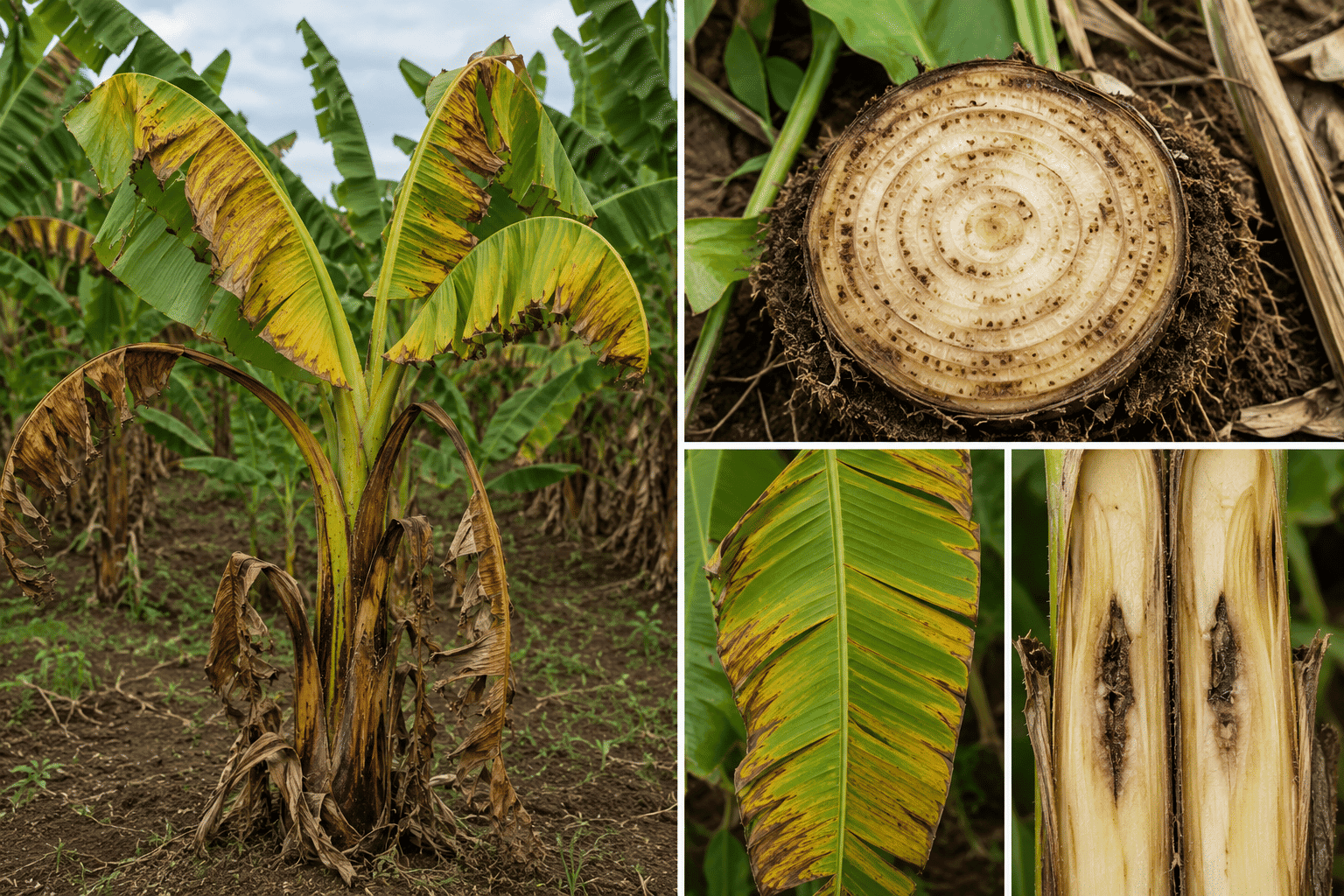
Early identification of symptoms is very important to prevent further spread of the disease. Farmers should regularly inspect banana fields for the following symptoms:
- Yellowing of older leaves starting from leaf margins
- Wilting and drooping of leaves
- Drying of leaves from lower to upper canopy
- Splitting of the pseudostem near the base
- Weak and stunted plant growth
- Reduced bunch size and poor fruit development
- Premature drying of plants
- Internal discoloration of vascular tissues when the pseudostem is cut
- Brown or dark streaks inside the stem and rhizome
- Complete collapse of severely infected plants
In many cases, infected leaves remain hanging around the pseudostem before drying completely. Internal stem discoloration is one of the important signs used to confirm Panama wilt infection.
How Panama Wilt Spreads in Banana Fields
Panama wilt spreads mainly through infected soil, water, planting material, and farm tools. Once the fungus enters the field, it becomes difficult to eliminate completely.
Major sources of spread include:
- Infected suckers used for planting
- Movement of contaminated soil from one field to another
- Irrigation water carrying fungal spores
- Farm tools and machinery contaminated with infected soil
- Flood water movement between fields
- Continuous banana cultivation in the same field
The fungus survives in soil and crop residues for several years even without banana plants. Therefore, preventive measures are extremely important.
Damage Caused by Panama Wilt
Panama wilt damages the banana crop by blocking water and nutrient movement inside the plant. As a result, the plant becomes weak and gradually dries.
Major losses caused by the disease include:
- Poor plant growth and reduced vigor
- Smaller bunch size
- Poor fruit filling and low fruit quality
- Premature plant death
- Reduced marketable yield
- Heavy economic loss in severely affected fields
In severe cases, large patches of banana plants in the field may dry completely, making the field unsuitable for future banana cultivation if proper management is not followed.
Favorable Conditions for Disease Development
Panama wilt develops rapidly under certain field and environmental conditions. Farmers should be more careful during:
- Warm and humid weather
- Poorly drained soils
- Continuous banana cultivation
- Waterlogging conditions
- Use of infected planting material
- Soil with poor organic matter
- Unbalanced fertilizer application
- Root injuries caused during intercultural operations
Waterlogged conditions weaken the root system and increase disease severity. Continuous monocropping also increases fungal buildup in soil.
Monitoring and Field Inspection
Regular field monitoring helps in early detection and management of Panama wilt. Farmers should inspect the field frequently, especially during vegetative and bunch development stages.
During field inspection:
- Observe yellowing and wilting of lower leaves
- Check for splitting near the base of pseudostem
- Identify weak or stunted plants
- Cut the pseudostem and rhizome to check for internal brown discoloration
- Remove and isolate suspicious plants immediately
Early removal of infected plants helps reduce further spread in the field.
Best Crop Management Practices for Panama Wilt
Integrated disease management is the best approach for controlling Panama wilt in banana. Farmers should combine preventive, cultural, biological, and chemical management practices for better results.
Cultural Management Practices
- Use disease-free and healthy planting material.
- Avoid planting infected suckers from diseased fields.
- Follow proper field sanitation practices.
- Remove and destroy infected plants immediately.
- Avoid movement of contaminated soil between fields.
- Improve soil drainage to prevent waterlogging.
- Practice crop rotation with non-host crops.
- Apply well-decomposed organic manure to improve soil health.
- Avoid root injury during intercultural operations.
Maintaining healthy soil and good drainage helps reduce disease severity.
Use of Resistant Varieties
Growing tolerant or resistant banana varieties helps reduce disease incidence. Farmers should select suitable varieties recommended for their region and disease situation.
Resistant varieties reduce the chances of severe crop loss in wilt-prone areas.
Biological Management
Biological control agents help suppress soil-borne fungal pathogens naturally.
Useful biological methods include:
- Application of Trichoderma species in soil
- Use of beneficial microbial formulations
- Application of organic amendments and compost
- Use of biofertilizers to improve root health
These methods improve soil microbial activity and reduce fungal population in the root zone.
Chemical Management
Chemical management alone may not completely control Panama wilt because the fungus survives inside the soil and plant tissues. However, recommended fungicides and soil treatment practices may help reduce disease spread when used properly.
Farmers should:
- Use only recommended fungicides and soil treatment products
- Follow label recommendations carefully
- Treat planting material before planting if advised
- Avoid excessive and unnecessary chemical use
Chemical management gives better results when combined with cultural and biological methods.
Precautions for Farmers
- Do not use suckers from infected fields for planting.
- Clean farm tools before moving between fields.
- Avoid movement of contaminated soil and irrigation water.
- Remove infected plants completely along with surrounding soil.
- Maintain proper field drainage.
- Avoid water stagnation around banana plants.
- Monitor fields regularly for early symptoms.
Preventive Measures to Reduce Disease Spread
Farmers can reduce Panama wilt incidence by following preventive practices:
- Use certified disease-free planting material
- Maintain clean nursery practices
- Follow crop rotation regularly
- Improve soil fertility and organic matter
- Apply balanced fertilizers
- Ensure proper drainage in the field
- Avoid continuous banana cultivation in the same land
- Monitor fields regularly and remove infected plants early
Preventive management is more effective than trying to control the disease after severe infection.
Conclusion
Panama wilt is one of the most destructive diseases in banana cultivation and can cause serious economic loss if ignored. The disease spreads mainly through infected soil and planting material and affects the plant’s water-conducting system, leading to wilting and plant death.
Early symptom identification, regular field monitoring, use of healthy planting material, proper drainage, field sanitation, and integrated disease management practices are essential for controlling Panama wilt effectively. Farmers should combine cultural, biological, and chemical methods instead of depending on a single practice. Timely management helps protect banana plants, improve bunch quality, reduce crop loss, and increase overall farm profit.