

Introduction
Apple is an important fruit crop grown in hilly and temperate regions. Farmers get good income from apple cultivation when trees remain healthy and fruits are clean, attractive, and marketable. However, apple scab is one of the most common and serious fungal diseases that affects apple orchards. If not managed on time, it can damage leaves, flowers, young shoots, and fruits, leading to poor fruit quality and reduced market price.
Apple scab spreads quickly during cool and wet weather. The disease mainly affects the leaves and fruits, causing dark spots, rough scabby patches, premature leaf fall, and cracked fruits. Since apple fruits are sold mainly based on appearance and quality, even mild scab infection can reduce market value. Therefore, early identification, orchard sanitation, proper pruning, and timely spray management are very important.
What is Apple Scab Disease?
Apple scab is a fungal disease caused by Venturia inaequalis. The fungus survives on infected fallen leaves and plant debris in the orchard. During favorable weather conditions, fungal spores spread through wind and rain splash and infect new leaves, flowers, and young fruits.
The disease usually starts during spring when new leaves and flower buds emerge. If the weather remains cool and wet, infection spreads rapidly. Once the disease enters the orchard, repeated infection can occur throughout the season if proper control measures are not followed.
Symptoms of Apple Scab Disease
Farmers should regularly inspect apple trees from the early growth stage. Early symptoms are usually seen on young leaves and later on fruits.
Common symptoms include:
- Small olive-green spots on young leaves
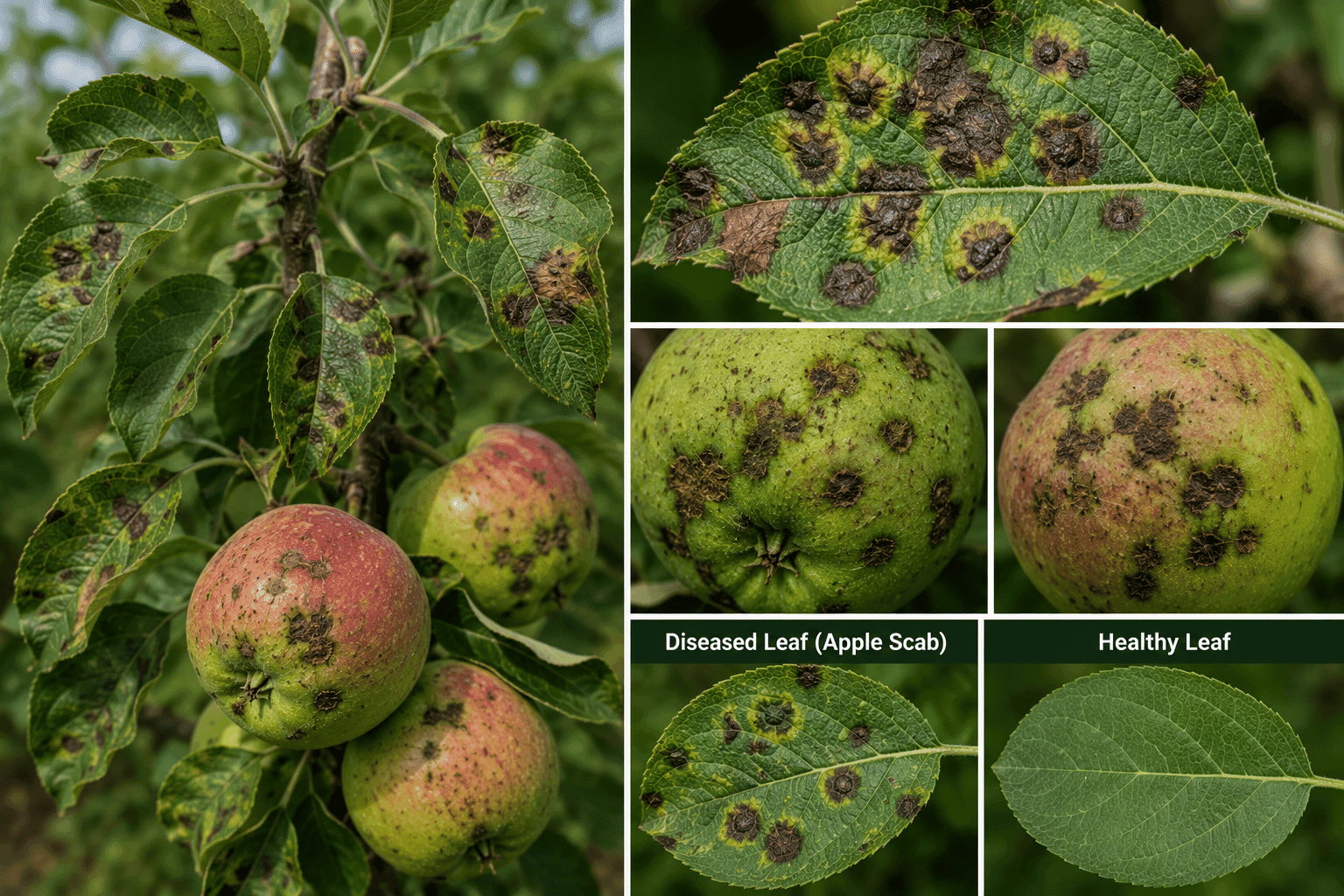
- Dark brown or black velvety patches on leaves
- Yellowing around infected leaf spots
- Curling or distortion of infected leaves
- Premature leaf drying and leaf fall
- Dark scabby spots on young fruits
- Rough, corky patches on fruit surface
- Cracking of infected fruits
- Deformed or uneven fruit growth
- Poor fruit appearance and reduced market quality
On leaves, the spots first appear as light green or olive-colored patches. Later, they become dark and velvety. In severe cases, many spots merge together and the leaves turn yellow and fall early.
On fruits, scab appears as dark, rough, and corky spots. As the fruit grows, the infected area may crack. Such fruits become unattractive and may not fetch a good price in the market.
Damage Caused by Apple Scab
Apple scab affects both yield and fruit quality. The disease reduces the healthy leaf area, which affects photosynthesis and weakens the tree. Premature leaf fall also reduces food preparation in the plant, affecting fruit development and next season’s flowering.
Major losses caused by apple scab include:
- Reduced tree vigor
- Poor fruit development
- Premature leaf fall
- Cracked and deformed fruits
- Reduced fruit size and quality
- Lower market value
- Increased cost of disease management
- Weak flowering in the next season
In severe infection, fruit quality is affected more than fruit quantity. Since apple buyers prefer clean and spotless fruits, scab-infected apples may be rejected or sold at a lower price.
Favorable Conditions for Disease Development
Apple scab spreads rapidly when weather and orchard conditions favor fungal growth. Farmers should be more alert during:
- Cool and wet weather
- Frequent rainfall
- High humidity
- Long leaf wetness period
- Dense tree canopy
- Poor air circulation
- Presence of infected fallen leaves
- Poor orchard sanitation
- Overhead irrigation or excess moisture
The disease is more severe when leaves remain wet for long hours. Dense orchards with poor pruning allow moisture to stay inside the canopy, increasing disease pressure.
How Apple Scab Spreads
The fungus survives mainly in infected leaves that fall on the orchard floor. During spring, fungal spores are released from these fallen leaves and spread to new leaves and fruits through wind and rain splash.
The disease spreads through:
- Infected fallen leaves
- Rain splash
- Wind-borne spores
- Wet and humid orchard conditions
- Dense canopy and poor aeration
- Infected plant debris left in the orchard
If fallen leaves are not removed or decomposed properly, they become the main source of infection for the next season.
Monitoring and Orchard Inspection
Regular orchard monitoring helps farmers detect apple scab at the early stage. Farmers should begin inspection from bud break and continue during flowering, fruit setting, and fruit development stages.
During field inspection:
- Check young leaves for olive-green spots
- Observe lower and inner canopy leaves carefully
- Inspect flowers and young fruits after rainy weather
- Look for dark scabby marks on developing fruits
- Check for premature leaf yellowing and leaf fall
- Record disease spread after rainfall
Early detection helps farmers take timely control measures before the disease becomes severe.
Prevention and Control Measures for Apple Scab
Integrated disease management gives better and long-lasting control. Farmers should follow orchard sanitation, cultural practices, resistant varieties, and timely fungicide sprays for effective management.
Cultural Control Methods
- Collect and destroy fallen infected leaves from the orchard.
- Remove diseased plant debris after harvest.
- Prune trees properly to improve air circulation.
- Avoid dense canopy formation.
- Maintain proper spacing between trees.
- Avoid overhead irrigation during disease-favorable weather.
- Remove water stagnation from the orchard.
- Maintain good orchard sanitation throughout the year.
Clean orchards have less disease pressure because the fungus survives mainly in infected fallen leaves.
Pruning and Canopy Management
Proper pruning plays an important role in reducing apple scab. A dense canopy holds moisture for a longer time and favors fungal infection. Farmers should prune trees to allow sunlight and air movement inside the canopy.
Benefits of pruning include:
- Faster drying of leaves after rain
- Better spray coverage
- Reduced humidity inside canopy
- Lower disease development
- Improved fruit color and quality
Pruning should be done carefully and diseased twigs should be removed from the orchard.
Resistant Varieties
Growing resistant or tolerant apple varieties can reduce disease incidence. Farmers in scab-prone areas should select varieties recommended for their region. Resistant varieties reduce the need for frequent fungicide sprays and help lower disease management cost.
Chemical Control Measures
When weather conditions favor disease development, farmers should use recommended fungicides as part of a proper spray schedule. Fungicide sprays are most effective when applied preventively, especially from early leaf emergence to fruit development stages.
Farmers should follow these important points:
- Use only recommended fungicides for apple scab.
- Start protection from early growth stages.
- Spray before or immediately after disease-favorable weather.
- Follow label dosage and instructions carefully.
- Rotate fungicides with different modes of action.
- Avoid repeated use of the same fungicide.
- Ensure proper coverage of leaves, flowers, and fruits.
Timely spraying is very important because controlling the disease after severe infection becomes difficult.
Precautions During Spraying
- Spray during calm weather.
- Avoid spraying during strong winds or rainfall.
- Ensure full coverage of the tree canopy.
- Use clean water for spray preparation.
- Follow recommended dosage only.
- Wear gloves, mask, and protective clothing.
- Keep children and animals away from the sprayed area.
- Follow the waiting period before harvesting fruits.
Preventive Measures for Farmers
Farmers can reduce apple scab risk by following preventive practices every season:
- Remove fallen infected leaves after harvest.
- Maintain proper pruning and canopy management.
- Monitor orchards regularly during cool and wet weather.
- Avoid waterlogging and excess moisture.
- Use healthy planting material.
- Follow balanced fertilizer management.
- Select resistant varieties where available.
- Follow timely fungicide spray schedules.
Prevention is more effective and economical than trying to control severe disease later.
Conclusion
Apple scab is one of the most serious fungal diseases in apple cultivation and can cause heavy loss in fruit quality and market value. The disease mainly affects leaves and fruits, causing olive-green spots, dark scabby patches, fruit cracking, premature leaf fall, and poor fruit appearance.
Early identification, regular orchard monitoring, removal of fallen infected leaves, proper pruning, good air circulation, and timely fungicide application are essential for effective disease control. Farmers should follow integrated disease management practices instead of depending only on chemical sprays. Proper management helps protect apple trees, improve fruit quality, reduce crop loss, and increase overall orchard profit.