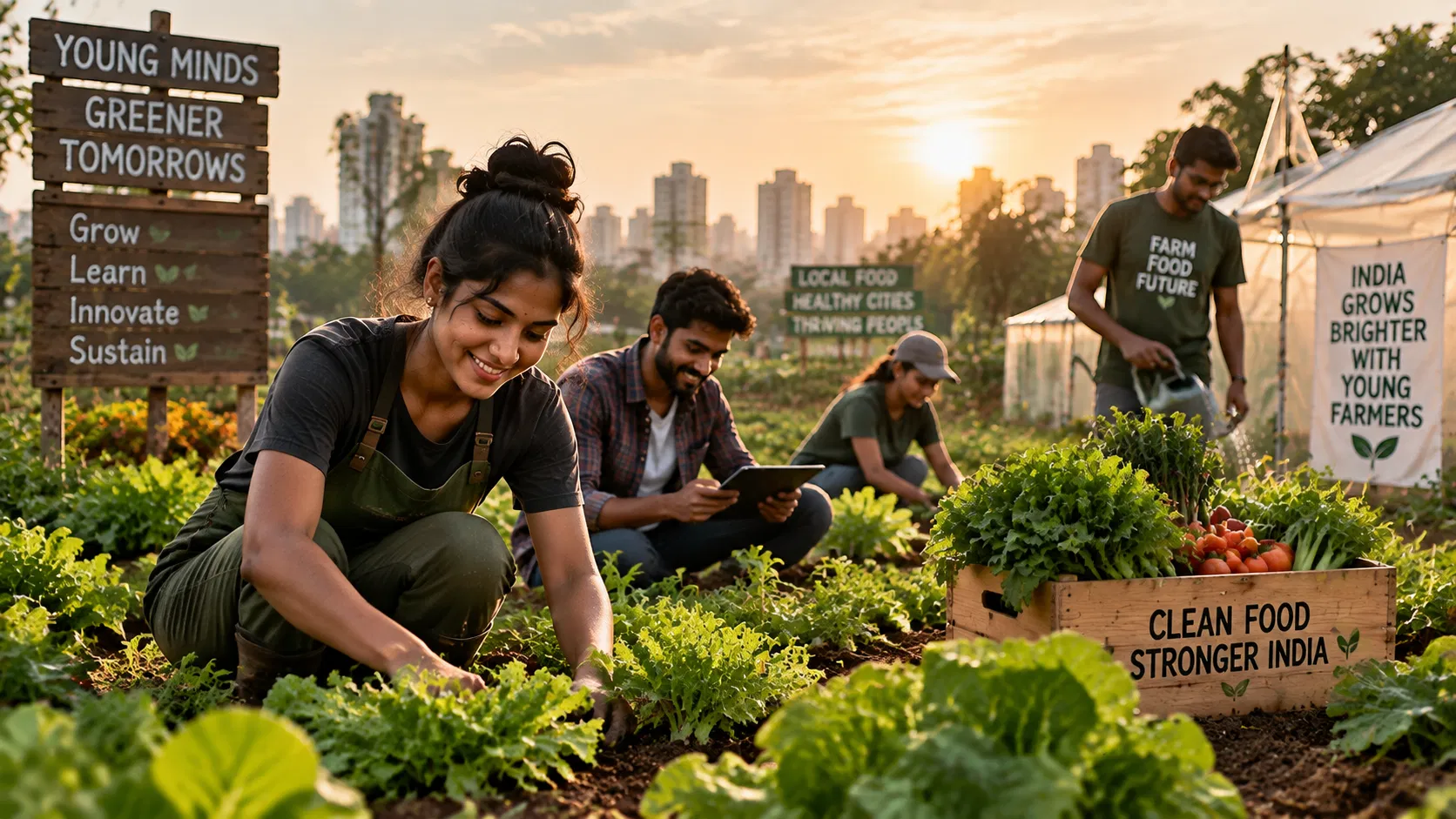
For decades, the dominant story was rural youth leaving farming behind for city jobs. That story hasn't reversed, but it has gotten more complicated — a growing number of young, often educated Indians are now choosing to engage with agriculture on their own terms, not out of necessity but by design.
1. Agriculture No Longer Means Just "Working the Land"
Agripreneurship — running agriculture as a business rather than subsistence farming — has broadened what a career in the sector can look like. Value addition, processing, agri-marketing, and supply chain roles now sit alongside traditional cultivation, giving young people entry points that don't require inheriting or working a family plot themselves.
2. Technology Has Changed the Nature of the Work
Precision agriculture tools — soil and crop sensors, data-driven irrigation, drone-based spraying and crop monitoring — have made farming look and feel more like a tech-enabled profession than manual labor. For digitally fluent young people, this shift narrows the gap between agriculture and the kind of tech-forward careers they were often steered toward instead. Equipment like battery-powered sprayers and other modern agri-implements also make day-to-day farm operations less physically punishing than they once were.
3. Government Support for Agripreneurship
Programmes like the RKVY-RAFTAAR Agribusiness Incubation initiative provide funding, mentorship, and training specifically aimed at helping young people start agriculture-linked ventures rather than just farm as their parents did. This institutional backing lowers the financial risk that has historically discouraged educated youth from considering agriculture as a serious career path.
4. Climate and Sustainability Concerns
Younger generations, broadly more attuned to climate and environmental issues, are increasingly drawn to agriculture as a field where they can have a direct, tangible impact — through regenerative practices, water conservation, or sustainable input use — rather than an abstract policy conversation.
5. Rural Employment Is Diversifying, Not Disappearing
Rural India's youth employment picture in 2026 shows agriculture evolving alongside — not being replaced by — expanding non-farm rural industries, better digital connectivity, and more flexible migration patterns. For many, this means farming is one credible option among several, rather than the only one available or the one being actively avoided.
6. Visibility Through Digital Platforms
Social media has given young farmers and agripreneurs a way to document and share their work — unusual crop experiments, farm-to-table ventures, or agri-tech projects — reaching an audience their parents' generation never had. This visibility has helped reframe farming as something worth talking about publicly rather than something to move away from quietly.
The Challenges That Remain
None of this erases the real constraints. Land access, low per-unit profitability in raw crop production, limited institutional support outside flagship schemes, and market-linkage gaps still make farming a genuinely harder path than many alternatives — particularly for first-generation agripreneurs without family land or capital. The interest is real, but it exists alongside these unresolved structural challenges, not in place of them.
Frequently Asked Questions
Are young Indians actually returning to farming, or just to agri-related careers?
Mostly the latter — interest is concentrated in agri-tech, agribusiness, and value-addition roles rather than a large-scale return to traditional land cultivation.
What government schemes support young people starting in agriculture?
Programmes like RKVY-RAFTAAR's Agribusiness Incubation initiative offer funding and mentorship specifically for agripreneurship ventures.
Is agri-tech a realistic career path for someone without a farming background?
Yes — many agri-tech and agribusiness roles don't require land ownership or a farming background, focusing instead on technology, marketing, or supply chain skills.
Disclaimer: General overview of trends in youth engagement with agriculture in India; individual outcomes depend on access to land, capital, and local market conditions.