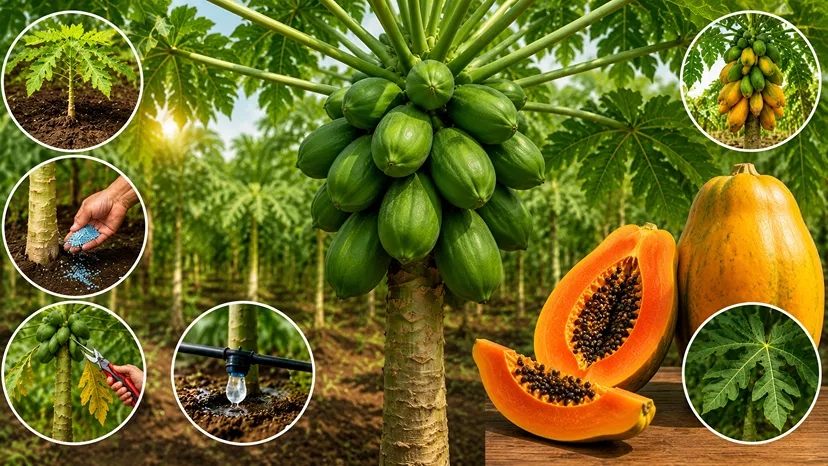
Papaya: Planting and Package of Practices
Papaya is one of the quickest fruit crops to pay back, with the first fruit generally ready within a year of planting and picking going on for well over a year after that. The crop is easy to grow but unforgiving in a few places: virus-free seedlings, a field that never holds water, the right number of male plants, and steady feeding every two months. Miss these and ring spot virus, collar rot or poor fruit set can wipe out much of the profit.
This guide covers the full package of practices in the order the work happens, from the nursery to harvest and papain tapping, with each stage set out in a table you can check at a glance.
Papaya Crop at a Glance
Item
Recommendation
Botanical name
Carica papaya, family Caricaceae
Common names
Papita, pappali, parangi, boppai
Temperature
About 25 to 30 degrees Celsius; growth slows below about 12 degrees and frost can kill plants
Soil
Well drained sandy loam at least 45 cm deep, or medium black soil; never waterlogged
Soil pH
About 6.0 to 7.0
Planting time
Mostly June to September; February to March in frost-prone areas
Seed rate
About 400 to 500 g per hectare for open pollinated varieties; about 250 g for hybrids
Seedling age
About 2 months, at 15 to 25 cm height
Spacing
1.8 x 1.8 m in most fields (about 1,200 plants per acre)
Fertilizer
About 200 g each of N, P and K per plant per year, in split doses
First harvest
About 8 to 10 months after planting
Crop life
About 24 to 30 months of economic bearing
Yield
About 30 to 50 kg of fruit per plant in a well managed crop
Recommended Varieties and Hybrids
Papaya plants come in two main sex forms, and this decides how you plant. Dioecious varieties carry male and female flowers on separate plants, so 2 to 3 seedlings go in each pit and the extra males are removed later. Gynodioecious varieties carry female and bisexual plants, give no unproductive males, and need only one seedling per pit.
Releasing institute or group
Varieties
Type and use
ICAR Indian Institute of Horticultural Research, Bengaluru
Arka Prabhath, Arka Surya, IIHR 39, IIHR 54
Gynodioecious table types; Arka Prabhath has deep pink flesh and starts bearing at 60 to 70 cm
Pusa series
Pusa Delicious, Pusa Majesty, Pusa Giant, Pusa Dwarf, Pusa Nanha
Pusa Delicious and Pusa Majesty are gynodioecious; Pusa Dwarf and Pusa Nanha suit high density planting; Pusa Giant suits canning
Tamil Nadu state releases
CO 1 to CO 8
CO 3 and CO 7 are gynodioecious table types; CO 2 and CO 5 are papain types; CO 6 and CO 8 are dual purpose
Other popular types
Coorg Honey Dew, Washington, Ranchi, Solo, Surya
Mostly table types; Solo suits kitchen gardens
Hybrids
Red Lady 786 (Taiwan 786), Taiwan 785
Gynodioecious table hybrids, widely planted across India
For table fruit, gynodioecious types are generally preferred because every plant can bear. Pusa Majesty is listed as tolerant to viral diseases and root knot nematode, and CO 2 and CO 5 are chosen where papain is the main product. Hybrid seed is available in the papaya seeds range, including:
East West SAPNA F1
Known-You Red Lady
Climate and Soil Requirements
Papaya is a tropical crop that grows best at about 25 to 30 degrees Celsius, from sea level up to about 1,000 metres. Night temperatures below about 12 degrees Celsius stunt growth and below 10 degrees delay ripening, while frost can kill young plants. Strong, hot or dry winds damage the soft stem and leaves, and a dry spell during ripening generally makes the fruit sweeter. High rainfall areas are risky because waterlogging brings collar rot.
Choose a well drained, upland field with sandy loam at least 45 cm deep, or medium black soil, at a pH of about 6.0 to 7.0. Drainage matters more than fertility, since even a short spell of standing water can kill plants. Testing the soil before planting helps fix both pH and fertilizer, as explained in this guide on soil testing before fertilizer application.
Planting Season
Situation
Planting time
Notes
Most of India
June to September, at the start of the monsoon
Planting can continue up to November where winters are mild
Frost-prone north and north east
February to March
Avoids young plants meeting winter cold
Spring planting
February to March
An option in many areas with assured irrigation
Sow the nursery about two months before your planned planting date, so seedlings are ready when the field is.
Nursery Raising
Ring spot virus often enters a papaya field with the seedlings, so the nursery is where protection starts. Raise seedlings in polybags under insect-proof net, away from old papaya and cucurbit fields. Our guide on growing papaya from seed to fruit shows the nursery steps with pictures.
Step
What to do
Seed
Use fresh seed, as papaya seed loses viability quickly
Seed rate
About 400 to 500 g per hectare for open pollinated types (160 to 200 g per acre); about 250 g per hectare for hybrids (100 g per acre)
Seed treatment
Trichoderma viride at about 3 to 4 g per kg of seed against damping off
Polybags
Fill with a mix of soil and well rotted manure; sow 3 to 4 seeds per bag, not more than 1 cm deep
Care
Keep bags in partial shade and water with a rose can
Protection
Keep the nursery under insect-proof net to stop aphids and whitefly
Seedlings per bag
Keep 3 healthy seedlings for dioecious types; 1 for gynodioecious hybrids
Transplanting
At about 2 months, when seedlings are 15 to 25 cm tall
Land Preparation, Pits and Spacing
Plough and level the field well, and plan drainage channels before digging pits. Dig pits about two weeks before planting so the soil weathers in the sun.
Item
Recommendation
Pit size
45 x 45 x 45 cm, or 60 x 60 x 60 cm in heavier soils
Pit filling
Topsoil mixed with farmyard manure (about 3:1), plus about 100 g single super phosphate; neem cake can be added against nematodes
Standard spacing
1.8 x 1.8 m, about 3,086 plants per hectare (about 1,230 per acre)
Tall varieties
Coorg Honey Dew and Washington at 2.4 x 2.4 m
High density
Pusa Nanha at 1.25 x 1.25 m, about 6,400 plants per hectare
Seedlings per pit
Dioecious: 2 to 3, about 10 to 15 cm apart. Gynodioecious: 1
Time of planting
Evening, followed by light irrigation
Manures and Fertilizers
Papaya flowers and fruits almost all year, so it needs regular feeding rather than one big dose. Apply fertilizer in a ring trench about 10 cm deep and 15 to 20 cm away from the stem, cover it with soil and give a light irrigation.
Input
Dose per plant
When
Farmyard manure
About 10 to 25 kg
At planting, and again each year
N, P and K
About 200 g each per year
In equal splits every two months, from about the second or third month
Common split
About 50 g each of N, P and K
Every two months from the third month, after removing extra plants
Azospirillum and phosphobacteria
About 20 g each
At planting and again after six months
Zinc and boron spray
Zinc sulphate 0.5% with boric acid 0.1%
At the fourth and eighth months
Drip fertigation
About 13.5 g urea and 10.5 g muriate of potash per week
With about 10 litres of water per plant per day
Ammonium sulphate as the nitrogen source and sulphate of potash as the potash source can improve fruit colour and keeping quality. More on using these cultures is in our complete guide to biofertilizers.
Irrigation and Water Management
Stage or season
Irrigation
After planting
A good irrigation right after transplanting
Summer
About once a week
Winter
About once in two weeks
Method
Ring or basin irrigation so water does not touch the stem
Drip
About 10 litres per plant per day, with fertigation
Rainy season
Drain the field quickly; standing water brings collar rot
Earth up 20 to 30 cm of soil around young plants after irrigation and before the monsoon, so water runs away from the stem.
Removing Extra Plants and Male Plants
Plants show their sex at first flowering, about 4 to 6 months after planting. Male plants carry long, hanging flower stalks, while female flowers sit close to the stem. In dioecious varieties, keep one vigorous female plant per pit, and keep about one male for every 10 to 20 females near the field for pollination. In gynodioecious varieties, keep one bisexual plant per pit for table fruit. Poor pollination and stress can still cause flower drop, and our post on flower drop and poor fruit set in papaya covers the fixes.
Weed Management, Border Crops and Frost Care
Keep the basins weed free, and mulch with straw or plastic to save moisture and cut weeding
Grow two or three rows of tall maize or sorghum around the field as a barrier against aphids and whitefly
Avoid growing tomato, chilli, tobacco or cucurbits right next to papaya, as they share viruses and vectors
Marigold as an intercrop can help reduce root knot nematode
Protect young plants from strong winds with windbreaks
In frost-prone areas, remove old leaves and cover the crown with straw or dry grass on cold nights
Pest Management
Pest
What you see
What generally helps
Papaya mealybug (Paracoccus marginatus)
White cottony colonies on leaves, stem and fruit; leaves curl and fruit drops
Release the parasitoid Acerophagus papayae and conserve natural enemies; avoid broad sprays that kill them
Whitefly (Bemisia tabaci)
Tiny white insects under leaves; spreads leaf curl
Yellow sticky traps, tall border crops and removal of leaf curl plants
Aphids
Colonies on tender leaves; spread ring spot virus
Yellow sticky traps at about 4 to 5 per acre, silver mulch and lacewing releases
Red spider mite (Tetranychus species)
Yellow speckled leaves with fine webbing, mainly in dry weather
Remove affected leaves and spray neem seed kernel extract 5%
Fruit fly (Bactrocera dorsalis)
Maggots inside ripening fruit; fruit rots and drops
Traps at about 4 to 5 per acre, lure changed on time, and collection of fallen fruit
Root knot nematode (Meloidogyne species)
Stunted plants with knotted roots
Neem cake at about 100 kg per acre at planting and a marigold intercrop
Parasitoids for papaya mealybug are generally supplied through state horticulture departments and Krishi Vigyan Kendras. Sticky trap placement is explained in our guide on using yellow and blue sticky traps, and for fruit fly, traps and lures whose description lists papaya include:
Tapas Fruit Fly Trap and Lure
Farm Methyl Eugenol
Disease Management
Disease
What you see
What generally helps
Ring spot virus
Mottled, distorted leaves, oily streaks on the stem and ring spots on fruit
Seedlings raised under net, tall border crops, yellow traps, early removal of infected plants and fortnightly micronutrient sprays
Leaf curl virus
Small, curled, crinkled leaves; plants stop growing
Uproot affected plants, control whitefly and keep the field weed free
Foot or collar rot (Pythium aphanidermatum)
Water soaked rot at the stem base; plants topple
Good drainage, ring irrigation and Trichoderma viride at about 15 g per plant with farmyard manure at planting
Damping off
Seedlings rot at the base and fall in the nursery
Seed treatment, clean potting mix and light watering
Powdery mildew (Oidium species)
White powder on leaves in humid, mild weather
Remove affected leaves; thiophanate methyl 70% WP is recommended on papaya
Anthracnose (Colletotrichum gloeosporioides)
Sunken, water soaked spots on ripening fruit
Remove diseased fruit, harvest on time, and dip fruit in hot water at 49 degrees Celsius for 20 minutes after harvest
Recommended options for powdery mildew on papaya include:
Biostadt Roko
AgriVenture Thiomet
Older leaflets suggest carbofuran, phosphamidon, monocrotophos, tridemorph and mercury compounds for papaya. These are banned or no longer allowed, so leave them out of your spray plan.
Harvesting and Post-Harvest Handling
Most varieties start bearing about 8 to 10 months after planting, and picking continues for well over a year. Harvest when the skin starts to turn from green to yellowish green and the latex becomes watery.
Stage
Practice
Distant markets
Harvest at colour break, up to about a quarter yellow
Local markets
Harvest when about half to three quarters of the skin is yellow
How to pick
Twist or cut the fruit with care and wear gloves, as latex stains the skin
Bagging
Bagging fruit about 15 days before harvest can reduce anthracnose
Hot water dip
49 degrees Celsius for 20 minutes against fruit rots
Packing
Wrap fruit in paper and pack in a single layer to avoid bruising
Yield
About 30 to 50 kg of fruit per plant in a well managed crop
Papain Tapping
Papain, the dried latex of green fruit, is used in brewing, meat tenderising and medicines. Tap fruit that is about 75 to 90 days old by making four shallow cuts, not more than 0.3 cm deep, from stalk to tip early in the morning before 10 am. Repeat about four times at three-day intervals on fresh areas, then dry the latex in shade or a drier and store it in sealed containers. CO 2 and CO 5 are the preferred papain varieties.
Frequently Asked Questions
What is the spacing for papaya per acre?
The standard spacing is about 1.8 x 1.8 m, which fits about 1,200 plants per acre.
How much papaya seed is needed per acre?
Generally about 160 to 200 g of open pollinated seed or about 100 g of hybrid seed, raised in polybags.
When is the best time to plant papaya?
Mostly from June to September at the start of the monsoon, and February to March in frost-prone areas.
How can I tell male and female papaya plants apart?
Male plants carry long, hanging flower stalks, while female flowers sit close to the stem.
How can ring spot virus be prevented in papaya?
Raise seedlings under insect-proof net, grow tall border crops, use yellow sticky traps and pull out infected plants early.
When does papaya start fruiting?
Most varieties start bearing about 8 to 10 months after planting.
How much fruit does one papaya plant give?
A well managed plant generally gives about 30 to 50 kg of fruit.
Related Reading
For lure care and trap placement across fruit crops, see our guide on pheromone traps and lures for pest monitoring, and for zinc, boron and other trace elements, our micronutrient management guide.
Disclaimer: Variety, spacing, fertilizer and spray recommendations for papaya differ between states and are revised from time to time, so confirm current advice with your state horticulture department. Test your soil before fixing a fertilizer dose, and follow the label and waiting period before spraying fruit close to harvest.