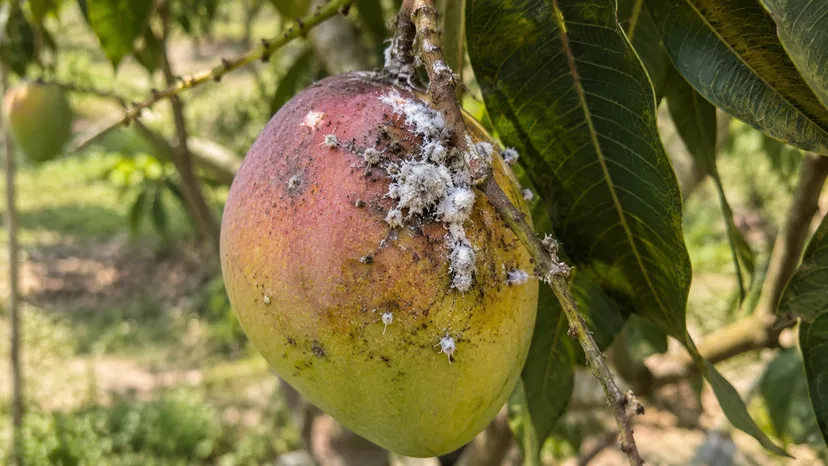
Powdery mildew control in mango is critical during flowering, when the fungus Oidium mangiferae is at its most damaging. It shows up as a white, powdery coating on flower panicles, young leaves, and developing fruit, and heavy infection can blight the entire flush, causing flowers and tiny fruitlets to drop before they ever set. Because the disease spreads fastest in cool, humid weather right around flowering, mango powdery mildew fungicide programmes work best as a preventive spray schedule timed to panicle emergence, with rotation across different modes of action to keep the fungus from building resistance.
1. Carbendazim 12% + Mancozeb 63% WP
This combination pairs a systemic benzimidazole with a contact dithiocarbamate for dual-mode protection. Carbendazim moves into plant tissue and disrupts fungal cell division from within, while Mancozeb forms a protective, multi-site barrier on the surface that stops spores from germinating in the first place. Because Mancozeb acts on several points in the fungal cell rather than one, this pairing also helps slow resistance build-up over repeated sprays.
Product Recommendations
2. Tebuconazole 50% + Trifloxystrobin 25% WG
Tebuconazole is a DMI (demethylation inhibitor) that blocks fungal cell membrane formation, while Trifloxystrobin interferes with the fungus's respiration, cutting off its energy supply. Together they give both curative action on existing infection and protective cover for new growth, with quick redistribution inside the plant that helps the spray reach areas missed during application.
Product Recommendations
3. Azoxystrobin 23% SC
Azoxystrobin belongs to the strobilurin (QoI) group and works by inhibiting mitochondrial respiration in the fungus, effectively cutting off the energy it needs to grow and spread. It moves systemically within the plant, giving protection to new flush and flower panicles formed after spraying, and its preventive, curative, and translaminar activity make it effective even when applied close to the first signs of disease.
Product Recommendations
4. Fluxapyroxad 250 g/l + Pyraclostrobin 250 g/l SC
This combination pairs two systemic modes of action: Fluxapyroxad is an SDHI that blocks fungal respiration at the succinate dehydrogenase enzyme, while Pyraclostrobin, a strobilurin, disrupts mitochondrial energy production at a different point in the same pathway. Together they're absorbed and distributed evenly through the leaf, giving continuous, longer-lasting disease control through the flowering and fruiting stages.
Product Recommendations
5. Hexaconazole 5% EC
Hexaconazole is a systemic triazole that blocks ergosterol biosynthesis, a step essential to building a stable fungal cell membrane, giving it protective, curative, and antisporulant activity. It moves through the plant to reach new growth, offering a longer duration of disease control from a single, well-timed spray.
Product Recommendations
6. Fluopyram 17.7% w/w + Tebuconazole 17.7% w/w SC
Fluopyram is an SDHI that blocks the fungus's energy production by breaking its respiration chain, while Tebuconazole works as a DMI that interferes with fungal cell wall formation, stopping reproduction and further growth. The two different modes of action together give broad, dual-action protection and help delay resistance build-up compared with using either active alone.
Product Recommendations
7. Sulphur 80% WG
Sulphur is a classic multi-site contact fungicide that disrupts fungal metabolism on the plant surface, which makes resistance development highly unlikely even with repeated use. Beyond disease control, it also supplies sulphur as a plant nutrient that supports chlorophyll formation, and it carries useful secondary activity against mites.
Product Recommendations
8. Hexaconazole 5% SC
This is the SC formulation of the same triazole chemistry as the EC version above, blocking ergosterol biosynthesis to disrupt fungal cell membrane formation. It offers the same protective, curative, and antisporulant activity with the rainfastness typical of SC formulations, giving reliable, longer-lasting control from a single application.
Product Recommendations
9. Sulphur 80% WP
Like the WG formulation, this wettable powder version of Sulphur works as a multi-site contact fungicide that disrupts fungal metabolism on the leaf and panicle surface. Its non-systemic, protectant action means thorough coverage before infection is key, and it doubles as a mild acaricide, helping suppress mite populations alongside powdery mildew.
Product Recommendations
10. Meptyl Dinocap 35.7% EC
Meptyl Dinocap works as an uncoupler of oxidative phosphorylation, disrupting the fungus's energy-producing ATP pathway on contact. It's particularly effective at controlling powdery mildew that has established itself on the woody parts of the tree, and it remains active even at lower temperatures when some systemic fungicides work less well, making it a useful rotation partner alongside the systemic options above.
Product Recommendations
Disclaimer: Always confirm current label registration, approved dosage, water volume, and pre-harvest interval (PHI) for your state before using any product — labels are periodically revised by regulatory authorities.
This guide is a general advisory. Do your own research and verification before using any product. Always confirm suitability for your crop stage, region, and field conditions before making any purchase, spray, or crop-management decision.