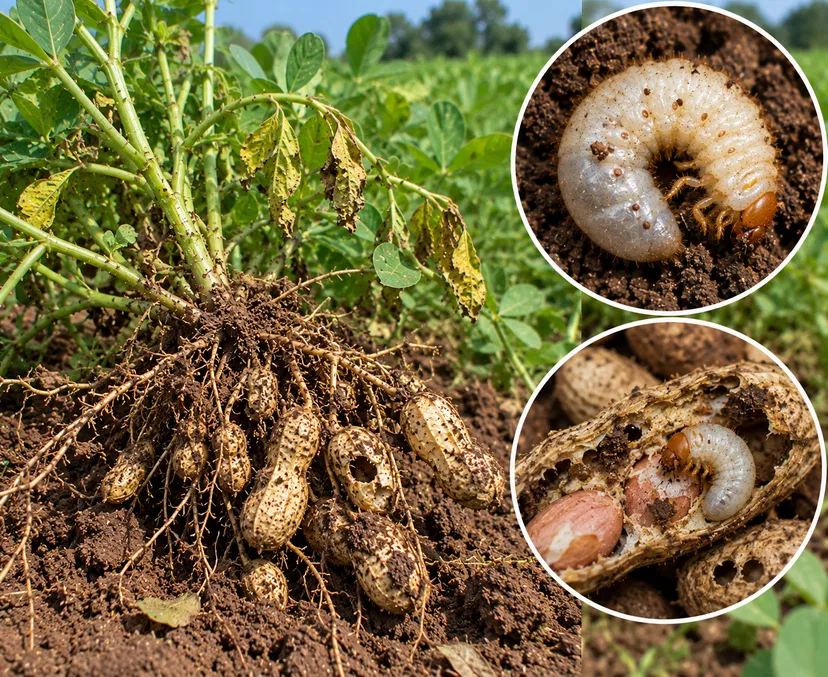
Pod borer in soybean is caused by Helicoverpa armigera, a caterpillar pest that feeds heavily around flowering and pod-fill. The moths lay eggs on tender pods, and the hatching larvae bore straight into them, feeding on developing seeds from inside. Left unchecked, this leads to hollowed-out pods, poor seed count, and real yield loss. Here are the signs, favourable conditions, and 6 solutions to manage it.
Signs of Pod Borer in Soybean
- Small round holes on pods and leaves
- Caterpillars boring into pods and feeding on developing seeds
- Webbing near flowers and pods, with visible larval droppings
- Hollowed-out or partially eaten pods with chewed seeds
- Green to brown caterpillars visible on foliage or inside opened pods
Conditions Favouring Pod Borer
- Warm weather during flowering to pod-filling stage
- Continuous soybean or pulse cropping without rotation
- Dense canopy that shelters larvae from sprays
- Moths drawn to flowering crop, laying eggs directly on tender pods
- Reduced natural predator activity from indiscriminate spraying
Solutions to Control Pod Borer in Soybean
1. Broflanilide 300 g/l SC
A meta-diamide insecticide that works through GABA-gated chloride channel modulation, disrupting nerve signals in the larva and causing paralysis. It moves both systemically and translaminarly through the plant, giving strong larvicidal action against pod borer (Helicoverpa armigera), with a novel mode of action that helps in resistance management.
| Product Recommendation | Dosage |
|---|---|
| BASF Exponus Insecticide | 42-62 ml/ha in 500 L water/ha (0.08-0.12 ml/L water) |
2. Flubendiamide 39.35% w/w SC
A diamide insecticide that acts on ryanodine receptors, disrupting calcium regulation in the larva's muscles. This halts feeding almost immediately after ingestion, protecting pods from further damage, and gives reliable control against pod borer (Helicoverpa armigera) in soybean.
| Product Recommendation | Dosage |
|---|---|
| Bayer Fame Insecticide | 150 ml/ha in 500 L water/ha (0.3 ml/L water) |
| Katyayani Fluben Insecticide |
3. Novaluron 5.25% + indoxacarb 4.50% SC
Two active ingredients working together: Novaluron inhibits chitin synthesis, so larvae fail to moult properly, while Indoxacarb blocks sodium channels in the nervous system, causing paralysis. This dual action gives strong control against pod borer (Helicoverpa armigera) in soybean.
| Product Recommendation | Dosage |
|---|---|
| Adama Plethora Insecticide | 825-875 ml/ha in 500 L water/ha (1.65-1.75 ml/L water) |
| Katyayani Aakramak Plus Insecticide |
4. Emamectin benzoate 1.9% EC
Works on glutamate-gated chloride channels in the larva's nervous system, causing paralysis and a quick stop to feeding. It gives good residual control against pod borer (Helicoverpa armigera) in soybean, with a low dose rate needed for effective action.
| Product Recommendation | Dosage |
|---|---|
| Katyayani EMA19 Insecticide | 425 ml/ha in 500 L water/ha (0.85 ml/L water) |
5. Chlorfluazuron 5.40% EC
An insect growth regulator that inhibits chitin synthesis, arresting the moulting process so larvae cannot progress to the next stage. It works through both contact and stomach action, giving long-lasting control of pod borer (Helicoverpa armigera) in soybean.
| Product Recommendation | Dosage |
|---|---|
| UPL Atabron Insecticide | 1500 ml/ha in 500 L water/ha (3 ml/L water) |
6. Pheromone Traps and Lures
These attract male Helicoverpa armigera moths using a synthetic sex pheromone, trapping them before mating happens so fewer eggs get laid on the crop. They work best as a monitoring and mass-trapping tool alongside sprays, not as a standalone replacement, and are especially useful for tracking when moth activity picks up so sprays can be timed better.
| Product Recommendation | Usage |
|---|---|
| Pheromone Trap and Lure Complete Set | 10 lures/acre, installed 7-10 days after sowing; replace every 30-45 days |
Note: Pod borer pressure builds fastest around flowering and pod-fill, so spraying at the first sign of eggs or young larvae works far better than waiting for visible pod damage. Rotating between different insecticide groups across the season, rather than repeating the same one, helps prevent resistance building up in the pod borer population.
Disclaimer: Always confirm current label registration, approved dosage, water volume, and pre-harvest interval (PHI) for your state before using any product, since labels are periodically revised by regulatory authorities.
This guide is a general advisory. Do your own research and verification before using any product. Always confirm suitability for your crop stage, region, and field conditions before making any purchase, spray, or crop-management decision.