Groundnut, also known as peanut, is an oilseed and pulse crop grown widely across India's semi-arid regions, valued both for its edible kernels and its oil content. It's a relatively hardy crop, but the pod, root, and foliage it depends on for yield make it a target for a wide range of pests through its growth cycle, from sap-sucking insects on the foliage to grubs and termites working below the soil surface. Left unchecked, these pests can cut into both pod count and kernel quality. Here are the pests that show up most often in groundnut fields, how to recognise the damage, and what to use for each.
1. Jassids and Leafhoppers
Jassids and leafhoppers feed by sucking sap from the underside of the leaves, causing a yellowing and browning along the leaf margins that curls inward, a symptom often called hopper burn. Heavy infestations stunt plant growth and can reduce pod set if the damage sets in early in the season.
Quinalphos 25% EC gives effective knockdown against both jassids and leafhoppers on groundnut, acting on contact as well as through ingestion.
Products recommendation
2. Leaf Eating Caterpillar
Leaf eating caterpillars chew through foliage from the margins inward, leaving ragged holes that expand as the larvae grow, and can skeletonise leaves entirely in a heavy outbreak. Since groundnut depends on healthy leaf area to fill its pods, unmanaged feeding directly cuts into yield.
A spray of Methoxyfenozide 20% + Chlorantraniliprole 5% SC targets the caterpillar's moulting and feeding process, giving control that holds up well even against larger larvae.
Products recommendation
3. Aphids
Aphids cluster on tender shoots and the underside of leaves, sucking sap and leaving behind sticky honeydew that invites sooty mould. Left unmanaged, a heavy infestation weakens the plant and can hold back pod development.
Chlorpyrifos 20% EC is a confirmed option for aphid control in groundnut, reaching the pest through contact, stomach, and fumigant action.
Products recommendation
- Katyayani Chloro 20 Insecticide
- Tricel Insecticide
- Dursban Insecticide
- Tafaban Insecticide
- Eldrin Insecticide
4. White Grub
White grub larvae live in the soil and feed on the roots through the season, and severely affected plants wilt suddenly, turn yellow, and come away from the ground with almost no effort. Adult beetles add to the damage by feeding on foliage after dusk, often going unnoticed until the root injury below shows up as patchy crop failure.
Applied as a soil treatment, Bifenthrin 8% + Clothianidin 10% SC combines a fast-acting pyrethroid with a systemic neonicotinoid to protect the root zone against grub feeding.
Products recommendation
5. Pod Borer
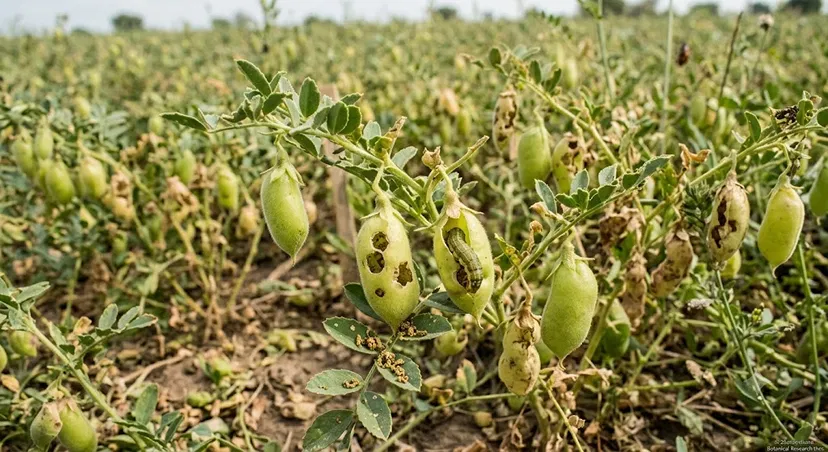
Pod borer larvae bore directly into developing pods and feed on the kernels inside, leaving behind hollowed-out or partially eaten pods that show up only at harvest. Because the damage happens underground and out of view, infestations are often missed until yield losses are already locked in.
Carbofuran 3% CG is applied to the soil around the root zone, where it's taken up systemically and protects developing pods from within the plant.
Products recommendation
6. Termites
Termites tunnel into the stem and root system, hollowing out the tissue from within, which causes plants to wilt and die in scattered patches across the field, especially during dry spells. In advanced infestations, termites also attack the pods directly below the soil surface, reducing both the number and quality of pods harvested.
Thiamethoxam 75% SG is a systemic insecticide that, when applied to the soil, protects the root zone and gives extended control against termite activity through the season.
Products recommendation
- Katyayani Thioxam 75
- AgriVenture Thi Platinum
- Exylon Thiaapex Insecticide
- Capcadis Insecticide
- Neo Super Insecticide
7. Leaf Webber
Leaf webber larvae draw leaves together with silken webbing and feed from within this shelter, scraping away the green tissue and leaving the leaves skeletonised. The webbed clusters are usually the first visible sign, showing up as tangled, discoloured patches scattered across the canopy.
A spray of Phenthoate 50% EC penetrates the webbing enough to reach the larvae feeding inside, giving control where purely contact sprays often fall short.
Products recommendation
8. Leaf Miner
Leaf miner larvae tunnel between the upper and lower surfaces of the leaf, feeding on the tissue in between and leaving behind thin, winding, pale trails that are easy to spot even from a distance. Heavily mined leaves dry up and drop early, cutting into the plant's overall leaf area.
Deltamethrin 2.80% EC is a fast-acting pyrethroid that controls leaf miner on groundnut through contact and stomach action, reaching the larvae as they move within the leaf.
Products recommendation
Conclusion
Groundnut pests operate both above and below the ground, so regular scouting has to cover the foliage as well as the base of the plant and the soil around it. Matching the right product to the pest at the first sign of trouble, whether it's hopper burn on the leaves or a plant that lifts too easily out of the soil, goes a long way in protecting pod count and quality through to harvest.
Disclaimer: Always confirm current label registration, approved dosage, water volume, and pre-harvest interval (PHI) for your state before using any product, since labels are periodically revised by regulatory authorities.
This guide is a general advisory. Do your own research and verification before using any product. Always confirm suitability for your crop stage, region, and field conditions before making any purchase, spray, or crop-management decision.