Soybean (Glycine max) is India's leading kharif oilseed, grown on close to 12 million hectares across Madhya Pradesh, Maharashtra, Rajasthan and Karnataka. It is also a crop grown almost entirely on monsoon rainfall, and that single fact explains most of its disease problems: warm temperatures, long spells of leaf wetness, and high humidity inside a closed canopy are exactly the conditions fungal pathogens need.
Soybean diseases are costly in a way that is easy to underestimate. There is no fruit to inspect and no obvious wilting in the early stages, the loss shows up as thinner pod filling, lighter seed, and a yield that comes in well short of what the crop looked capable of. By the time leaves are dropping, the damage to pod development is already done.
Growing soybean after soybean in the same field makes it worse, because the fungi behind root rot, charcoal rot and collar rot survive in soil and crop residue from one season to the next. This guide covers the 10 diseases that cost Indian soybean growers the most, the field symptoms that tell each one apart, and the solutions registered against it.
1. Rust (Phakopsora pachyrhizi)
Rust is the most feared foliar disease of soybean worldwide and a recurring threat in India's southern and central growing belts. It spreads by airborne spores, moves fast through a humid canopy, and forces the plant to shed leaves during pod filling, the one stage when the crop can least afford to lose green leaf area.
How to Spot It
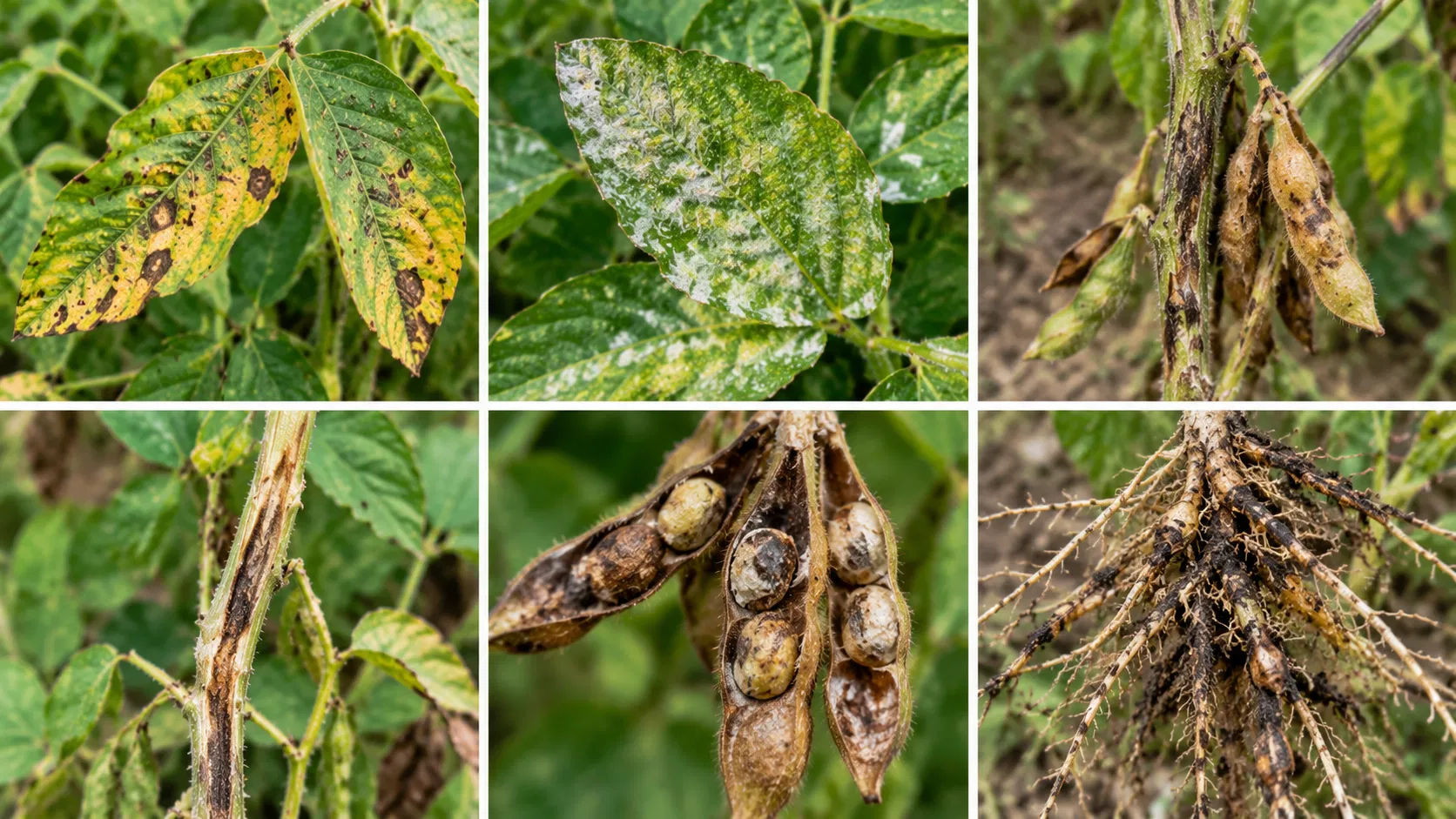
Small tan-to-reddish-brown raised pustules on the underside of leaves, starting on the lower canopy and moving upward; matching small grey-brown angular specks on the upper leaf surface; a dusty brown deposit on fingers or clothing when infected leaves are rubbed; rapid yellowing and premature leaf drop that strips a plant from the bottom up.
Solutions to Manage It
| Product | Active Ingredient |
|---|---|
| Tata Ergon Fungicide | Kresoxim-methyl 44.3% SC |
| Crystal Tilt Fungicide | Propiconazole 25% EC |
| Syngenta Amistar Top Fungicide | Azoxystrobin 18.2% + Difenoconazole 11.4% SC |
| Dhanuka Godiwa Super Fungicide | Azoxystrobin 18.2% + Difenoconazole 11.4% SC |
2. Myrothecium Leaf Spot (Myrothecium roridum)
Myrothecium leaf spot has become one of the most consistently reported foliar problems in Indian soybean, particularly during extended wet spells in the middle of the crop's life. It is rarely dramatic in a single day, but it punches steadily through the canopy and thins it exactly when pods are setting and filling.
How to Spot It
Circular to irregular greyish-white spots ringed by a dark brown border; minute black cushion-like fungal structures dotting the dead centres in humid weather, visible with a hand lens; papery spot centres that tear away and leave shot-holes through the leaf; spots that run together into large blighted patches, followed by leaf drop.
Solutions to Manage It
| Product | Active Ingredient |
|---|---|
| BASF Polyram Fungicide | Metiram 70% WG |
| Bayer Buonos Fungicide | Tebuconazole 38.39% w/w SC |
| UPL Avancer Glow Fungicide | Azoxystrobin 8.3% + Mancozeb 66.7% WG |
| UPL Saaf Fungicide | Carbendazim 12% + Mancozeb 63% WP |
| Dhanuka Sixer Fungicide | Carbendazim 12% + Mancozeb 63% WP |
3. Cercospora Leaf Spot (Cercospora kikuchii)
This is the disease behind purple seed stain, and it hits growers twice: once by blighting the upper canopy, and again at the mandi, where discoloured seed is downgraded. It becomes most visible late in the season, during pod fill and maturity, when the upper leaves take on a distinctive bronzed cast.
How to Spot It
Upper, sun-exposed leaves turning a leathery reddish-purple or bronze rather than showing discrete spots; small angular purple-brown lesions on leaves and petioles; early shedding of the top canopy leaves while lower leaves stay green; pink-to-purple blotches on the seed coat at harvest, ranging from small specks to staining across the whole seed.
Solutions to Manage It
| Product | Active Ingredient |
|---|---|
| BASF Opera Fungicide | Pyraclostrobin 133 g/l + Epoxiconazole 50 g/l SE |
| Bayer Buonos Fungicide | Tebuconazole 38.39% w/w SC |
| UPL Avancer Glow Fungicide | Azoxystrobin 8.3% + Mancozeb 66.7% WG |
4. Frog Eye Leaf Spot (Cercospora sojina)
Frog eye leaf spot is named for the ringed appearance of its lesions, and it is one of the easier soybean diseases to identify with confidence in the field. It attacks the newest, youngest leaves rather than the oldest, which means it cuts into the canopy the plant is actively building. Severe infections also reach the pods and seed.
How to Spot It
Small circular to angular spots with pale grey or light tan centres surrounded by a sharp reddish-brown to purple margin — the ring that gives the disease its name; spots appear mainly on the upper, younger leaves; in heavy infections the lesions coalesce and leaves drop early, and elongated dark lesions may appear on stems and pods.
Solutions to Manage It
| Product | Active Ingredient |
|---|---|
| BASF Priaxor Fungicide | Fluxapyroxad 167 g/l + Pyraclostrobin 333 g/l SC |
5. Alternaria Leaf Spot (Alternaria alternata)
Alternaria is an opportunist. It moves in most heavily on plants already stressed by drought, poor nutrition or another disease, and on leaves approaching maturity. Because it favours the older lower canopy first, it accelerates the natural leaf drop of an ageing crop and shortens the effective pod-filling window.
How to Spot It
Brown to dark brown spots marked with concentric rings in a target-board or bull's-eye pattern, usually ringed by a yellow halo; damage beginning on older, lower leaves; spots enlarging and merging until whole leaflets brown off and fall; more severe where the crop is already under stress.
Solutions to Manage It
| Product | Active Ingredient |
|---|---|
| Bayer Buonos Fungicide | Tebuconazole 38.39% w/w SC |
| UPL Avancer Glow Fungicide | Azoxystrobin 8.3% + Mancozeb 66.7% WG |
| UPL Saaf Fungicide | Carbendazim 12% + Mancozeb 63% WP |
| Dhanuka Sixer Fungicide | Carbendazim 12% + Mancozeb 63% WP |
6. Anthracnose (Colletotrichum truncatum)
Anthracnose can infect soybean at any growth stage but stays latent and invisible until the plant begins to mature, which is what makes it so easy to miss. It then breaks out on stems, petioles and pods during warm, wet weather close to harvest. Infected seed carries the fungus forward into the next season.
How to Spot It
Irregular dark brown to black sunken lesions on stems, petioles and pods; tiny black spines or bristles emerging from the lesion surface, visible with a hand lens, the clearest single sign of anthracnose; premature defoliation and dark blotching on the stem; pods that fail to fill and seed that comes out small, shrivelled and mouldy.
Solutions to Manage It
| Product | Active Ingredient |
|---|---|
| Bayer Folicur Fungicide | Tebuconazole 25.9% EC |
| UPL Saaf Fungicide | Carbendazim 12% + Mancozeb 63% WP |
| Dhanuka Sixer Fungicide | Carbendazim 12% + Mancozeb 63% WP |
7. Pod and Stem Blight (Diaporthe phaseolorum)
Pod and stem blight has the most direct line to lost seed weight of any soybean disease. The same fungus colonises the pod wall and the stem, so pods either stay flat or fill with small, chalky seed while the stem's conducting tissue is choked. Damage is worst when the crop matures under wet conditions or when harvest is delayed by late rain.
How to Spot It
Rows of tiny raised black dots arranged in neat lines along the pod surface and stem, the diagnostic sign, quite unlike the scattered specks of other diseases; pods that stay flat and empty or hold shrunken, dull, mouldy seed; elongated brown-to-black lesions running along the main stem; plants dying off early, with stems that snap easily and show internal browning when split.
Solutions to Manage It
| Product | Active Ingredient |
|---|---|
| Bayer Folicur Fungicide | Tebuconazole 25.9% EC |
| Sumitomo Swadheen Fungicide | Tebuconazole 10% + Sulphur 65% WG |
| UPL Saaf Fungicide | Carbendazim 12% + Mancozeb 63% WP |
| Dhanuka Sixer Fungicide | Carbendazim 12% + Mancozeb 63% WP |
8. Charcoal Rot (Macrophomina phaseolina)
Charcoal rot is the disease of a dry spell. The fungus is present in most soybean soils but turns aggressive when the crop hits moisture stress and high temperatures during pod filling, the classic mid-season monsoon break. It blocks the plant's water-conducting tissue at the very moment the plant needs water most, and losses can run across a whole field.
How to Spot It
Plants ripening off early in patches, with leaves yellowing, drying and staying attached to the stem instead of dropping; a silvery-grey discolouration on the lower stem and taproot when the outer skin is scraped away; fine black specks peppered through that grey tissue, looking exactly like sprinkled charcoal dust, the definitive sign; roots that are shrunken and brittle.
Solutions to Manage It
| Product | Active Ingredient |
|---|---|
| Dhanuka Vitavax Power Fungicide | Carboxin 37.5% + Thiram 37.5% WS |
| UPL Saaf Fungicide | Carbendazim 12% + Mancozeb 63% WP |
| Dhanuka Sixer Fungicide | Carbendazim 12% + Mancozeb 63% WP |
9. Collar Rot (Sclerotium rolfsii)
Collar rot attacks the plant precisely where the stem meets the soil, girdling it and cutting off everything above. It is a disease of warm, moist soils rich in undecomposed crop residue, which is why it builds up in fields carrying heavy trash from the previous crop. Affected plants die standing, often scattered through an otherwise healthy field.
How to Spot It
A dark, sunken lesion encircling the stem at soil level; white, cottony, fan-like fungal growth spreading over the collar and the soil around it; small round bodies the size and colour of mustard seed, white at first and turning brown, sitting on the stem base and nearby soil; sudden wilting and death of individual plants that stay upright.
Solutions to Manage It
| Product | Active Ingredient |
|---|---|
| Dhanuka Vitavax Power Fungicide | Carboxin 37.5% + Thiram 37.5% WS |
| UPL Saaf Fungicide | Carbendazim 12% + Mancozeb 63% WP |
| Dhanuka Sixer Fungicide | Carbendazim 12% + Mancozeb 63% WP |
10. Root Rot (Rhizoctonia solani, Fusarium and Pythium spp.)
Root rot decides whether a field establishes a full plant stand at all. Several soil fungi are usually at work together, rotting the root system either before the seedling emerges or in the weeks just after. Because the damage is entirely below ground, it is almost always read as poor soil, weak seed or a nutrient problem rather than as disease — and any field growing soybean season after season builds up the fungi responsible.
How to Spot It
Patchy, uneven emergence with visible gaps along the rows; young seedlings collapsing with a soft, pinched, water-soaked stem right at soil level; older plants that stay short and pale despite adequate fertiliser, wilting by day and recovering by evening before wilting for good; brown to black decayed roots whose outer layer strips off between the fingers, lifting from the soil with almost no resistance. Losses concentrate in low-lying, poorly drained and compacted parts of the field.
Solutions to Manage It
| Product | Active Ingredient |
|---|---|
| Dhanuka Vitavax Power Fungicide | Carboxin 37.5% + Thiram 37.5% WS |
| Bayer EverGol Xtend Fungicide | Penflufen 13.28% w/w + Trifloxystrobin 13.28% w/w FS |
| UPL Saaf Fungicide | Carbendazim 12% + Mancozeb 63% WP |
Disclaimer: Always confirm current label registration, approved dosage, water volume, and pre-harvest interval (PHI) for your state before using any product labels are periodically revised by regulatory authorities.
This guide is a general advisory. Do your own research and verification before using any product. Always confirm suitability for your crop stage, region, and field conditions before making any purchase, spray, or crop-management decision.