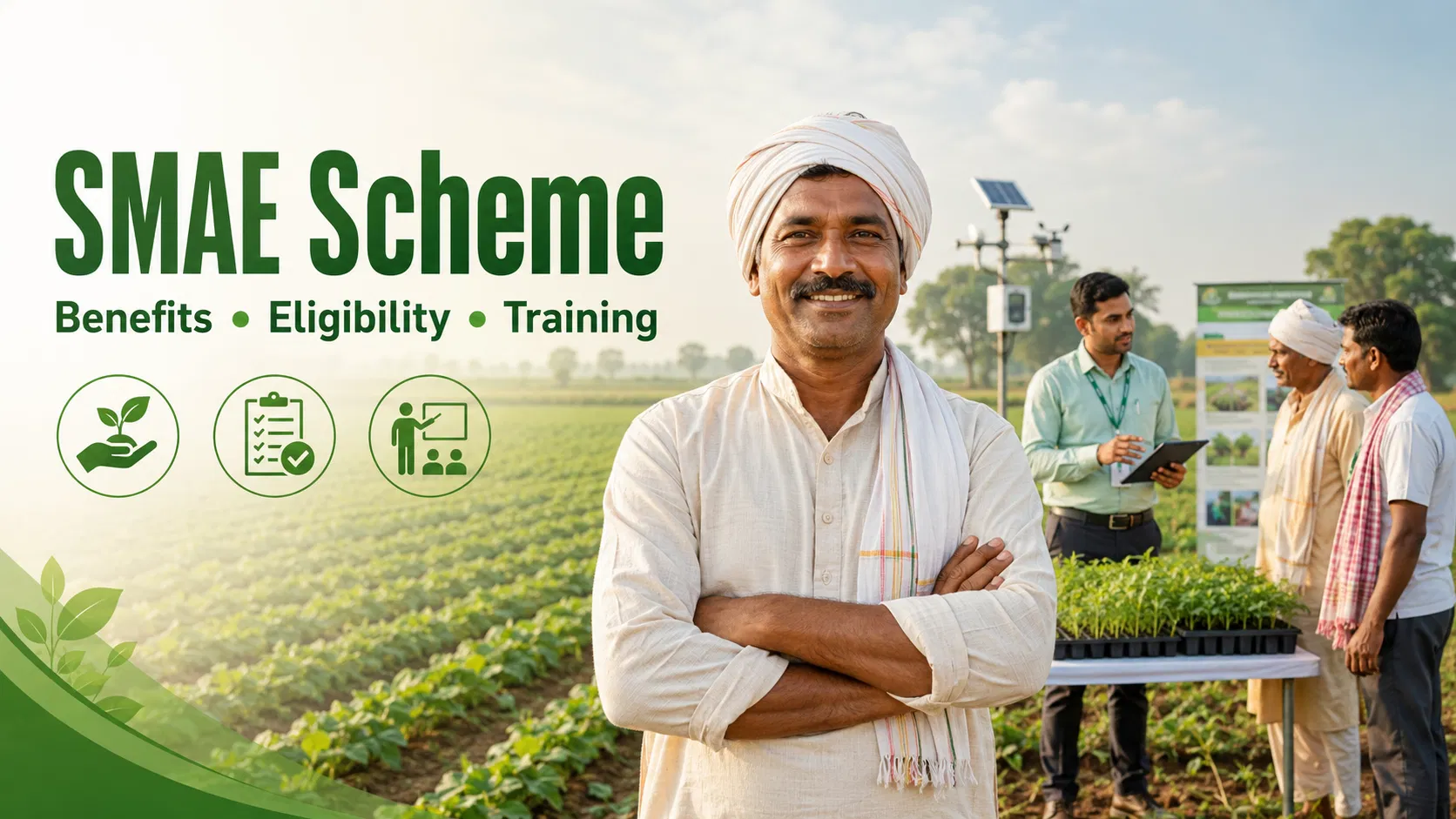
The Sub-Mission on Agricultural Extension (SMAE) is a Central Government scheme built around a simple but persistent problem: research institutions keep developing better crop varieties and farming techniques, but this knowledge often never reaches the small and marginal farmers who need it most. SMAE's flagship component, the Agricultural Technology Management Agency (ATMA), was first launched in 2005-06 to close that gap through decentralised, farmer-driven extension services at the district level. ATMA was originally pilot-tested from 1998 to 2005 under the World Bank-funded National Agricultural Technology Project across seven states, before being scaled up nationally and later restructured as a component of the National Mission on Agricultural Extension and Technology (NMAET) in 2014, and now sits under the "Green Revolution – Krishonnati Yojana" umbrella.
SMAE Scheme Overview
- Scheme Name – Sub-Mission on Agricultural Extension (SMAE), with "Support to State Extension Programmes for Extension Reforms (ATMA)" as its key component
- Scheme Modification Date – ATMA launched 2005-06; restructured under NMAET in 2014; currently operating as a component of the Green Revolution – Krishonnati Yojana
- Scheme Fund Allocated – Centrally Sponsored Scheme with a shared Centre-State funding pattern; specific activities carry their own cost norms — for example, agri-venture training under the scheme offers a subsidy of 44% for women, SC/ST, and North-Eastern/Hill State candidates, and 36% for other categories
- Type of Scheme – Central Government (Centrally Sponsored Scheme), implemented through district-level Agricultural Technology Management Agencies (ATMAs) under State Agriculture Departments
- Helpline No – Kisan Call Centre, 1800-180-1551; farmers can also contact their District ATMA office, Block Technology Team (BTT), or the local Assistant Agriculture Officer
- States Covered – All-India, currently implemented in over 690 districts across 28 states and 5 Union Territories (recent figures cited also note 684 districts across 29 states and 3 UTs, reflecting periodic district-level updates)
Objectives of the Scheme
- Restructure and strengthen agricultural extension to deliver appropriate technology and improved agronomic practices to farmers
- Make extension services more decentralised, farmer-driven, and farmer-accountable
- Bridge the gap between agricultural research and actual field-level adoption
- Build stronger farmer institutions, including Farmer Interest Groups (FIGs) and Commodity Interest Groups (CIGs)
- Improve farmer skills and productivity through training, demonstrations, and exposure visits
Key Features of SMAE and ATMA
- Operates through district-level Agricultural Technology Management Agencies (ATMAs), which coordinate extension activities with state agriculture departments, research bodies, NGOs, and farmers
- Core activities include farmer training programmes, on-farm demonstrations, exposure visits to progressive farms and research stations, farm schools, and Kisan Melas (farmer fairs)
- Promotes farmer mobilisation and group formation through Commodity Interest Groups (CIGs) and Farmer Interest Groups (FIGs)
- Includes farmer-scientist interaction sessions to directly connect farmers with agricultural researchers
- Runs DAESI (Diploma in Agricultural Extension Services for Input Dealers) training to improve the technical knowledge of local input dealers who farmers rely on for advice
- Uses ICT-based extension services to widen the reach of agricultural information beyond in-person sessions
- State Agricultural Management and Extension Training Institutes (SAMETI) provide capacity building for extension staff and consultancy support to ATMAs
- Governance runs through a Block Technology Team (BTT) and Block Farmers Advisory Committee (BFAC) at the block level, with district oversight through the ATMA Governing Body, chaired by the District Magistrate
SMAE/ATMA Benefits to Farmers
- Access to periodic, structured training in modern agricultural practices, including crop management, soil health, irrigation techniques, and sustainable farming methods
- Exposure visits to model farms, research institutions, and other locations to observe best practices first-hand
- Opportunities to interact directly with agricultural scientists and researchers to resolve farm-specific problems
- Stronger local farmer institutions (FIGs, CIGs) that improve collective bargaining power and knowledge sharing
- Better-informed local input dealers through DAESI training, indirectly improving the advice farmers receive at the point of purchase
- Improved yield and productivity over time through greater adoption of research-backed farming innovations
Eligibility for SMAE/ATMA Benefits
- Farmers, farmer groups (FIGs, CIGs, FPOs), farm women, rural youth, and rural entrepreneurs are the broad target groups
- Generally open to farmers who are residents of the district, possess cultivable land, and are registered in local land records (specific documentation requirements vary by state)
- Selection for specific training programmes or benefits, such as agri-venture training subsidies, may prioritise women, SC/ST candidates, and applicants from North-Eastern and Hill States with a higher subsidy rate
- Precise eligibility and application procedures depend on state- and district-level rules, typically administered through block or ATMA offices
Limitations of the Scheme
- Implementation and specific benefit structures vary by state and district, since ATMA operates through decentralised, district-level agencies
- District coverage figures are periodically updated, so not every district may currently have an active ATMA structure at a given time
- Selection for certain training or subsidy components (like agri-venture training) involves a structured, multi-level approval process — from Farmers Advisory Committee meetings to the ATMA Governing Body — which can take time
- Benefits are primarily knowledge- and capacity-building focused rather than direct cash transfers, so the scheme's impact is often gradual rather than immediate
- Effectiveness depends significantly on local ATMA functionaries' engagement and how well extension activities are tailored to farmer needs in a given block
Documents Required
- Aadhaar Card
- Land ownership or cultivation records showing registration in local land records
- Residence proof for the concerned district/block
- Bank account passbook, where applicable for subsidy-linked components
- Passport-size photograph
How to Access SMAE/ATMA Benefits
- Contact your local ATMA office, Block Technology Team (BTT), or the Assistant Agriculture Officer at the block or district level to enquire about ongoing training programmes, demonstrations, or exposure visits.
- Submit a written request or application, along with land records and identity proof, to the relevant office — this could be the Block Agriculture Office, District Agriculture Office, or Project Director (ATMA) at the district level, depending on the state's process.
- For farmer selection into specific programmes, applications are typically reviewed in an open meeting of the Block Farmers Advisory Committee, in the presence of departmental officers and public representatives.
- Final approval for many ATMA activities is granted through the ATMA Governing Body Meeting, chaired by the District Magistrate.
- Once selected, participate in the training, demonstration, or exposure visit as scheduled by your local ATMA/SAMETI office.
- Stay connected with your Block Technology Team for updates on future Kisan Melas, farmer-scientist interactions, and other extension activities in your area.
Conclusion
SMAE and its ATMA framework work in the background of Indian agriculture, less visible than a direct subsidy but arguably just as important — they are the bridge between what agricultural science knows and what actually reaches a farmer's field. By running structured training, demonstrations, exposure visits, and farmer-scientist interactions at the district and block level, the scheme steadily builds the skills and institutional strength that help farmers adopt better practices over time. Farmers looking to benefit should start with their local ATMA or Block Agriculture Office, where most training and extension opportunities are coordinated.
Disclaimer: This article is for informational purposes only. Scheme details, interest rates, and subvention amounts are subject to periodic revision by the Government of India, RBI, and NABARD. Farmers are advised to verify the latest terms and eligibility criteria with their bank, NABARD, or official government sources before applying.