Almost every disease a cucumber grower learns to fear needs water. Powdery mildew does not. It spreads on dry leaves, in warm weather, in exactly the conditions you would call a good spell, and it is often worst under a plastic tunnel where no rain reaches the crop at all. That single difference is why it catches so many growers off guard: they stop watching for disease when the weather turns dry, and that is precisely when this one takes off.
The second thing that makes it hard is where it starts. It does not begin on the fresh growth at the top where you are looking. It begins low down, on the older shaded leaves near the crown, often on the undersides first and by the time the white patches are visible on the upper canopy, the disease has been running for a week or more. Those old crown leaves are also the ones feeding the fruit you are picking now, so losing them costs you directly in size and finish.
Symptoms
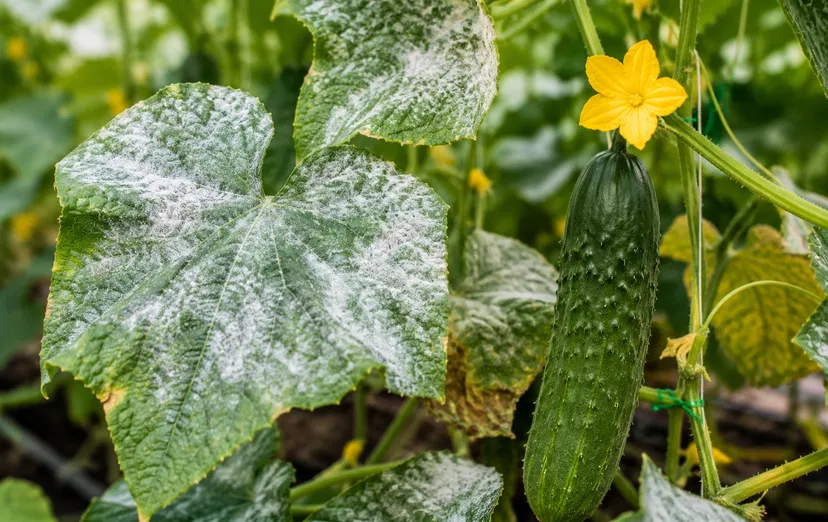
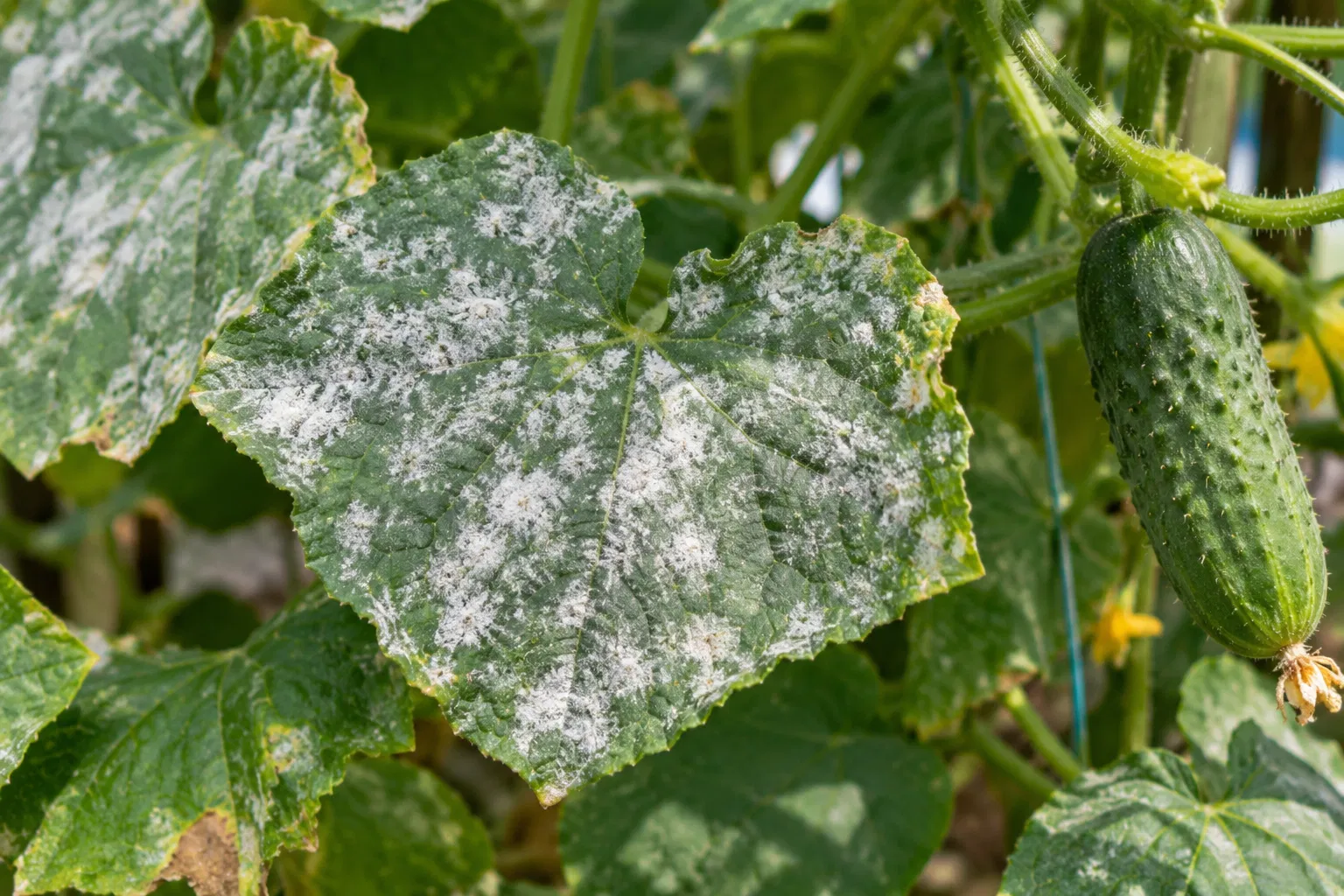
- Small, round, powdery white patches that look like a spot of talcum powder or spilled flour, first on the older leaves near the base of the plant.
- Patches that begin on the underside of the leaf as often as the upper surface, and that rub off easily on a fingertip or a wet cloth.
- Spots that enlarge, run together and eventually coat the whole leaf blade, so a leaf that was green looks dusted grey-white.
- White powder spreading onto the petioles, the stems and the tendrils not just the leaves which distinguishes it from most other cucumber leaf diseases.
- Affected leaves turning pale, then yellow, then brown and brittle, curling upward at the margins and dying while still attached to the vine.
- Premature defoliation from the crown upward, leaving fruit exposed to direct sun and prone to sunscald.
- Fruit that stays small, sets poorly, ripens unevenly and tastes flat or bitter, because the leaf area that fills it has been destroyed.
- A shortened picking season, with the vine collapsing weeks earlier than it should even though the growing point looks healthy.
- Little or no white growth on the fruit itself in most cases the damage to fruit is indirect, through the loss of leaves.
Causes
- The disease is caused by Podosphaera xanthii, still widely known by its older name Sphaerotheca fuliginea, which is the dominant cucurbit powdery mildew in most Indian growing regions. Golovinomyces cichoracearum, previously called Erysiphe cichoracearum, causes the same symptoms and occurs alongside it, more often in cooler weather.
- Unlike downy mildew and most leaf spots, this fungus does not need free water on the leaf to germinate. Spores infect a dry surface, so a dry spell offers no protection at all.
- Warm days of roughly 20 to 30 degrees Celsius with high air humidity are ideal. Very hot, dry air above the mid-thirties slows it, and heavy driving rain physically washes spores off.
- Spores are carried on wind over long distances, so the first infection usually arrives from outside your plot rather than from your own soil or crop residue.
- Protected cultivation favours it strongly. Polyhouses and tunnels give warm, still, humid air with no rain to wash leaves, which is close to a perfect environment.
- A dense canopy is the main thing you control. Close spacing, unpruned vines and heavy vegetative growth create shaded, still, humid air inside the crop where the fungus establishes long before you can see it.
- Excess nitrogen pushes soft, crowded leaf growth that is both more susceptible and harder to spray through.
- Water stress weakens the plant's own defences, so crops on inadequate or irregular irrigation break down faster once infection begins.
- Susceptible varieties. Cucumber hybrids differ enormously in their resistance to this disease, and a susceptible variety in a polyhouse will need repeated spraying no matter what else you do well.
- Older leaves are more susceptible than young ones, which is why the disease works from the bottom of the plant upward rather than from the growing tip down.
- Volunteer cucurbits, weeds in the same family and overlapping plantings of pumpkin, bottle gourd, melon or ridge gourd nearby act as a continuous source between your crops.
How to Identify
The confirming test is the simplest one in plant pathology: rub it. Powdery mildew is a superficial growth sitting on the leaf surface, so it wipes away on your thumb and leaves a slightly discoloured patch of leaf underneath. Almost nothing else on a cucumber leaf behaves that way. If what you are looking at will not rub off, it is not this disease.
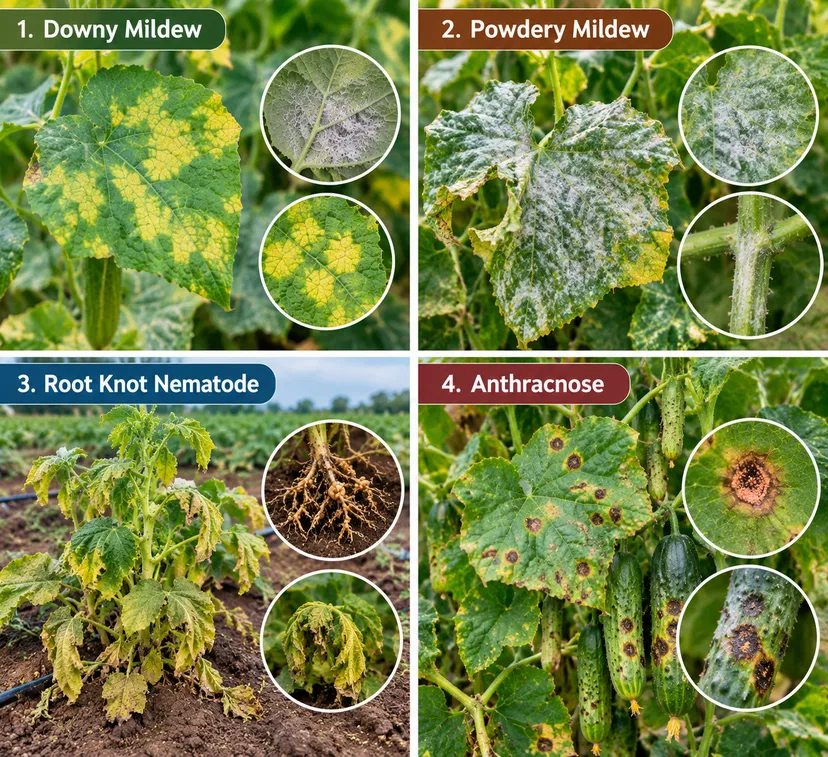
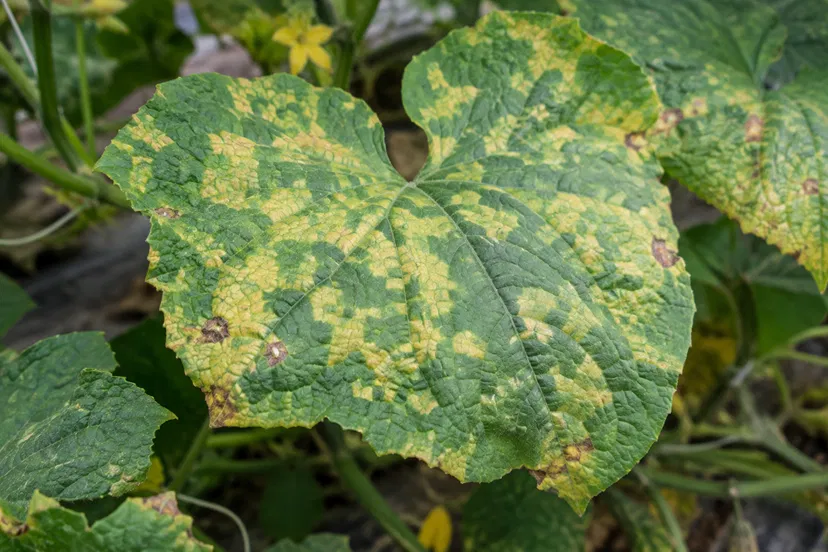
The distinction that matters most in cucumber is against downy mildew, because the two arrive in the same season, look superficially similar from a distance, and need completely different chemistry a fungicide chosen for one may do very little against the other. Downy mildew produces angular yellow patches on the upper leaf surface that stop sharply at the veins, giving a blocky, tile-like pattern, and its growth appears only on the underside as a fine grey-purple down that does not rub off cleanly. Powdery mildew makes round white patches that ignore the veins entirely, appears on both leaf surfaces, and wipes away. Downy mildew also needs leaf wetness or dew to spread, so it follows rain and irrigation; powdery mildew does not. If you are uncertain, check the underside of a fresh lesion: white and powdery means this disease, greyish and felted means downy mildew.
Finally, note where the plant is in its life. Because this disease starts on the oldest, most shaded leaves, the right place to scout is inside and underneath the canopy at the base of the plant, from around the time the vines begin to run. Checking only the top of the canopy will reliably tell you the crop is clean right up until it is not.
Control Methods
Chemical Control
1. Azoxystrobin 23% SC
Azoxystrobin is a systemic strobilurin that blocks respiration inside the fungal cell, stopping the energy supply the pathogen needs to grow and produce spores. It moves within the leaf and has useful vapour action, which helps it reach a little beyond where the droplet landed genuinely valuable in a dense cucumber canopy where perfect coverage is impossible. It works best applied early, at the first sign of infection or just before, rather than as a rescue treatment on a crop already coated white. Use it once in a season rather than repeatedly, for the reason set out below.
Product Recommendation
2. Fluxapyroxad 250 g/l + Pyraclostrobin 250 g/l SC
This pairs two systemic actives that both attack fungal respiration but at different points in the chain, so the combination is considerably harder for the pathogen to overcome than either alone. Fluxapyroxad belongs to the carboxamide group and pyraclostrobin to the strobilurins. In practice this is one of the stronger options against powdery mildew, with good curative activity on colonies that have already established and long-lasting protection on new growth. It suits the situation where you have found the disease low in the canopy and need to stop it climbing.
Product Recommendation
3. Fluxapyroxad 75 g/l + Difenoconazole 50 g/l SC
Here fluxapyroxad is paired instead with difenoconazole, a triazole that works on a completely different target the production of ergosterol, a building block of the fungal cell membrane. That gives you two unrelated modes of action in one spray and a different second partner from the product above, which matters when you are planning a season rather than a single application. Triazoles also give some curative reach into a colony that has already begun, so this is a reasonable choice for a follow-up spray.
Product Recommendation
4. Metrafenone 500 g/l SC
Metrafenone is the most useful product on this list for a reason that has nothing to do with raw strength: it is chemically unrelated to everything else here. It interferes with the way the fungus builds its cell structure and directs its own growth, a target no other product in this article shares. It is also specific to powdery mildew rather than broad-spectrum, and it has strong activity on the surface growth and on spore production, which means it both stops the colony spreading and reduces what it sends to the rest of your crop. If you can only fit one non-strobilurin product into your programme, this is the one to fit, and it is the single best rotation partner available to you.
Product Recommendation
5. Azoxystrobin 4.7% + Mancozeb 59.7% + Tebuconazole 5.6% WG
A three-way combination whose powdery mildew work is done by the azoxystrobin and the tebuconazole, a triazole. Mancozeb is a broad protectant that contributes very little against powdery mildew specifically; what it adds is cover against the other diseases that arrive in the same season, such as downy mildew and anthracnose, plus a multi-site partner that supports resistance management. Be clear about where this fits: mancozeb leaves a visible deposit and a substantial residue load, which is awkward on a crop you are picking every few days for fresh market. Use this earlier in the crop, during vegetative growth and before fruiting begins, rather than in the middle of a harvest run.
Product Recommendation
6. Azoxystrobin 4.8% + Chlorothalonil 40% SC
The same logic applies to this pairing. Azoxystrobin supplies the systemic activity against powdery mildew; chlorothalonil is a multi-site protectant that is strong on anthracnose, downy mildew and leaf spots but only moderately active against powdery mildew. Its value here is broad cover and resistance management rather than being the main answer to this particular disease. Chlorothalonil can also mark cucurbit foliage under hot conditions and carries residue limits that matter for graded and export fruit, so treat it as an early-season and pre-fruiting tool and keep it away from the picking window.
Product Recommendation
Fitting Sprays Around a Continuous Harvest
This is the constraint that shapes everything in cucumber and gets almost no attention. You are not spraying a crop you harvest once. You are picking every two or three days for weeks, and many systemic fungicides carry a waiting period between the last spray and harvest that is longer than the gap between your pickings. Running an intensive spray programme through a picking run is therefore genuinely difficult to do legally and safely, and residue failures on fresh cucumber are common for exactly this reason. Plan around it: put your strongest and longest-residue products in early, before flowering and fruit set, so that the crop enters the harvest phase with the disease already suppressed. Once picking starts, shift toward the shortest-interval options, confirm the pre-harvest interval for each product on its label for your state before every spray, and lean more heavily on canopy management and the biological option. A grower who gets ahead of this disease in the vegetative phase has far fewer difficult choices later.
Getting Spray to the Underside of the Leaf
Because the disease begins on shaded lower leaves and often on their undersides, a spray that only wets the top of the canopy treats the part of the plant that is not yet infected. On a trellised crop, direct nozzles inward and upward from both sides of the row, not just downward from above. Use enough water volume to reach the crown on a dense canopy this usually means more than growers expect and increase it as the crop grows rather than keeping the same volume from planting to picking. A non-ionic wetting agent helps the spray spread over the waxy leaf and stick to the powdery colony rather than beading off it. Walking the same row with half the water and twice the concentration is not a substitute; the issue is where the liquid physically goes, not how strong it is.
Spray in the Cool Part of the Day
Cucumber leaves and fruit mark easily. Several of the products here, and most wetting agents and oils, can scorch foliage or blemish fruit skin when applied in strong sun and high temperature, and blemished cucumber loses grade even when the plant is otherwise healthy. Spray in the early morning or late evening, avoid applications when the crop is under water stress, and be especially careful inside a polyhouse where temperatures run higher than outside. Never tank-mix an oil-based product with sulphur or apply the two close together on cucurbits that combination is a well-known cause of leaf burn.
Biological Control
1. Ampelomyces quisqualis 2.0% AS
This one is worth understanding properly, because it is not a fungicide in the ordinary sense. Ampelomyces quisqualis is a fungus that parasitizes powdery mildew fungi specifically it invades the mildew colony, feeds on it from inside and destroys its spore-producing structures. It attacks the pathogen directly rather than poisoning it, so resistance is not a practical concern, and it does nothing to the crop or to beneficial insects.
Its limitations are equally real, and knowing them is what makes it useful. It is slow, taking days rather than hours to visibly check a colony, and it will not rescue a canopy that is already white. It needs reasonably humid conditions to establish. And it works best applied preventively or at the very first trace of infection, when colonies are small and there is still time for the parasite to get ahead. Where it earns its place in cucumber is precisely during the harvest run, when residue limits and pre-harvest intervals make conventional spraying awkward here you have something you can apply repeatedly without a residue problem, and it gives your chemical programme real breathing room. Apply it in the evening, avoid tank-mixing it with fungicides that would kill it, and keep the treated crop humid enough for it to establish.
Product Recommendation
- Katyayani Ampelomyces Quisqualis Bio Fungicide
- Anand Agro Dr. Bacto's Ampelo Bio Fungicide
- EBS Ampelomyces Quisqualis Bio Fungicide
- Milgo Ampelomyces Quisqualis Bio Fungicide
- Sun Bio Ampelo Bio Fungicide
Cultural Control
- Choose a resistant variety. Cucumber hybrids vary enormously in their susceptibility to this disease, and a resistant one can reduce the number of sprays a season needs to a fraction. This is the single highest-value decision available, and it is made before planting.
- Open up the canopy. Wider spacing, trellising, and training vines vertically so air moves through the crop attacks the humid, still, shaded microclimate the fungus depends on. This is worth more than most growers credit it with.
- Remove the lower and older leaves as the crop develops. These are the most susceptible tissue, the first to be infected, and the least productive. Taking them off removes the launch pad and improves airflow at the crown at the same time.
- Ventilate protected structures. Opening polyhouse and tunnel vents during the day to move humid air out changes the conditions inside markedly, and in protected cucumber this is often the difference between a manageable infection and a season-long fight.
- Keep nitrogen in balance. Heavy nitrogen produces soft, crowded growth that is both more susceptible and harder to spray through. Adequate potassium supports sturdier tissue.
- Irrigate steadily at the root zone. Consistent moisture keeps the plant's own defences working; drip irrigation avoids wetting foliage for the other diseases while doing nothing to help this one, which needs no water anyway.
- Do not plant a new cucurbit crop next to an old infected one. Overlapping plantings of cucumber, pumpkin, gourd or melon let the fungus move straight from the finishing crop into the new one on the wind.
- Clear volunteer cucurbits and related weeds from field margins, and destroy crop residue after harvest rather than leaving infected vines at the edge of the plot.
- Scout the base of the plant weekly from the time the vines run, lifting the lower leaves and checking undersides. Finding the first colonies is the whole game; everything above works better applied early and worse applied late.
Physical Control
Where infection is still limited to a handful of leaves low in the canopy, cutting those leaves off and removing them from the field is a genuinely effective step and costs nothing but time. Do it with clean secateurs, collect the leaves into a bag rather than dropping them between the rows, and destroy or bury them away from the crop leaves left on the ground continue releasing spores into the canopy above them. This is most worthwhile in polyhouses and on small plots, where a careful pass through the crop can remove most of the inoculum before it multiplies.
The same logic applies at the end of the season. Pull and destroy the spent vines promptly instead of leaving them to dry at the field edge, particularly if another cucurbit crop is going in nearby or a neighbouring plot is still in production. And keep the crop free of the dust that accumulates on foliage near unpaved roads and pathways, since a dusty leaf both hides early symptoms and makes it harder for a spray to reach the leaf surface properly.
Conclusion
Powdery mildew in cucumber rewards two habits and punishes the lack of them. The first is looking in the right place at the right time: under the canopy, on the old leaves at the crown, from the moment the vines begin to run not at the top of the plant once the white patches are obvious. The second is planning a season rather than reacting to a week. Because so many of the products available share a strobilurin, and two of the strongest share a carboxamide partner, it is easy to spray four times and hit the same target every time, which is how growers lose the chemistry that was working. Build the programme around genuine differences in mode of action, put the longest-residue products in before fruit set so the picking run is not spent fighting both the disease and the pre-harvest interval, lean on the biological option during harvest, and do the unglamorous work of opening the canopy and stripping the old leaves. Start with a resistant variety and all of it gets easier.
Disclaimer: Always confirm current label registration, approved dosage, water volume, and pre-harvest interval (PHI) for your state before using any product, since labels are periodically revised by regulatory authorities.
This guide is a general advisory. Do your own research and verification before using any product. Always confirm suitability for your crop stage, region, and field conditions before making any purchase, spray, or crop-management decision.