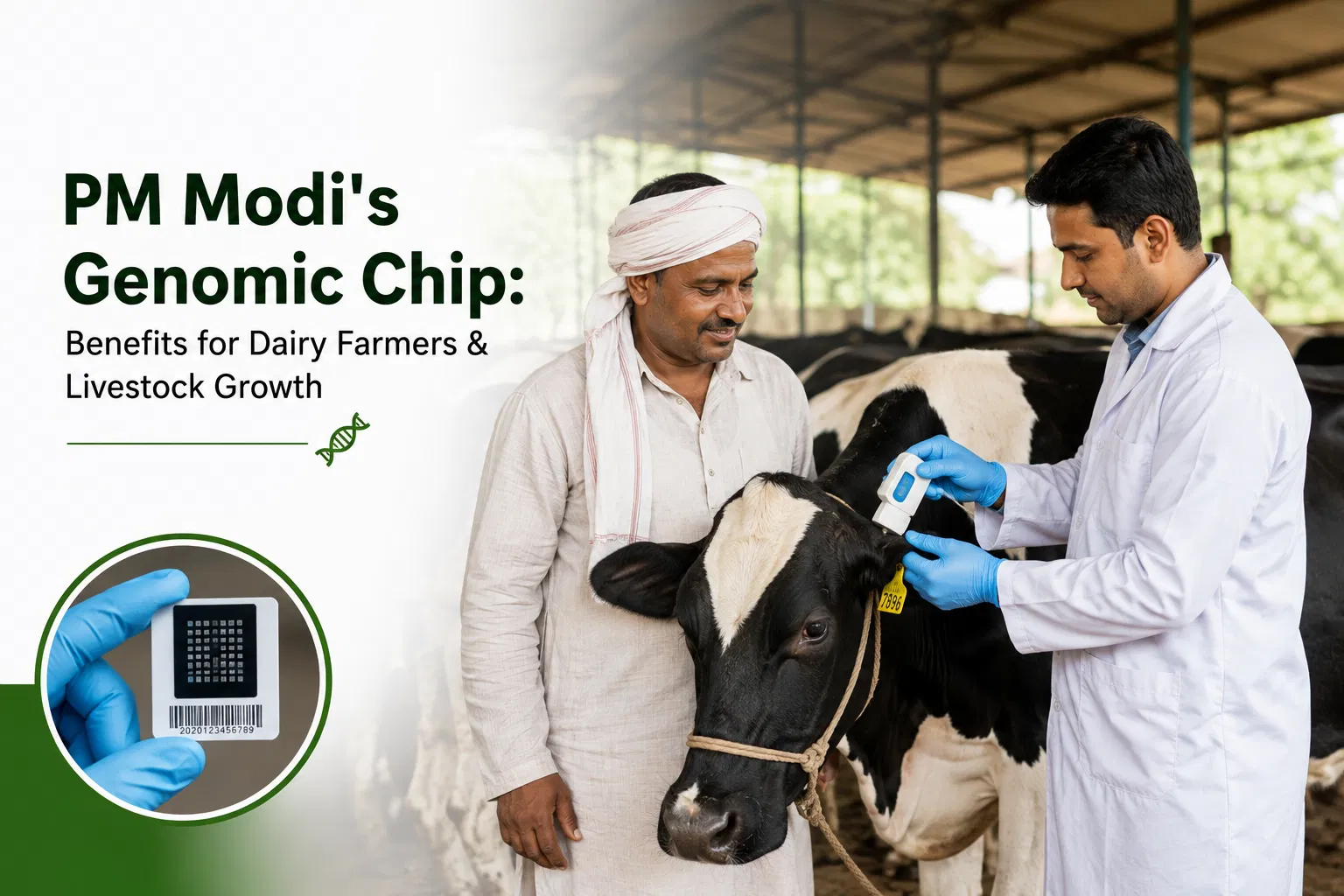
Prime Minister Narendra Modi launched the Unified Genomic Chip on 5 October 2024 at Pohara Devi, Washim, Maharashtra, as part of a package of agriculture and animal husbandry initiatives worth around ₹23,300 crore. The chip was developed to solve a long-standing challenge in Indian dairy farming: identifying which young bulls and cows carry genuinely superior genetic traits used to take years of observation and milk-record data, by which time much of the breeding opportunity was already lost. This SNP (Single Nucleotide Polymorphism) chip reads an animal's DNA directly, so its genetic potential for traits like milk yield and disease resistance can be estimated almost from birth — a scientific leap for a country that has traditionally relied on indigenous cattle and buffalo breeds for its dairy economy.
Unified Genomic Chip Overview
- Initiative Name – Unified Genomic Chip, comprising the "Gau Chip" for indigenous cattle and the "Mahish Chip" for buffaloes
- Launch Date – 5 October 2024, by Prime Minister Narendra Modi at Pohara Devi, Washim, Maharashtra
- Developed By – A consortium led by the National Dairy Development Board (NDDB), with the ICAR-National Bureau of Animal Genetic Resources (NBAGR) and BAIF Development Research Foundation, under the Department of Animal Husbandry and Dairying (DAHD)
- Implementing Programme – Delivered as part of the Revised Rashtriya Gokul Mission (RGM), with a total outlay of ₹3,400 crore for the 15th Finance Commission cycle (2021-22 to 2025-26)
- Type – Central Government technology initiative (Central Sector component), part of the "Make in India" and "Atmanirbhar Bharat" push in dairy breeding technology
- Helpline No – Kisan Call Centre, 1800-180-1551; farmers can also contact their district Animal Husbandry Department or nearest Artificial Insemination (AI) centre under RGM
- States Covered – All-India, delivered through the Nationwide Artificial Insemination Programme (NAIP), currently active in 605 districts where baseline AI coverage was below 50%
Objectives of the Initiative
- Identify High Genetic Merit (HGM) bulls and cows at a young age, rather than waiting years for milk-yield records
- Accelerate genetic improvement in indigenous cattle and buffalo breeds through genomic selection
- Reduce dependence on imported breeding technology by developing an indigenous, affordable genomic testing tool
- Improve dairy farming efficiency and milk productivity across India's livestock population
- Support the conservation and genetic strengthening of India's native cattle and buffalo breeds
Key Features of the Gau Chip and Mahish Chip
- The Unified Genomic Chip is an SNP (Single Nucleotide Polymorphism) chip that reads specific points in an animal's DNA to assess its genetic quality
- Two variants exist: the "Gau Chip" tailored for indigenous cattle breeds, and the "Mahish Chip" tailored for buffaloes
- Developed by pooling genome sequence and genotype data from multiple research organisations, led by NDDB in partnership with NBAGR and BAIF
- Enables genomic selection — evaluating an animal's breeding value directly from its DNA rather than relying solely on pedigree or milk-yield history
- Works alongside "Gau Sort," an indigenously developed sex-sorted semen technology also launched by NDDB, which produces predominantly female calves with over a 90% success rate
- Sex-sorted semen technology has cut the cost per dose from around ₹1,000 (for earlier imported technology) to about ₹200, with government assistance covering up to 50% of the cost for participating farmers
- Delivered through the Nationwide Artificial Insemination Programme (NAIP), which already provides free-of-cost AI at farmers' doorsteps in 605 identified districts, having covered over 8.39 crore animals and benefited over 5.21 crore farmers so far
- Complemented by 22 In Vitro Fertilisation (IVF) labs set up under State Livestock Boards and universities, which have produced over 2,541 High Genetic Merit calves
Benefits to Dairy Farmers and Livestock Growth
- Farmers can identify young, high-quality bulls and cows early, well before traditional milk-record-based selection would reveal their genetic potential
- Better-informed breeding decisions lead to higher milk yield and improved herd quality over successive generations
- Reduced number of non-productive or low-yield animals, making dairy farming more economically sustainable for smallholders
- Access to sex-sorted semen at a fraction of the earlier cost, helping farmers produce more female calves and grow their dairy herd faster
- Strengthens the genetic quality of indigenous cattle and buffalo breeds, supporting long-term breed conservation alongside productivity gains
- Delivered largely free-of-cost or heavily subsidised through the Rashtriya Gokul Mission's artificial insemination and breeding infrastructure
Limitations to Keep in Mind
- Genomic testing and its full benefits are most accessible through the artificial insemination and breeding infrastructure under RGM, so farmers outside the 605 focus districts or without nearby AI centres may have more limited direct access
- As a relatively new technology (launched October 2024), rollout and awareness are still expanding across states and districts
- Sex-sorted semen assistance covers up to 50% of cost — farmers still bear the remaining cost, though it is significantly lower than earlier imported alternatives
- Realising the full benefit of genomic selection depends on farmers consistently using AI and follow-up breeding services rather than one-off adoption
- As with other advanced breeding technologies, benefits build up gradually across generations of animals rather than delivering an immediate, one-time gain
Documents Required
- Aadhaar Card
- Proof of livestock ownership (cattle/buffalo registration, where maintained locally)
- Bank account passbook, for subsidy-linked components such as sex-sorted semen assistance
- Registration with the local Artificial Insemination (AI) centre or Animal Husbandry Department, where applicable
How Farmers Can Access These Benefits
- Contact your district Animal Husbandry Department or nearest Artificial Insemination (AI) centre to check if genomic selection and sex-sorted semen services are available in your area under the Rashtriya Gokul Mission.
- Register your animal for artificial insemination services, which are provided free-of-cost at the farmer's doorstep in identified districts under the Nationwide Artificial Insemination Programme.
- Where sex-sorted semen is opted for, apply through the AI centre to avail the government's cost assistance (up to 50% of the cost).
- Follow up with your local Animal Husbandry Department or State Livestock Board for updates on genomic testing availability for your cattle or buffalo.
- Use the genomic and breeding data provided to make informed decisions on which animals to retain, breed further, or upgrade in your herd.
- Stay in touch with your nearest IVF lab or State Livestock Board if you're interested in High Genetic Merit heifer programmes linked to this technology.
Conclusion
The Unified Genomic Chip represents a genuine scientific leap for India's dairy sector — turning what used to be years of guesswork into a DNA-based assessment that can identify a superior bull or cow almost from birth. Paired with indigenous sex-sorted semen technology and delivered through the free doorstep artificial insemination network of the Rashtriya Gokul Mission, it gives dairy farmers a realistic path to stronger, more productive herds built on India's own indigenous breeds. As the rollout expands across more districts, this technology is set to play a growing role in improving both milk productivity and the long-term genetic health of India's cattle and buffalo population.
[Disclaimer: This article is for informational purposes only. Scheme details, interest rates, and subvention amounts are subject to periodic revision by the Government of India, RBI, and NABARD. Farmers are advised to verify the latest terms and eligibility criteria with their bank, NABARD, or official government sources before applying.]