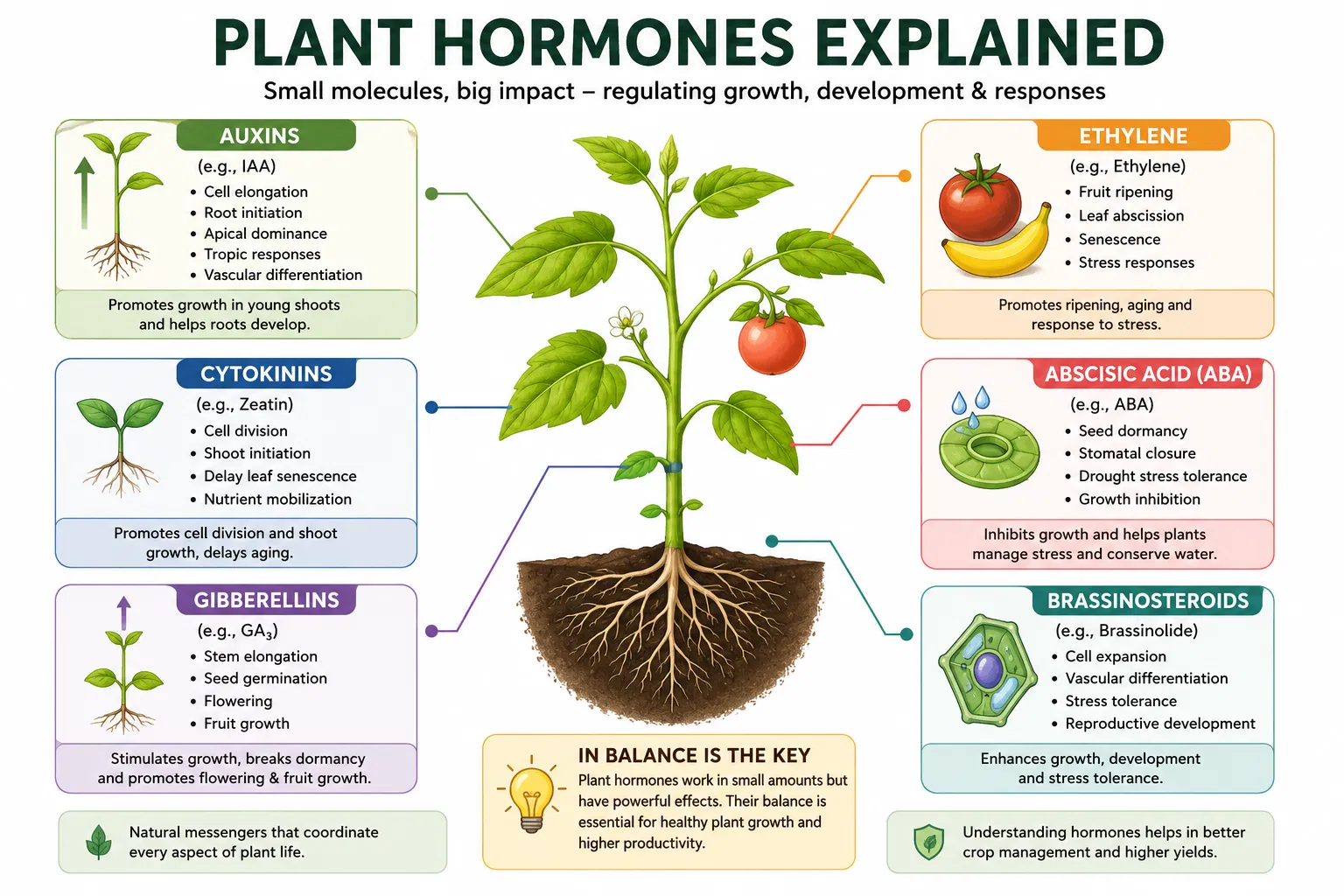
Plants may look still and silent, but inside every stem, leaf, root, and flower, powerful chemical signals are constantly at work. These signals, known as plant hormones or phytohormones, control how plants grow, respond to stress, bloom, and even age. If you have ever wondered why a plant bends toward sunlight, seeds suddenly sprout, or fruit ripens at just the right time, plant hormones are the reason.
Understanding plant hormones explained in simple terms can help gardeners, farmers, students, and plant lovers better appreciate how plants survive and thrive. In this guide, we will break down the major plant hormones—auxins, gibberellins, cytokinins, abscisic acid, and ethylene—and explore how each one shapes plant life.
What Are Plant Hormones?
Plant hormones are natural chemical messengers that regulate growth and development in very small amounts. Unlike animals, plants do not have nerves or a brain. Instead, they rely on hormones to send signals from one part of the plant to another.
These hormones influence nearly every stage of a plant's life cycle, including:
- Seed germination
- Root and shoot growth
- Flowering and fruiting
- Leaf drop and dormancy
- Responses to light, gravity, drought, and damage
Although each hormone has a primary role, plant hormones often work together in complex ways. Their balance is what determines how a plant grows and responds to its environment.
Auxins: The Growth and Direction Hormones
Auxins were the first plant hormones discovered, and they remain some of the most important. They are produced mainly in the tips of growing shoots and young leaves.
One of their best-known roles is promoting cell elongation, especially in stems. This helps plants grow upward and bend toward light, a process called phototropism. Auxins also help control apical dominance, which is why the main stem often grows stronger than side branches.
Key functions of auxins
- Stimulate stem elongation
- Help roots develop, especially at low concentrations
- Control phototropism and gravitropism
- Maintain apical dominance
- Support fruit development and prevent premature leaf drop
Auxins are widely used in agriculture and horticulture. Synthetic auxins can help with rooting cuttings or, in higher doses, act as weed killers for broadleaf weeds.
In simple terms: auxins tell plants where and how to grow.
Gibberellins: The Elongation and Germination Boosters
Gibberellins are plant hormones that play a major role in stem elongation, seed germination, and flowering. They are especially important in young, actively growing tissues and developing seeds.
One of the most important functions of gibberellins is helping break seed dormancy. When conditions are right, gibberellins trigger enzymes that mobilize stored food in the seed, giving the embryo the energy it needs to grow.
Key functions of gibberellins
- Promote stem and internode elongation
- Break seed dormancy and support germination
- Stimulate flowering in some plants
- Support fruit growth and development
- Help some plants overcome dwarf growth
Gibberellins are also used commercially to increase fruit size, improve grape production, and encourage uniform germination in crops. Their effect is especially noticeable in plants that are genetically dwarf or short-stemmed.
Cytokinins: The Cell Division Hormones
Cytokinins are hormones that mainly stimulate cell division and delay aging in plant tissues. They are produced in root tips and transported upward through the plant.
These hormones often work in balance with auxins. While auxins promote root formation, cytokinins support shoot growth. The ratio between the two can influence whether a plant develops more roots or more shoots.
Key functions of cytokinins
- Promote cell division
- Encourage shoot growth
- Delay leaf aging and senescence
- Support nutrient movement within the plant
- Help regulate bud growth and branching
Cytokinins are important for keeping leaves greener for longer. They also help plants recover from stress and maintain active growth in young tissues.
Abscisic Acid: The Stress and Dormancy Hormone
Abscisic acid, often abbreviated as ABA, is best known as the plant's stress hormone. It helps plants respond to unfavorable conditions, especially drought.
When water is limited, ABA signals stomata—the tiny pores on leaves—to close. This reduces water loss through transpiration. It also helps seeds remain dormant until conditions are suitable for germination.
Key functions of abscisic acid
- Closes stomata during drought stress
- Promotes seed dormancy
- Helps plants survive environmental stress
- Slows growth when conditions are poor
Although its name suggests it causes abscission, abscisic acid is now understood mainly as a regulator of stress response and dormancy. It helps plants conserve energy and water when survival is at risk.
Ethylene: The Ripening and Aging Hormone
Ethylene is a unique plant hormone because it is a gas. It influences fruit ripening, flower wilting, leaf fall, and many stress responses.
Ethylene is especially important in fruits such as bananas, apples, and tomatoes. When fruit begins to ripen, ethylene production increases, triggering softening, color change, and sugar development.
Key functions of ethylene
- Promotes fruit ripening
- Accelerates leaf and flower aging
- Triggers leaf and fruit drop
- Helps plants respond to stress or injury
- Influences stem elongation in some cases
In agriculture, ethylene management is important for storing and transporting produce. Farmers and distributors often control ethylene exposure to slow ripening or ripen fruit on demand.
How Plant Hormones Work Together
Plant hormones do not act alone. Their effects depend on timing, location, concentration, and interaction with other hormones. A single hormone can produce very different outcomes depending on the tissue it affects.
For example:
- Auxins and cytokinins balance root and shoot formation
- Gibberellins and ABA often have opposite effects on seed germination
- Ethylene and auxins interact during fruit development and leaf drop
This chemical teamwork allows plants to adapt to changing conditions with remarkable precision.
Why Plant Hormones Matter in Agriculture and Gardening
Knowing how plant hormones work is useful far beyond the classroom. Farmers and gardeners use hormone knowledge to improve crop yield, manage growth, and solve common plant problems.
Here are a few practical applications:
- Rooting cuttings: Auxin-based products help cuttings develop roots faster.
- Seed treatment: Gibberellins can help break dormancy and improve germination.
- Fruit ripening: Ethylene is used to ripen fruit more evenly after harvest.
- Stress management: Understanding ABA helps explain how plants survive drought.
- Growth control: Cytokinins and auxins help shape plant form in nurseries and greenhouses.
These hormones are not just scientific concepts—they have real-world value in food production, landscaping, and plant care.
Conclusion
Plant hormones are the hidden force behind everything from seed sprouting to fruit ripening. Auxins direct growth, gibberellins encourage elongation and germination, cytokinins drive cell division, abscisic acid helps plants survive stress, and ethylene controls ripening and aging. Together, they form an elegant internal communication system that keeps plants alive and adapting.
If you want to understand plants more deeply, start by looking at their hormones. Once you see how these chemical messengers shape growth and survival, the plant world becomes far more fascinating. Keep exploring, and you will discover that even the quietest green life is full of activity.