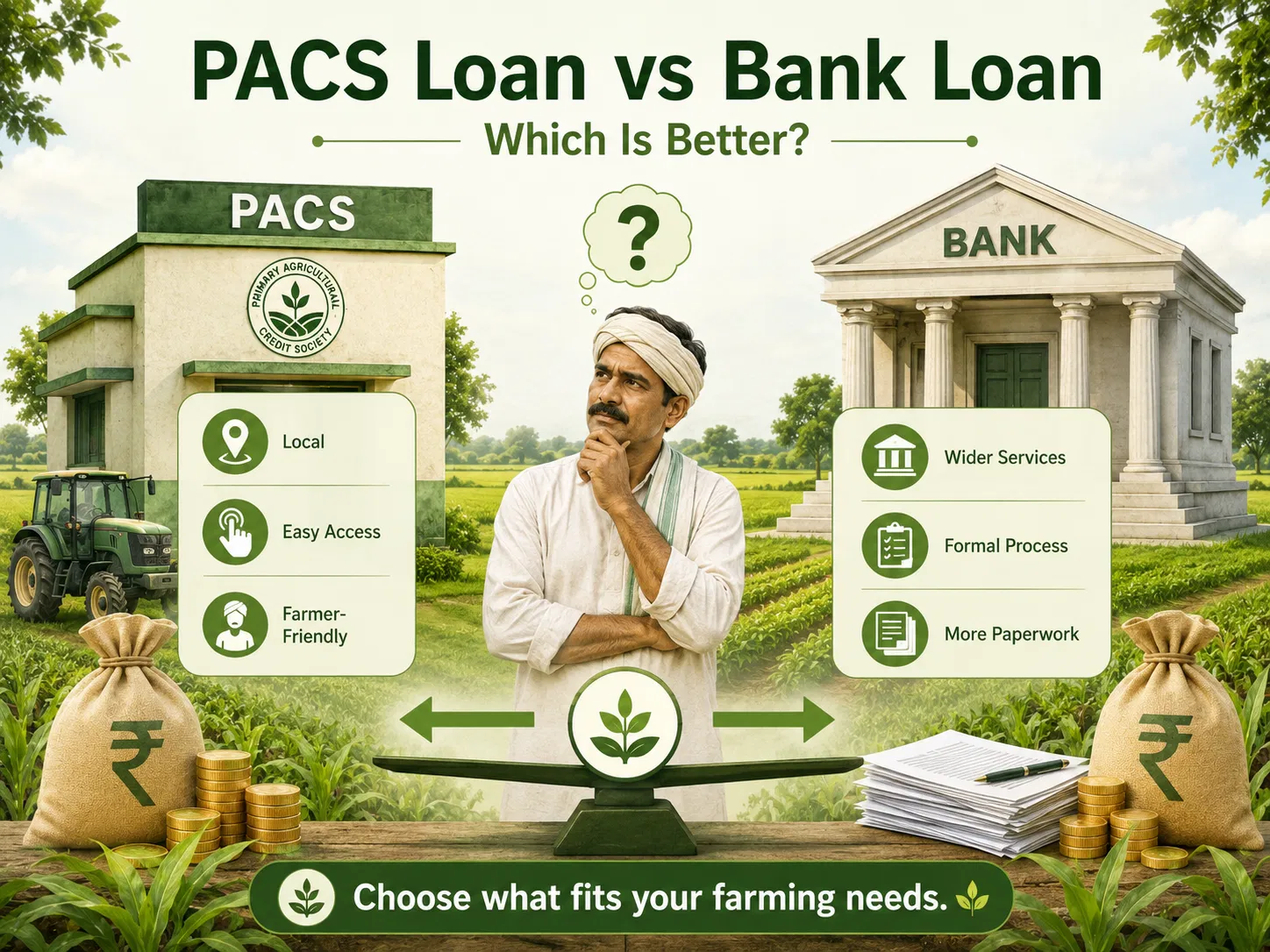
Farmers in India generally borrow through two routes: Primary Agricultural Credit Societies (PACS) at the village level, or commercial/public sector banks and Regional Rural Banks (RRBs). Both channels are part of the same government-backed credit push through the Kisan Credit Card (KCC) and the Modified Interest Subvention Scheme (MISS), but they differ in reach, processing style, and borrower experience. According to government data, cooperative institutions including PACS account for roughly 41% of all KCC loans issued nationally, and 95% of PACS-linked KCC loans go to small and marginal farmers — showing how central PACS remain to rural credit, even as commercial banks handle a large share of loan value.
PACS Loan vs Bank Loan: Key Differences
| Factor | PACS Loan | Commercial/Public Sector Bank Loan |
|---|---|---|
| Location & reach | Village-level, present in over 93% of gram panchayats | Branch-based; concentrated more in towns and district centres |
| Regulation | Registered under state Cooperative Societies Act; outside direct RBI regulation | Regulated by RBI under the Banking Regulation Act |
| Interest rate (KCC-linked) | 7% base, effective ~4% with MISS subvention and prompt repayment | Same 7% base and ~4% effective rate under MISS, as both channels follow RBI/NABARD guidelines |
| Collateral requirement | Loans up to ₹2 lakh generally collateral-free under KCC norms | Same ₹2 lakh collateral-free limit under KCC norms |
| Processing style | Personal, relationship-based; managed by local elected committee | More formal, document-driven process with bank officers |
| Deposit/institution safety | PACS deposits are not covered by DICGC insurance; financial health varies by society | Bank deposits are DICGC-insured up to ₹5 lakh per depositor |
| Loan share of allied activities | Strong presence in crop loans; PACS are transitioning into Multi-Service Centres for wider services | Wider range of loan products, including term loans for equipment, dairy, and infrastructure |
Objectives Behind Both Credit Channels
- Deliver affordable, subsidised short-term credit to farmers through KCC
- Reduce dependence on informal, high-interest moneylenders
- Extend rural credit coverage down to the village level through PACS while offering broader financial products through banks
- Ensure timely disbursal aligned with the crop cycle
Key Features Compared
- Both PACS and banks issue KCC-linked loans eligible for the same MISS interest subvention and Prompt Repayment Incentive
- PACS loans are sanctioned by a local elected management committee familiar with the borrower and the land
- Bank loans go through a branch-level credit appraisal process, which can involve more documentation for larger amounts
- Cooperative banks and PACS together process the largest share of KCC applications nationally, ahead of commercial banks and RRBs
- Both channels now route interest subvention and Prompt Repayment Incentive claims digitally through the Kisan Rin Portal
Benefits: When PACS Works Better
- Loan access without travelling far, since PACS are present in most villages
- Simpler membership and application process suited to small and marginal farmers
- Local, personal relationship with the lender, which can help with flexibility during genuine hardship
- Often bundled with input supply, storage, and marketing support alongside credit
Benefits: When a Bank Loan Works Better
- Broader loan products beyond crop loans, term loans for tractors, irrigation, dairy sheds, and other investments
- Stronger regulatory oversight and deposit insurance protection
- Better suited for farmers seeking larger loan amounts or a full banking relationship, including savings and digital banking services
- More standardised service quality across branches, since operations are centrally regulated
Limitations to Keep in Mind
- Not all PACS are financially healthy, an RBI report found only a little under half of all PACS were operating in profit
- PACS loan terms and efficiency can vary significantly from one society to another, depending on local management
- Banks may involve more paperwork and longer processing time for first-time or small-ticket borrowers
- Both channels cap the concessional MISS interest rate at the notified KCC loan limit; borrowing beyond it attracts standard interest
Documents Required (Common to Both)
- Aadhaar Card
- Land ownership or tenancy/lease proof
- Bank/PACS account passbook
- KCC application form
- Passport-size photograph
- PACS membership/share receipt (PACS route only)
How to Decide and Apply
- If you need a small, short-term crop loan and want quick, local access, start with your village PACS.
- If you need a larger loan, a term loan for equipment or infrastructure, or a fuller banking relationship, approach a commercial or public sector bank branch.
- Either way, apply for or use your Kisan Credit Card, since MISS interest subvention and the Prompt Repayment Incentive apply only to KCC-linked loans.
- Submit Aadhaar, land documents, and the KCC form at the chosen institution.
- Link Aadhaar to your loan account, as this is mandatory to claim the interest subvention.
- Repay on or before the due date to secure the Prompt Repayment Incentive and keep the effective rate near 4%.
Conclusion
Neither PACS nor bank loans are universally "better" — both operate under the same KCC and MISS framework, so the effective interest rate is largely the same. The real difference lies in reach, convenience, and the range of services on offer. PACS suit farmers who want quick, local, relationship-based credit for crop needs, while banks suit those who need larger loans, more product variety, or stronger institutional safeguards. Many farmers use both, depending on the purpose of the loan.
Disclaimer: This article is for informational purposes only. Scheme details, interest rates, and subvention amounts are subject to periodic revision by the Government of India, RBI, and NABARD. Farmers are advised to verify the latest terms and eligibility criteria with their bank, NABARD, or official government sources before applying.