Introduction
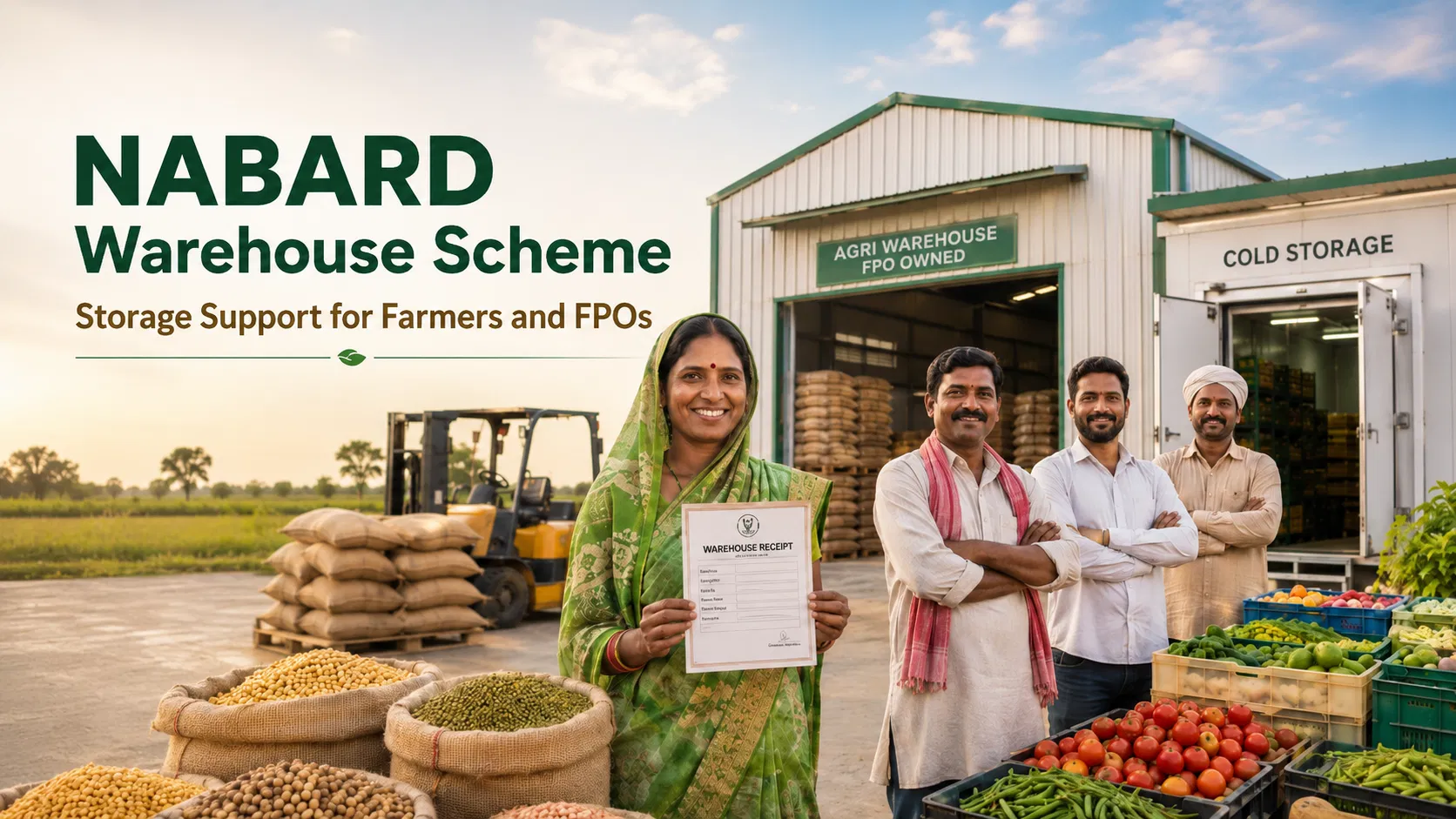
Poor storage is one of the biggest reasons Indian farmers are forced into distress sales right after harvest, when prices are at their lowest. To fix this, the National Bank for Agriculture and Rural Development (NABARD) channels both subsidy and refinance for building rural godowns, warehouses, and cold storage. The current umbrella for godown-level subsidy is the New Agricultural Marketing Infrastructure (AMI) sub-scheme of ISAM, which replaced the older Rural Godown Scheme (Gramin Bhandaran Yojana). For larger, capacity-heavy storage and cold-chain projects, NABARD also runs the Warehouse Infrastructure Fund (WIF). Both routes are open to individual farmers, Farmer Producer Organisations (FPOs), cooperatives, and private entrepreneurs, and both work through participating banks rather than direct lending by NABARD.
NABARD Warehouse Scheme Overview
- Scheme Name — New Agricultural Marketing Infrastructure (AMI) sub-scheme of ISAM (godown/warehouse subsidy); Warehouse Infrastructure Fund (WIF) for large-capacity storage loans
- Administering Body — Ministry of Agriculture & Farmers' Welfare (AMI) and NABARD as channelising/refinancing agency
- Scheme Fund Allocated — WIF corpus of ₹5,000 crore; AMI subsidy is credit-linked and released project-wise, with no fixed corpus cap
- Scheme Status — AMI sub-scheme of ISAM approved for continuation up to 31 March 2026; WIF is an ongoing refinance window
- Type of Scheme — Central Government, implemented through NABARD and empanelled banks
- Helpline No — 022-2653 9895 / 022-2653 9897
- States Covered — All India, with enhanced subsidy for North Eastern Region and hilly areas
Objectives of the Scheme
- Create scientific storage capacity for foodgrains and other agricultural produce close to the farm-gate.
- Prevent distress sale of crops by giving farmers a way to hold produce until prices improve.
- Strengthen agricultural marketing infrastructure, including Grameen Agricultural Markets (GrAMs).
- Support primary processing, grading, and packaging facilities alongside storage.
- Enable warehouse receipt-based pledge financing so farmers can borrow against stored produce.
Key Features of the NABARD Warehouse Scheme
- Under the AMI sub-scheme, eligible projects get a back-ended capital subsidy of 25% of project cost for general applicants and 33.33% for SC/ST, women entrepreneurs, FPOs, and projects in the North East or hilly regions.
- Subsidy is released in two tranches — an advance instalment held in a Subsidy Reserve Fund, and the balance after a Joint Inspection Committee verifies construction.
- The subsidy is adjusted against the loan only after the entire loan and interest are repaid, with adjustment starting no earlier than five years from first disbursement.
- WIF supports larger-scale projects — warehouses, silos, cold storage, and cold-chain infrastructure — with a minimum aggregate capacity of 5,000 metric tonnes, financed through public and private sector loans.
- Both individual farmers/entrepreneurs and collective entities such as FPOs, cooperatives, and Primary Agricultural Credit Societies (PACS) are eligible applicants.
NABARD Warehouse Scheme Benefits to Farmers and FPOs
- Significantly lower project cost through back-ended capital subsidy, easing the burden of building scientific storage.
- Higher 33.33% subsidy for FPOs, SC/ST beneficiaries, and women entrepreneurs, encouraging inclusive infrastructure ownership.
- Ability to avoid distress sales by holding produce in proper storage until market prices are favourable.
- Access to pledge loans against warehouse receipts, improving short-term liquidity without selling stock.
- Support for both small rural godowns and large-scale cold-chain or silo projects under a single NABARD-linked ecosystem.
- Better produce quality and reduced post-harvest losses through grading, packaging, and controlled storage.
Limitations of the Scheme
- Subsidy is available only for credit-linked projects; self-financed or informal storage construction does not qualify.
- The AMI sub-scheme's subsidy ceiling is capped in absolute terms (for example, up to roughly ₹25 lakh for general category and ₹30 lakh for the 33.33% category, depending on project type), so very large projects will need additional financing routes.
- Subsidy release and final adjustment depend on a Joint Inspection Committee's verification, which can take time after construction is completed.
- WIF's minimum 5,000 MT capacity requirement puts it out of reach for a single small farmer; it suits FPOs, cooperatives, or larger developers.
- Scheme continuation dates (currently approved only up to 31 March 2026 for AMI) mean terms can change; applicants should check current validity before planning a project.
Documents Required
- Aadhaar Card and valid photo ID/address proof of the applicant or authorised signatory
- Land ownership or lease documents for the proposed godown/warehouse site
- Detailed Project Report (DPR) with cost estimates and technical specifications
- FPO/cooperative registration certificate and society bye-laws, where applicable
- Bank account details and any existing loan account information
- Caste/category certificate, where relevant, for the enhanced 33.33% subsidy
How to Apply for the NABARD Warehouse Scheme
- Prepare a Detailed Project Report for the godown, warehouse, or cold storage unit, including capacity, cost, and location.
- Approach a bank or financial institution eligible for NABARD refinance — commercial bank, cooperative bank, RRB, or SFC — for term loan sanction.
- The financing institution forwards the project details to NABARD for subsidy approval under the AMI sub-scheme, or for refinance consideration under WIF for larger projects.
- Construct the facility as per approved technical specifications within the project timeline.
- After a Joint Inspection Committee verifies completion, NABARD releases the balance subsidy to the bank, which is adjusted against the loan.
Conclusion
Reliable storage is what stands between a farmer selling at a fair price and being forced into a distress sale at harvest time. NABARD's warehouse-linked support — the AMI sub-scheme's capital subsidy for godowns and the Warehouse Infrastructure Fund's refinance for larger cold-chain projects — gives farmers, FPOs, and cooperatives a practical route to build that storage capacity through the banking system. Anyone planning a godown or warehouse project should start with a detailed project report and a conversation with their bank, since the exact subsidy rate and route depend on project size, location, and applicant category.
Disclaimer: Scheme names, subsidy percentages, ceilings, and validity periods are subject to periodic revision by NABARD and the Government of India, and the AMI sub-scheme is currently approved only up to 31 March 2026. Readers are advised to verify the latest, currently active scheme details on the official NABARD website (nabard.org) or with their nearest bank branch before applying or making any financial decision.