Your plants can’t talk, but their leaves can. When a plant is missing key micronutrients, the first warning signs often show up in the foliage—yellowing between veins, distorted new growth, spotting, or leaf curl. Learning how to read these leaf symptoms can help you catch problems early, correct deficiencies quickly, and protect yield, color, and overall plant health.
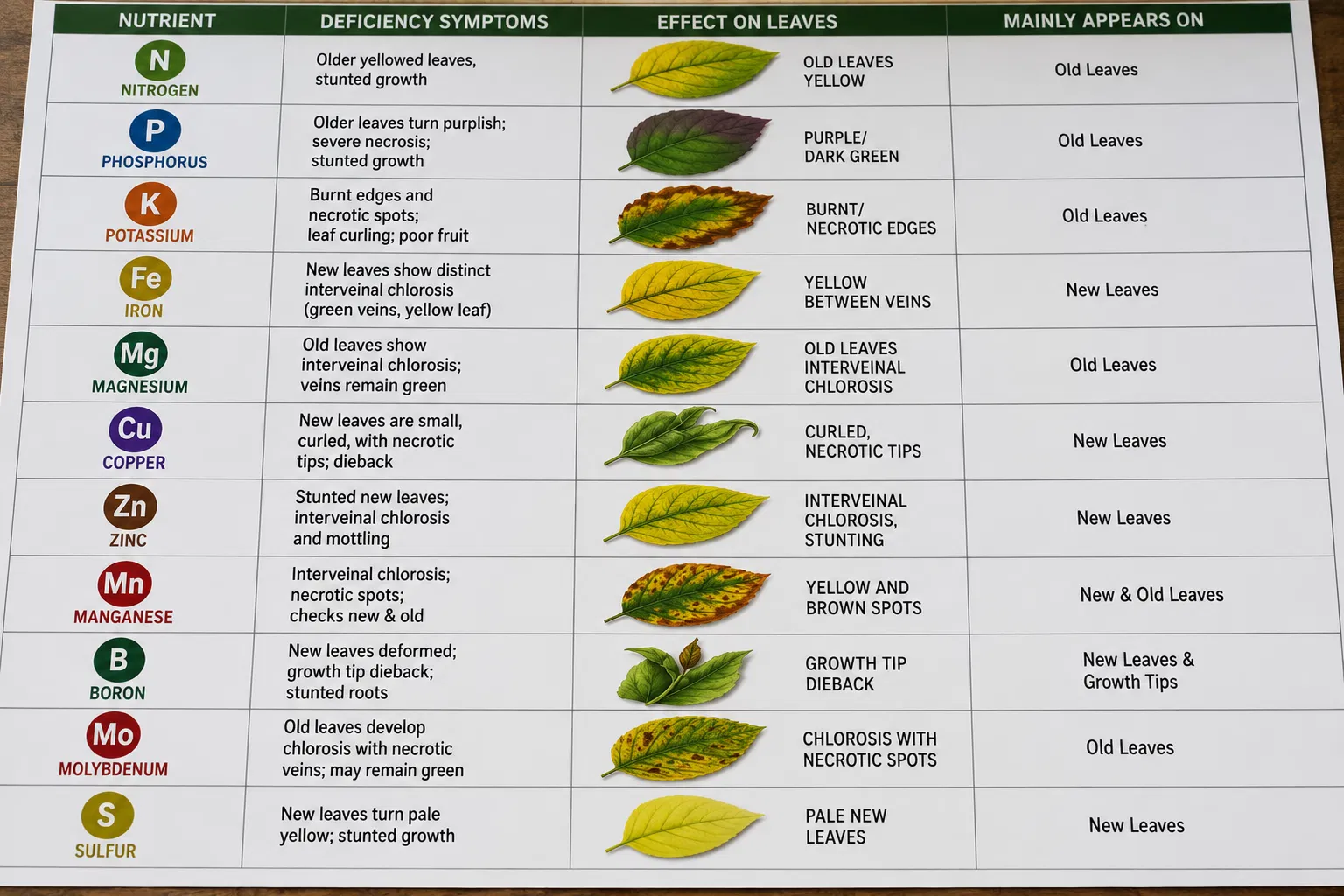
Micronutrient Deficiency Chart by Leaf Symptoms
Use this quick reference to identify common micronutrient deficiencies in plants by visible leaf symptoms.
| Micronutrient | Common Leaf Symptoms | Where Symptoms Appear First |
|---|---|---|
| Iron (Fe) | Interveinal chlorosis, yellowing of young leaves, veins stay green | New growth |
| Manganese (Mn) | Interveinal chlorosis with small necrotic spots, pale mottling | Young to middle leaves |
| Zinc (Zn) | Small leaves, shortened internodes, rosetting, chlorosis | New growth |
| Boron (B) | Deformed leaves, brittle tissue, thickened or cracked growing points | Growing tips and young tissue |
| Copper (Cu) | Leaf tip dieback, dark green leaves, wilting, chlorosis | Young leaves |
| Molybdenum (Mo) | General chlorosis, leaf curling, leaf edge scorching, “whiptail” in some crops | Older to middle leaves |
| Chlorine (Cl) | Wilting, chlorosis, bronzing, leaf spotting | Leaves overall |
| Nickel (Ni) | Leaf tip necrosis, reduced germination, distorted young leaves | New growth |
What Micronutrient Deficiency Means
Micronutrients are essential plant nutrients needed in small amounts, but they play a huge role in photosynthesis, enzyme activity, hormone balance, and new tissue development. Unlike macronutrients, micronutrient shortages may be subtle at first. By the time symptoms become obvious, plant growth may already be affected.
Because each nutrient moves differently within the plant, deficiency symptoms often show up in specific places. Some micronutrient deficiencies appear first on young leaves, while others appear on older foliage. This pattern is one of the biggest clues in diagnosing the problem.
How to Identify Micronutrient Deficiency by Leaf Symptoms
Iron Deficiency
Iron deficiency is one of the most common micronutrient problems, especially in alkaline soils or container plants with poor drainage. The classic symptom is interveinal chlorosis on young leaves. The leaf turns yellow while the veins remain green.
If the deficiency continues, the leaves may become almost white. Because iron is not very mobile in plants, symptoms usually appear first in new growth.
Manganese Deficiency
Manganese deficiency can look a lot like iron deficiency, but it often includes small necrotic specks or a finer mottled pattern. Leaves may appear pale with green veins, and severe cases can lead to dead patches in the tissue.
This deficiency tends to affect young to middle-aged leaves and is often linked to high pH or overly wet soils.
Zinc Deficiency
Zinc deficiency often causes small leaves, short internodes, and rosetting, where leaves appear bunched together at the stem tip. New growth may be pale or misshapen, and leaf size may be noticeably reduced.
In many crops, zinc deficiency also causes banding or interveinal chlorosis. It is commonly associated with alkaline conditions, cool soils, or root stress.
Boron Deficiency
Boron is critical for cell wall formation and growing tissues. A deficiency can cause distorted young leaves, brittle texture, cracked stems, and death of growing points. Leaves may become thickened, malformed, or curled.
Boron deficiency often shows up in new tissue first because boron does not move easily within the plant. Even slight shortages can seriously damage growing tips.
Copper Deficiency
Copper deficiency is less common, but it can cause wilting, chlorosis, leaf tip dieback, and weak stems. Young leaves may look dark green at first and then become twisted or show necrotic margins.
In some plants, copper deficiency reduces overall vigor and may lead to poor flowering or poor grain development.
Molybdenum Deficiency
Molybdenum deficiency may present as general chlorosis, curled leaves, edge scorching, or narrow distorted leaves. In certain crops, it creates a distinctive “whiptail” appearance where leaves fail to develop normally.
Though molybdenum is required in tiny amounts, it is essential for nitrogen metabolism. Symptoms may resemble nitrogen deficiency in some cases.
Chlorine Deficiency
Chlorine deficiency is rare, but when it occurs, symptoms may include wilting, bronzing, spotting, and reduced root growth. Because chlorine is usually present in most environments, true deficiency is uncommon.
When symptoms do appear, they can affect foliage across the plant rather than a single leaf age group.
Nickel Deficiency
Nickel deficiency is uncommon but can cause leaf tip necrosis, distorted young leaves, and poor seed germination. Since nickel is needed for specific enzyme functions, a shortage may also affect overall plant development.
Symptoms often appear first in new growth and can be mistaken for other nutrient or toxicity issues.
How to Tell Micronutrient Deficiency Apart from Other Problems
Leaf symptoms alone are helpful, but they are not always enough for a precise diagnosis. Similar signs can also be caused by pests, disease, herbicide drift, root damage, heat stress, or pH imbalance.
Look for these clues:
- Young leaves affected first often indicate iron, manganese, zinc, boron, copper, or nickel issues.
- Older leaves affected first may suggest molybdenum or other mobile nutrient problems.
- Interveinal chlorosis points strongly toward iron, manganese, or zinc deficiency.
- Deformed new growth often indicates boron or zinc deficiency.
- Leaf tip burn or necrosis may be linked to copper, nickel, or general stress.
Tip: Always check soil pH before correcting a suspected micronutrient deficiency. A nutrient may be present in the soil but unavailable to the plant because of pH, compaction, or poor root function.
Common Causes of Micronutrient Deficiency
Micronutrient deficiencies do not always mean the soil lacks nutrients. In many cases, the nutrients are present but unavailable. Common causes include:
- Improper soil pH — High or low pH can lock up micronutrients.
- Poor root health — Damaged roots absorb fewer nutrients.
- Overwatering — Waterlogged soils reduce nutrient uptake.
- Low organic matter — Soils with little organic content may not hold micronutrients well.
- Cold soil conditions — Slow root activity can trigger deficiency symptoms.
- Excessive fertilization — Too much phosphorus, for example, can interfere with micronutrient availability.
How to Correct Micronutrient Deficiencies
Once you identify the likely deficiency, the next step is correction. The best solution depends on the nutrient involved and the growing conditions.
- Adjust soil pH if nutrient lockout is the issue.
- Apply a balanced micronutrient fertilizer formulated for the crop or plant type.
- Use foliar sprays for a faster short-term response, especially for iron or zinc.
- Improve drainage and root health to support nutrient uptake.
- Add compost or organic matter to improve nutrient retention and biological activity.
- Retest soil or tissue to confirm the deficiency and track recovery.
For severe cases, especially in high-value crops, a tissue test or lab soil analysis can confirm the exact deficiency and prevent guesswork.
Prevention Tips for Healthy Leaves
Preventing micronutrient deficiency is easier than fixing it after symptoms appear. Healthy soil management goes a long way.
- Test soil regularly and monitor pH.
- Use crop-appropriate fertilizers with trace minerals.
- Avoid overwatering and compacted soil.
- Support root health with good drainage and aeration.
- Watch for early leaf changes during active growth periods.
- Keep a record of recurring nutrient symptoms by season or crop type.
Final Thoughts
Micronutrient deficiency in plants is often visible first in the leaves, making leaf symptom recognition one of the fastest ways to diagnose trouble. Whether you’re seeing yellowing new growth, distorted leaves, spotting, or tip dieback, these signs can point you toward the nutrient that’s missing.
If you want healthier plants, start by reading the leaves, checking soil conditions, and correcting imbalances early. A quick diagnosis today can prevent serious growth loss tomorrow.
Use this micronutrient deficiency chart as a fast reference, and act as soon as symptoms appear for the best results.