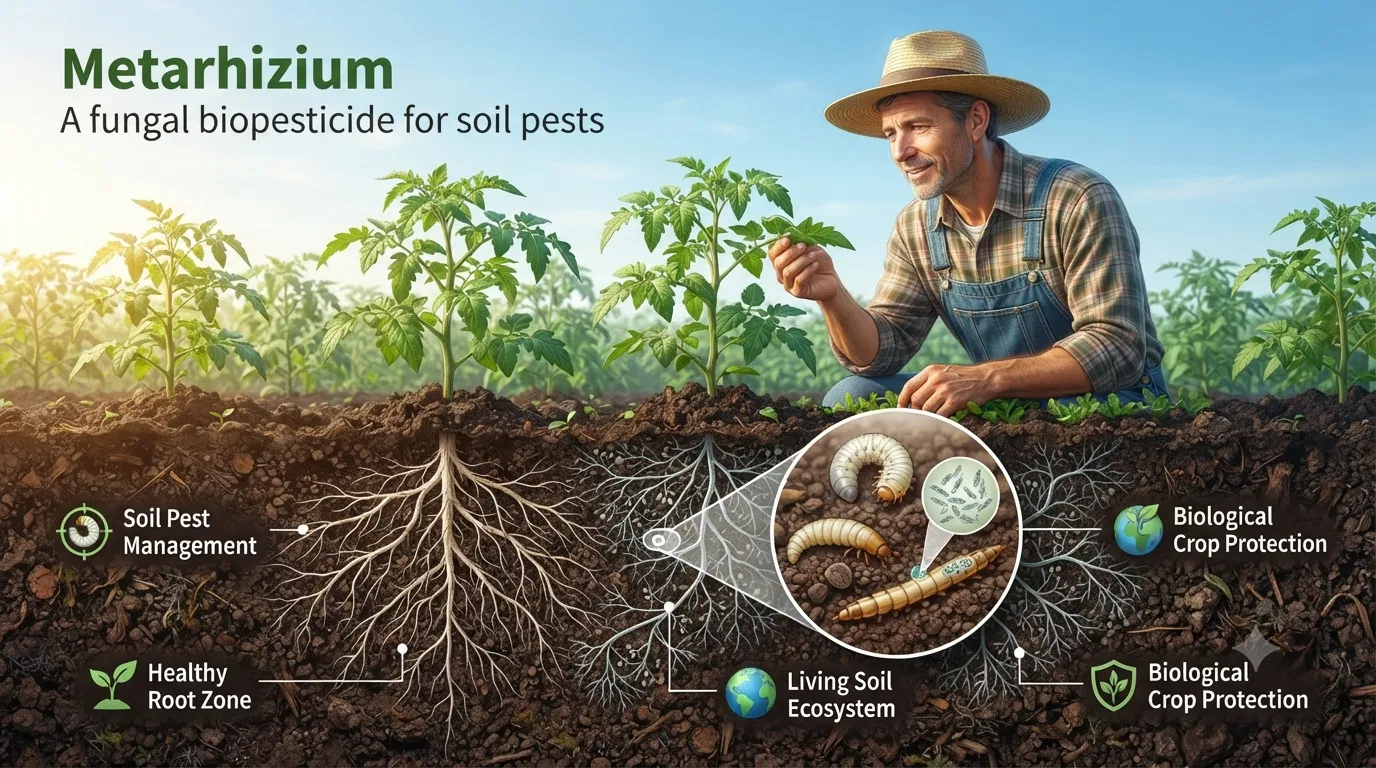
Soil pests can quietly damage crops long before the problem becomes visible above ground. Root-feeding insects, grubs, and other hidden threats weaken plants, reduce yields, and make pest control a constant challenge. For growers looking for a sustainable solution, Metarhizium has emerged as a powerful fungal biopesticide for soil pest management.
This beneficial fungus offers a targeted, environmentally friendly way to suppress destructive insects in the soil while supporting modern integrated pest management programs. As demand grows for safer and more sustainable agricultural tools, Metarhizium is becoming a standout option for farmers, gardeners, and turf managers alike.
What Is Metarhizium?
Metarhizium is a genus of naturally occurring fungi known for infecting and killing a wide range of insect pests. It is often used as a biological control agent because it attacks insects rather than relying on synthetic chemicals.
In the soil, Metarhizium spores come into contact with pest insects such as grubs, root weevils, termites, white grubs, and other larvae. Once attached to the insect's body, the fungus penetrates the cuticle, grows inside the pest, and eventually kills it.
Key point: Metarhizium works as a living pest control tool, making it especially valuable for long-term, sustainable soil pest management.
How Metarhizium Works as a Fungal Biopesticide
The success of Metarhizium as a fungal biopesticide lies in its infection process. Unlike conventional insecticides that act through contact or ingestion of toxic chemicals, Metarhizium uses a biological mode of action.
Step-by-step infection process
- Spore contact: The fungal spores attach to the insect's outer surface.
- Germination: Under favorable soil moisture and temperature, the spores germinate.
- Penetration: The fungus penetrates the insect cuticle using enzymes and physical pressure.
- Internal growth: Once inside, the fungus multiplies and consumes the host tissues.
- Insect death: The pest dies, and the fungus may produce more spores that can spread to other insects.
This infection cycle makes Metarhizium especially effective against soil-dwelling pests that are difficult to reach with surface sprays.
Why Metarhizium Is Valuable for Soil Pest Control
Soil pests are notoriously hard to manage because they live below the surface, where they can damage roots, stems, and crowns with little warning. Metarhizium offers several advantages in this environment.
- Targets hidden pests: It reaches insects that live and feed in the soil.
- Reduces chemical dependency: It helps lower reliance on synthetic insecticides.
- Supports integrated pest management: It fits well into IPM programs.
- Can persist in the soil: Some strains can remain active and provide longer-term suppression.
- Environmentally friendly: It is generally considered safer for beneficial organisms when used properly.
For growers balancing productivity with sustainability, Metarhizium provides a practical alternative to broad-spectrum chemical control.
Common Soil Pests Controlled by Metarhizium
Metarhizium is used against a variety of insect pests that damage crops, ornamentals, lawns, and turf. While effectiveness can vary by strain and environment, it is commonly associated with control of:
- White grubs
- Root weevils
- Wireworms
- Termites
- Fungus gnat larvae
- Beetle larvae
- Other soil-dwelling insect stages
Because these pests often attack roots and underground plant parts, early intervention is important. Metarhizium can help reduce pest pressure before serious damage occurs.
Benefits of Using Metarhizium in Agriculture
Metarhizium is increasingly popular because it aligns with the goals of modern agriculture: effective pest control, reduced environmental impact, and improved crop resilience.
1. Sustainable pest management
As a biological control product, Metarhizium offers a more sustainable alternative to repeated chemical applications. It can help preserve soil health and support biodiversity in farming systems.
2. Lower risk of resistance
Many insect pests develop resistance to conventional insecticides over time. Since Metarhizium kills insects through a biological infection process, it can be a useful rotation tool in resistance management programs.
3. Compatibility with organic and low-input systems
Depending on the formulation and local regulations, Metarhizium products may be suitable for organic or reduced-chemical production systems. This makes it attractive for growers seeking eco-conscious solutions.
4. Soil-friendly approach
Because it acts in the root zone, Metarhizium is especially useful in crops where pests are active below the surface. It provides a more targeted approach than blanket treatments.
Factors That Affect Performance
Like any biopesticide, Metarhizium works best under conditions that support fungal activity. Success depends on several environmental and management factors.
- Soil moisture: Adequate moisture helps spores germinate and infect pests.
- Temperature: Performance depends on the strain and local climate.
- Soil type: Soil texture and organic matter can influence fungal movement and survival.
- Pest life stage: Young larvae are often more vulnerable than mature insects.
- Application timing: Applying when pests are active in the soil improves results.
In many cases, Metarhizium performs best when it is integrated with cultural practices that promote pest pressure reduction and healthy soil conditions.
Best Practices for Using Metarhizium
To get the most from a Metarhizium-based biopesticide, proper application and timing are essential.
Practical tips for growers
- Apply when target pests are present in the soil.
- Maintain soil moisture where possible after application.
- Avoid mixing with products that may reduce fungal viability.
- Use compatible cultural and biological control methods.
- Follow label directions carefully for rate, timing, and placement.
Because Metarhizium is a living organism, it should be treated differently from conventional insecticides. Handling, storage, and application conditions can all affect its success.
Metarhizium in Integrated Pest Management
One of the strongest uses for Metarhizium is within integrated pest management. Rather than replacing every other tactic, it works alongside monitoring, crop rotation, habitat management, and selective pesticide use.
In an IPM program, Metarhizium can help:
- Reduce pest populations early
- Lower spray frequency
- Preserve beneficial insects
- Improve long-term soil pest suppression
- Support more resilient production systems
This integrated approach is especially important for growers managing recurring root-zone pest problems.
The Future of Fungal Biopesticides
As agriculture continues to shift toward more sustainable solutions, fungal biopesticides like Metarhizium are gaining attention worldwide. Research is expanding on strain selection, formulation improvements, and application methods that increase consistency and effectiveness.
With better delivery systems and refined pest targeting, Metarhizium is likely to play an even larger role in future pest management strategies. Its ability to control soil pests while fitting into environmentally responsible programs makes it one of the most promising tools in biological control.
Conclusion
Metarhizium is more than just a fungus—it is a practical, science-backed biopesticide for managing destructive soil pests. By targeting insects underground, supporting sustainable agriculture, and fitting naturally into integrated pest management, it offers a smart alternative to overreliance on chemical insecticides.
If soil pests are limiting crop health or productivity, Metarhizium deserves serious consideration as part of a modern pest control strategy. For growers and land managers seeking effective, environmentally conscious solutions, this fungal biopesticide is a powerful step in the right direction.