The Livestock Insurance Scheme was launched by the Government of India to protect farmers from the financial shock of losing their animals to death, disease, or accidents. It was first tried on a pilot basis during 2005-06 and 2006-07, then rolled out regularly from 2008-09 across 100 selected districts, and now operates through the National Livestock Mission (NLM) in nearly every state except Goa. For many rural households, livestock like milch cattle and buffaloes represent one of their most valuable and reliable sources of income, so this scheme exists to give them a safety net when the unexpected happens.
Livestock Insurance Scheme Overview
- Scheme Name – Livestock Insurance Scheme, implemented under the National Livestock Mission (NLM)
- Scheme Modification Date – Premium subsidy structure enhanced under NLM, with farmer premium share in some regions reduced to as low as 15% as of January 2026
- Scheme Fund Allocated – Central Government bears the full cost of the premium subsidy; funds are routed through State Livestock Development Boards and the National Livestock Mission
- Type of Scheme – Centrally Sponsored Scheme, implemented in all states except Goa through State Livestock Development Boards
- Helpline No – Kisan Call Centre, 1800-180-1551; farmers can also contact their district Animal Husbandry office or the designated insurance company's local branch
- States Covered – All states except Goa; Himalayan and North-Eastern states and Union Territories receive higher premium support
Objectives of the Scheme
- Protect livestock owners against financial loss from the death of their animals
- Demonstrate and popularise the benefit of livestock insurance among rural households
- Encourage scientific animal husbandry practices backed by a risk-cover safety net
- Extend affordable insurance access through a heavily subsidised premium structure
- Support the economic stability of households that depend on milk and meat as a primary income source
Key Features of the Livestock Insurance Scheme
- Covers crossbred and high-yielding cattle and buffaloes, along with other livestock such as sheep, goats, pigs, and pack animals depending on the state's scheme design
- Animals are insured at their current market price, assessed jointly by a veterinary practitioner, insurance agent, and the livestock owner
- Premium subsidy stands at 50% in regular states, funded entirely by the Central Government; under NLM enhancements, farmer premium share in several regions has been reduced further, to as low as 15% in some cases, with Himalayan and North-Eastern states receiving up to 90% subsidy and Union Territories receiving full coverage
- Subsidy benefit is generally capped at 2 animals per beneficiary for a policy period of up to 3 years under the core central scheme; state-run components under NLM may set different caps, such as 5 animals per household
- Every insured animal must be uniquely identified through ear tagging (or microchipping in some states); the cost of tagging is borne by the insurer, while the owner must maintain the tag
- Milch animals typically need to meet a minimum yield threshold (for example, a specified daily yield for cows and buffaloes) to qualify for insurance
- Diseases contracted within 15 days of policy commencement are generally not covered
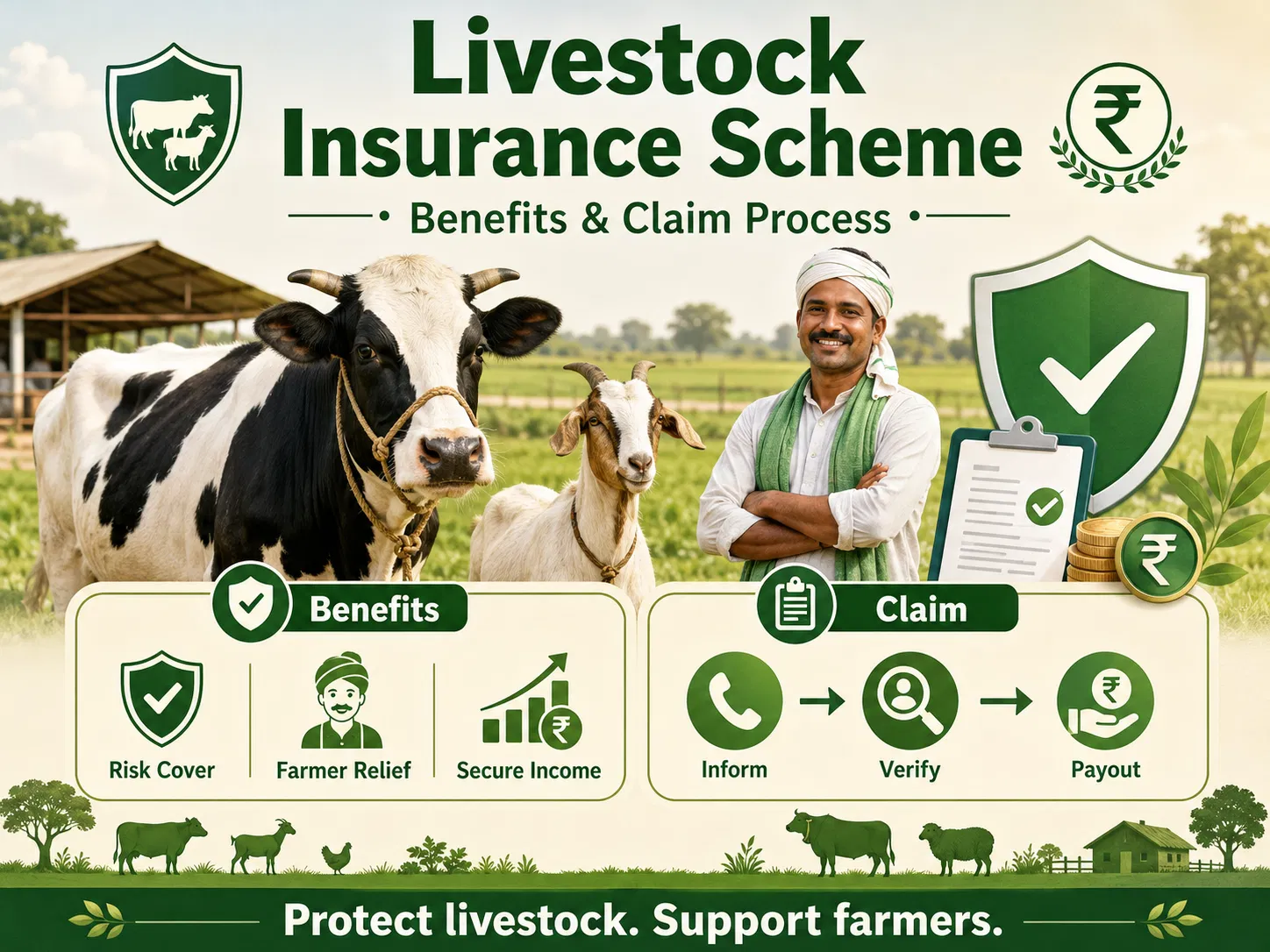
Livestock Insurance Scheme Benefits to Farmers
- Financial compensation up to the animal's assessed market value in case of death
- Heavily subsidised premium, making insurance affordable even for small and marginal livestock owners
- Protection against death from natural calamities, disease, and accidents, not just old age or routine loss
- Encourages better animal care, since insured animals are tagged, tracked, and periodically assessed
- Extra premium relief for farmers in Himalayan, North-Eastern, and Union Territory regions
- Reduces the risk of a single animal death pushing a livestock-dependent household into financial distress
Limitations of the Scheme
- Subsidy benefit is usually capped at a maximum of 2 animals per beneficiary under the core scheme, though some state NLM components extend this further
- Diseases contracted within 15 days of the policy starting are excluded from coverage
- Claims are rejected under the "No Tag, No Claim" rule if the ear tag is not surrendered or cannot be produced at the time of claim
- Intentional slaughter, theft, and clandestine sale of the insured animal are excluded from coverage, except humane destruction certified by a veterinarian
- Claim settlement depends on timely intimation and complete documentation; delays or missing paperwork can hold up payment
Documents Required
- Duly completed claim form
- Policy or insurance certificate
- Death certificate issued by a qualified veterinarian
- Post-mortem examination report (may be waived for animals financed under government schemes, subject to a joint death certificate from designated local officials)
- Ear tag of the deceased animal (must be surrendered)
- Photographs of the animal, particularly for high-value animals
- Identity and bank account proof of the beneficiary
How to Claim Under the Livestock Insurance Scheme
- Intimate the insurance company or local implementing office immediately after the animal's death — prompt reporting is essential for a smooth claim.
- Arrange for a qualified veterinarian to examine the animal and issue a death certificate, along with a post-mortem report if required.
- Collect the duly completed claim form from the insurer and fill in the details exactly as per the policy records.
- Surrender the ear tag of the deceased animal, since claims are not processed without it.
- Submit the claim form along with the death certificate, post-mortem report (if applicable), photographs, and the policy document to the insurer or implementing office.
- The insurer verifies the documents and, once approved, releases the claim amount up to the animal's assessed insured value.
Conclusion
For farmers whose livelihood depends on cattle, buffaloes, or other livestock, the Livestock Insurance Scheme offers a genuine cushion against sudden, costly loss. With premium subsidies covering a large share of the cost — and even more in Himalayan, North-Eastern, and Union Territory regions — the scheme makes insurance accessible where it matters most. Keeping the ear tag safe, reporting deaths promptly, and maintaining proper veterinary documentation are the small but essential steps that ensure a smooth claim when farmers need it.
Disclaimer: This article is for informational purposes only. Scheme details, interest rates, and subvention amounts are subject to periodic revision by the Government of India, RBI, and NABARD. Farmers are advised to verify the latest terms and eligibility criteria with their bank, NABARD, or official government sources before applying.