Leaf spot rarely kills a chilli plant outright, which is exactly why it gets underestimated. What it does instead is strip the crop of its leaves during fruit development, and a defoliated plant produces small, poorly coloured fruit and leaves the remaining fruit exposed to sunscald. There is a second complication specific to this disease: what farmers call leaf spot in chilli is actually two different problems, one fungal and one bacterial, and they look similar enough to be confused. They do not respond to the same treatment, so identifying which one is present matters more here than the choice of any particular product.
Symptoms
Fungal leaf spot (Cercospora or frogeye leaf spot)
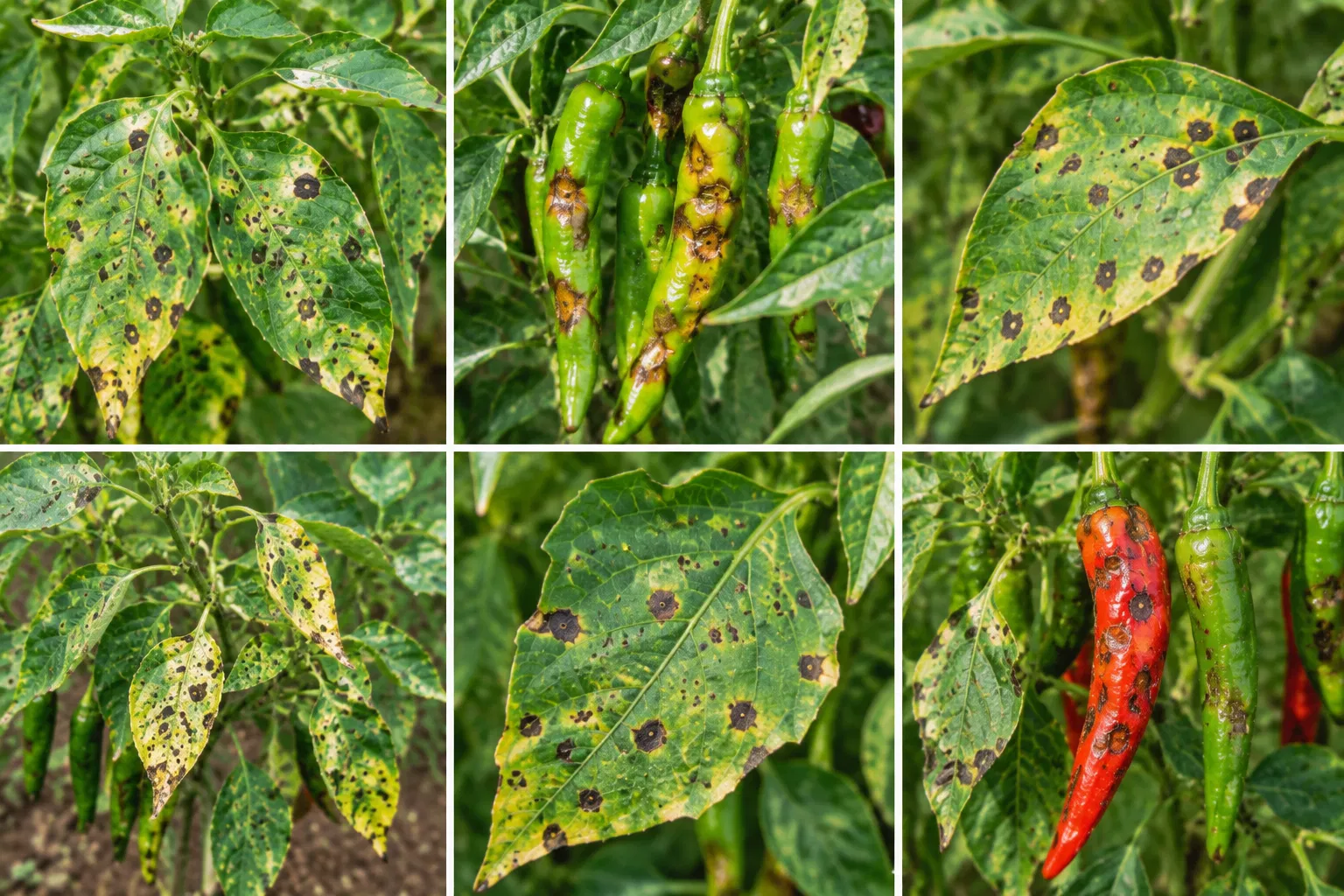
- Circular to oval spots with pale grey or whitish centres ringed by a distinct dark brown margin, giving the frog's-eye appearance the disease is named for
- Spots enlarging and merging as infection progresses, with the dry centres sometimes dropping out to leave shot-holes
- Elongated lesions on stems, petioles and fruit stalks, which weaken the attachment and cause fruit to drop
- Yellowing around the lesions followed by heavy premature leaf fall, beginning with the lower older leaves
Bacterial leaf spot
- Small water-soaked spots appearing first on the underside of the leaf, turning dark brown to black as they age
- Spots that are angular rather than round, because their spread is stopped by the leaf veins, often with a yellow halo around them
- A greasy or translucent look at the lesion edge when the spots are fresh
- Raised, rough, scabby spots on the fruit surface that downgrade the produce even when the plant itself looks reasonable
Both types end the same way: progressive defoliation from the bottom of the plant upward, smaller and poorly coloured fruit, and sunscald damage on fruit left without leaf cover.
Causes
- Cercospora capsici, the fungus responsible for frogeye leaf spot, which survives on infected crop debris and on seed between seasons
- Xanthomonas campestris pv. vesicatoria, the bacterium behind bacterial leaf spot, which also carries over on seed and in residue and enters the plant through natural openings and wounds
- Infected seed, which introduces either pathogen into a clean field and makes seed treatment the first line of defence
- Warm humid weather between roughly 25 and 30 degrees Celsius with frequent rain or long dew periods, since both pathogens need leaf wetness to infect
- Rain splash and overhead irrigation, which carry spores and bacterial cells from lesion to leaf and plant to plant
- Working through the crop while the foliage is still wet, which spreads bacterial leaf spot rapidly on hands, clothing and equipment
- Wind-driven rain and storms, which create the small wounds bacteria use to enter the leaf
- Dense planting and a slow-drying canopy, along with excess nitrogen that produces soft susceptible growth
- Continuous chilli or other solanaceous cropping with infected residue left in the field after harvest
How to Identify
Start with the shape of the spot. Fungal frogeye lesions are round, cross the veins freely and have a clearly defined pale centre with a dark ring around it. Bacterial lesions are angular and blocky because the veins stop them spreading, and they look water-soaked or greasy when fresh rather than dry with a light centre. A yellow halo is more typical of the bacterial form.
Then check the fruit. Bacterial leaf spot produces raised, rough, scabby spots on the fruit surface, while frogeye leaf spot largely stays on leaves, stems and fruit stalks. If the leaves are spotted and the fruit carries scabby raised lesions, the problem is bacterial.
This distinction is not academic. Fungicides such as mancozeb, carbendazim, tebuconazole and myclobutanil act on fungi and do nothing against bacteria, so spraying them on bacterial leaf spot wastes both the product and the window in which the disease could have been checked. Copper and kasugamycin are the options that work on the bacterial form. Scout twice a week through the season, increase checks after every rain spell, and inspect the lower canopy first, since that is where both diseases establish.
Control Methods
Chemical Control
1. Carbendazim 12% + Mancozeb 63% WP
This is the standard choice for fungal leaf spot in chilli. Carbendazim moves systemically inside the plant and stops the fungus multiplying, while mancozeb forms a protective contact barrier on the leaf surface that prevents new spores from establishing. Having both internal and external action in a single spray is what makes it the common first response when frogeye lesions appear.
Product Recommendation
2. Mancozeb 75% WP
Mancozeb is a multisite contact protectant that disrupts several fungal enzyme systems at once, which is why decades of use have not produced resistance. It forms a protective film over the leaf surface and is the standard base spray to alternate with systemic products through the season. It also supplies trace manganese and zinc to the crop.
Product Recommendation
3. Tebuconazole 50% + Trifloxystrobin 25% WG
A strobilurin and triazole combination for heavier fungal infection. Trifloxystrobin spreads across the leaf surface and blocks spore germination, while tebuconazole moves into the tissue and stops infection already established. It gives long residual protection, which cuts the number of sprays needed during the rainy stretch when leaf spot pressure is highest.
Product Recommendation
4. Myclobutanil 10% WP
Myclobutanil is a triazole that blocks ergosterol biosynthesis and stops fungal growth inside the leaf. It is xylem-mobile, so it moves from treated tissue into new growth and protects leaves that emerge between sprays, and it becomes rainfast about an hour after application. It is registered for leaf spots in chilli along with powdery mildew and dieback, which makes it useful where more than one fungal disease is present.
Product Recommendation
5. Copper Oxychloride 50% WP
Copper oxychloride releases copper ions on the plant surface that disrupt enzyme systems in both fungal and bacterial pathogens. That dual activity is what makes it valuable here, since it is one of the few options that works on bacterial leaf spot as well as the fungal form. It is purely protective, so it has to be applied before or at the very start of infection, and coverage needs to be thorough.
Product Recommendation
6. Kasugamycin 3% SL
Kasugamycin is an antibiotic derived from fermentation of Streptomyces kasugaensis, active against bacteria as well as some fungi. It is absorbed and translocated through the plant, and works by blocking protein synthesis in the pathogen. Where lesions are angular, water-soaked and accompanied by scabby fruit spots, this is the group to reach for, usually alternated with a copper spray.
Product Recommendation
Matching the Product to the Spot
For round frogeye lesions with pale centres, any of the first four solutions will work, with mancozeb as the protective base and a systemic combination brought in when infection is heavy. For angular water-soaked lesions with scabby fruit spots, only copper and kasugamycin are worth spraying, and alternating the two gives better results than repeating either. Where both appear together, which happens often during a wet season, a copper spray alternated with a fungicide covers both fronts.
On resistance, keep mancozeb and copper as the multisite backbone, since neither loses effectiveness with repetition. Triazoles and strobilurins are prone to resistance, so avoid using the same group twice in succession and limit strobilurin-containing sprays to two or three in a season.
Cultural Control
- Use certified disease-free seed and treat it before sowing, since both pathogens travel on seed into otherwise clean fields
- Rotate with a non-solanaceous crop for at least two seasons where leaf spot has been severe, and avoid planting beside an older chilli or tomato crop
- Plough in or destroy crop residue immediately after harvest rather than leaving infected debris to carry the pathogen over
- Keep spacing wide enough for the canopy to dry quickly, and stake the plants to lift foliage clear of the soil
- Irrigate through drip rather than overhead sprinklers, since splashing water is the main way both diseases move through a field
- Stay out of the crop while the foliage is wet, and wash hands and tools between blocks where bacterial leaf spot is present
- Keep nitrogen moderate and potassium adequate, as soft nitrogen-driven growth is the most susceptible
- Strip off and destroy heavily spotted lower leaves early, before they seed the rest of the canopy
- Control solanaceous weeds around the field, which host both pathogens between crops
Conclusion
The decisive step with chilli leaf spot happens before any spray is mixed: look closely at the lesion and work out whether it is fungal or bacterial. Round spots with pale centres call for a fungicide programme built on mancozeb with a systemic combination when pressure rises. Angular water-soaked spots with scabby fruit call for copper and kasugamycin, and no fungicide will help. Around whichever applies, the cultural measures do a great deal of the work — clean seed, rotation, drip irrigation, wider spacing and staying out of a wet crop. Keep the canopy intact through fruit development and the yield takes care of itself.
Disclaimer: Always confirm current label registration, approved dosage, water volume, and pre-harvest interval (PHI) for your state before using any product, since labels are periodically revised by regulatory authorities.
This guide is a general advisory. Do your own research and verification before using any product. Always confirm suitability for your crop stage, region, and field conditions before making any purchase, spray, or crop-management decision.