
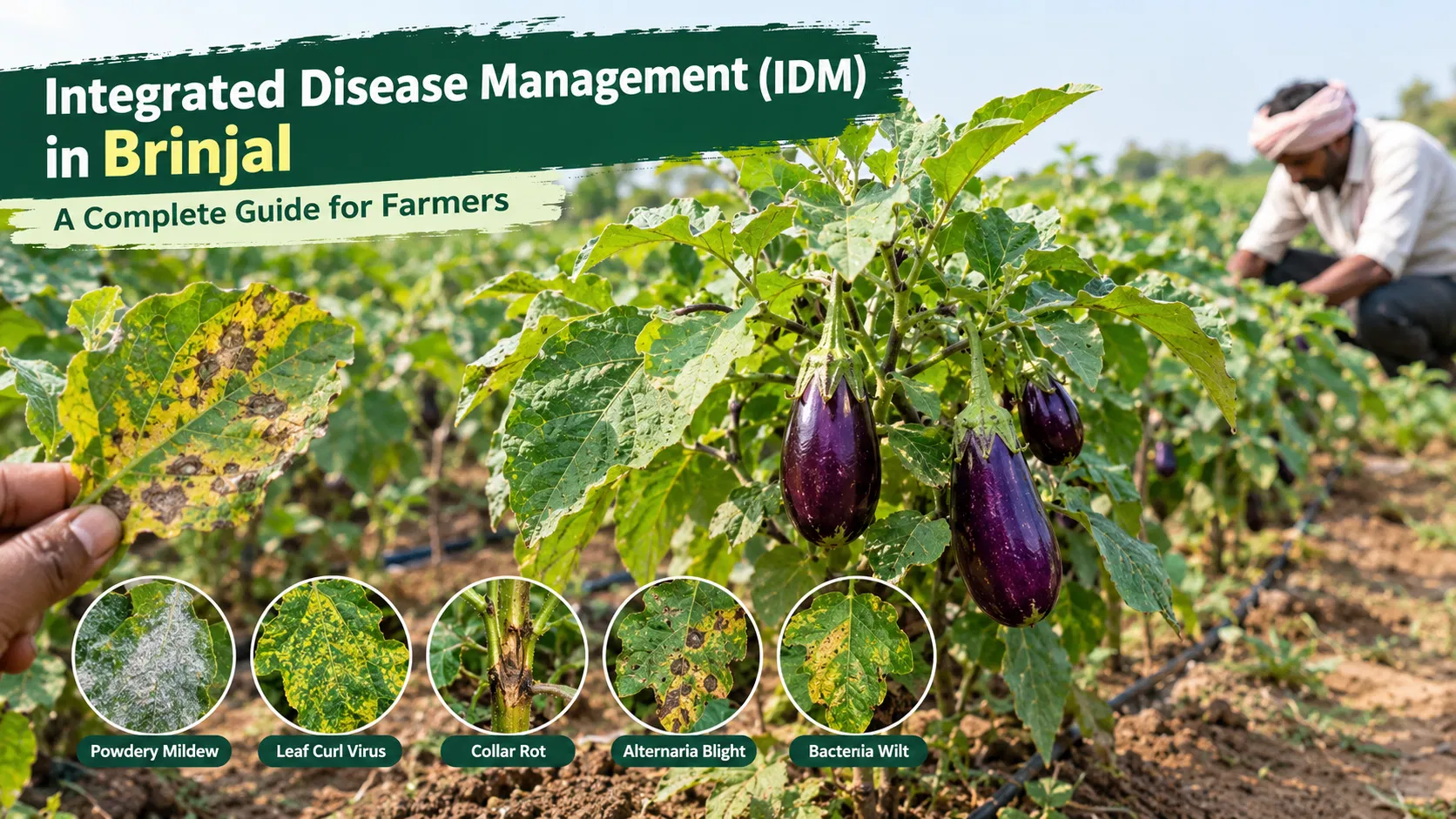
Seedlings collapsing in the nursery, plants wilting one by one in a patch, fruits rotting with black dots before they reach the market — brinjal farmers face these problems every season, and a fungicide spray alone rarely solves them because most brinjal diseases start in the soil, the seed or the nursery. Integrated Disease Management (IDM) is a practical plan that combines a clean nursery, good field practices, bio-fungicides and need-based sprays so that disease stays low from sowing to the last picking. This guide explains, in simple farmer language, how to follow IDM in brinjal.
What Is IDM in Brinjal?
IDM in brinjal means preventing disease first — healthy seed, a treated nursery, crop rotation and drainage — then protecting the crop with biological agents, and finally using a registered fungicide only when symptoms appear and conditions favour spread. Because wilts and rots cannot be cured once a plant is infected, prevention is generally the most cost-effective step.
Major Diseases of Brinjal and How to Spot Them
| Disease | What you may see in the field |
|---|---|
| Damping off (Pythium, Rhizoctonia spp.) | Seedlings rot at the collar and topple over in patches in the nursery; poor germination in wet, crowded beds. |
| Phomopsis blight and fruit rot (Phomopsis vexans) | Round brown spots on leaves; sunken, soft spots on fruit that enlarge into rot with tiny black dots; seedlings may also die. |
| Leaf spots (Alternaria spp., Cercospora melongenae) | Brown spots with light centres or concentric rings; spots merge, leaves yellow and drop early. |
| Fusarium wilt (Fusarium spp.) | Lower leaves yellow and droop, plant wilts slowly; brown discolouration inside the stem when cut. |
| Bacterial wilt (Ralstonia solanacearum) | Sudden wilting of green plants in warm, wet weather; a cut stem placed in clean water releases a milky ooze. |
| Collar rot / root rot (Sclerotium rolfsii, Rhizoctonia spp.) | White fungal threads and mustard-like bodies at the stem base; plant wilts and the collar rots. |
| Little leaf (phytoplasma, spread by leaf hoppers) | Very small, narrow leaves, bushy plants, flowers turn leafy and fruit rarely sets. |
Related reading: root-related wilt diseases in brinjal and little leaf disease in brinjal.
Step 1: Cultural Practices for Brinjal IDM
- Healthy seed and tolerant varieties: Use seed from a disease-free source and, in wilt-prone fields, choose wilt-tolerant varieties recommended for your region. Browse brinjal seeds.
- Clean nursery: Raise seedlings on beds about 10–15 cm high for drainage. Solarise the bed under clear polythene for three to four weeks in summer, keeping the soil moist. Avoid thick sowing and over-watering, which favour damping off. A nylon net cover keeps leaf hoppers (little leaf carriers) away.
- Crop rotation: Avoid brinjal after brinjal, tomato, chilli or potato; a rotation of 3–4 years with non-solanaceous crops such as cereals or pulses may reduce wilt, bacterial wilt and Phomopsis in the soil.
- Drainage and spacing: Plant on raised beds or ridges, avoid water stagnation, and keep recommended spacing so leaves dry quickly after rain or irrigation.
- Balanced nutrition: Avoid excess nitrogen; adequate potash and well-decomposed FYM enriched with Trichoderma generally help plants resist soil-borne infection.
- Field sanitation: Remove crop residues, volunteer plants and weeds after harvest; wilt bacteria and Phomopsis survive on debris and in soil.
Step 2: Mechanical and Physical Practices
- Rogue out wilted and little leaf-affected plants as soon as they are seen, with roots, and burn or bury them away from the field.
- Remove rotten fruits at every picking and never leave them under the plants.
- Avoid injuring roots during weeding and earthing up; wounds are entry points for bacterial wilt.
- Irrigate in the morning and avoid flooding the field so that water does not carry wilt bacteria from an infected patch to healthy plants.
- Manage leaf hoppers with yellow sticky traps to reduce little leaf spread (see leaf hoppers in brinjal).
Step 3: Biological Control in Brinjal
Bio-fungicides work best when used early — on seed, in the nursery bed and in the soil at transplanting — rather than after wilting starts.
- Trichoderma viride 1.5% WP is registered on brinjal against Fusarium wilt. It can be used as seed treatment, nursery bed drench, seedling root dip and soil application mixed with FYM before transplanting — e.g. Multiplex Nisarga Bio Fungicide. Trichoderma harzianum 1% WP is registered the same way against wilt.
- Pseudomonas fluorescens 1% WP is registered on brinjal against bacterial wilt, applied as seed treatment, nursery bed treatment and soil application with enriched FYM — e.g. Katyayani Striker Bio Fungicide Powder.
- Keep about a week between bio-fungicide and chemical fungicide applications to the soil, and apply bio-agents to moist soil in the evening.
More options in bio fungicides.
Step 4: Need-Based Chemical Control
Spray only when spots or rot are seen and weather is humid, cover fruit and leaf undersides well, rotate fungicide groups, and follow the waiting period before picking. The solutions below are registered for brinjal against the diseases shown.
Leaf spot and fruit rot
- Crystal Bavistin Fungicide (Carbendazim 50% WP)
- Dhanuka Dhanustin Fungicide (Carbendazim 50% WP)
Phomopsis blight
Zineb 75% WP is registered on brinjal against blight and can be used as a protective spray when the weather turns wet; look for it under fungicides.
Damping off in the nursery
Captan 75% WP is registered as a nursery soil drench against damping off; a Trichoderma-treated, solarised bed generally reduces the need for it.
There is no registered chemical cure for bacterial wilt or little leaf in brinjal; these are managed through resistant varieties, rotation, sanitation, Pseudomonas and leaf hopper control. See bacterial wilt of brinjal solutions.
Frequently Asked Questions
1. What is the most serious disease of brinjal?
Bacterial wilt is generally considered the most damaging in warm, wet regions, as infected plants die quickly and the bacteria survive in soil for years; Phomopsis fruit rot causes the biggest loss of marketable fruit.
2. How can I tell bacterial wilt from fungal wilt in brinjal?
Cut the lower stem and dip it in clean water. A milky ooze within a few minutes generally indicates bacterial wilt; brown streaks inside the stem without ooze point to fungal wilt.
3. How do I stop damping off in a brinjal nursery?
Use raised, solarised beds, thin sowing, light watering, seed treatment with Trichoderma and good drainage. A registered nursery drench may be used if seedlings still collapse.
4. Can wilt in brinjal be cured after a plant wilts?
Generally no. Remove wilted plants and protect the neighbours with soil application of bio-agents, better drainage and no flood irrigation.
5. Which crops can be rotated with brinjal to reduce diseases?
Cereals such as maize, paddy or sorghum, and pulses; avoid tomato, chilli, potato and capsicum, which share the same wilt and blight pathogens.
6. When should Trichoderma be applied to brinjal?
Before disease appears: as seed treatment, nursery bed drench, seedling root dip at transplanting and soil application mixed with FYM.
7. Why do brinjal fruits rot with black dots?
This is typically Phomopsis fruit rot, spread from infected seed, debris and splashing water in humid weather; removing rotten fruits and protective sprays can limit it.
8. Is little leaf of brinjal a fungal disease?
No. It is caused by a phytoplasma carried by leaf hoppers, so leaf hopper control and removal of affected plants is the practical management.
Disclaimer: Always confirm current label registration, approved dosage, water volume, and pre-harvest interval (PHI) for your state before using any product - labels are periodically revised by regulatory authorities.
The information in this article is for general guidance only. Disease incidence and product performance can vary with weather, variety and local conditions. Please consult your local agricultural officer or a qualified agronomist before taking any crop management decision.