Choosing the right water sprinkler for your crop can make the difference between healthy, high-yield growth and wasted water, uneven coverage, and stressed plants. With so many sprinkler types, spray patterns, and flow rates available, the best choice depends on your crop, field size, soil type, and irrigation goals. When you match the right sprinkler to the needs of your farm, you improve efficiency, reduce water loss, and support more consistent crop development.
Why the Right Sprinkler Matters
A sprinkler is more than just a tool that sprays water. It is a key part of your irrigation strategy. The wrong system can lead to overwatering, underwatering, runoff, soil erosion, or disease pressure caused by excess moisture on leaves. The right system, on the other hand, helps distribute water evenly and at the right intensity for your crop.
Efficient irrigation supports stronger root growth, better nutrient uptake, and more reliable harvests. It also helps conserve water, which is increasingly important in regions where water is limited or costly.
Understand Your Crop’s Water Needs
Before choosing a sprinkler, you need to understand what your crop requires. Different crops have different water demands depending on their growth stage, root depth, and sensitivity to moisture.
Consider these factors:
- Crop type: Row crops, vegetables, orchards, and pasture all have different irrigation needs.
- Growth stage: Seedlings usually need gentler, more frequent watering than mature plants.
- Root depth: Shallow-rooted crops may need lighter, more frequent irrigation.
- Leaf sensitivity: Some crops are more prone to fungal problems when foliage stays wet too long.
For example, leafy vegetables often benefit from even, gentle watering, while deeper-rooted crops may do better with broader coverage and longer intervals between irrigation cycles.
Know the Main Types of Water Sprinklers
Not all sprinklers are designed for the same purpose. Understanding the main types will help you narrow down the best option for your crop.
1. Impact Sprinklers
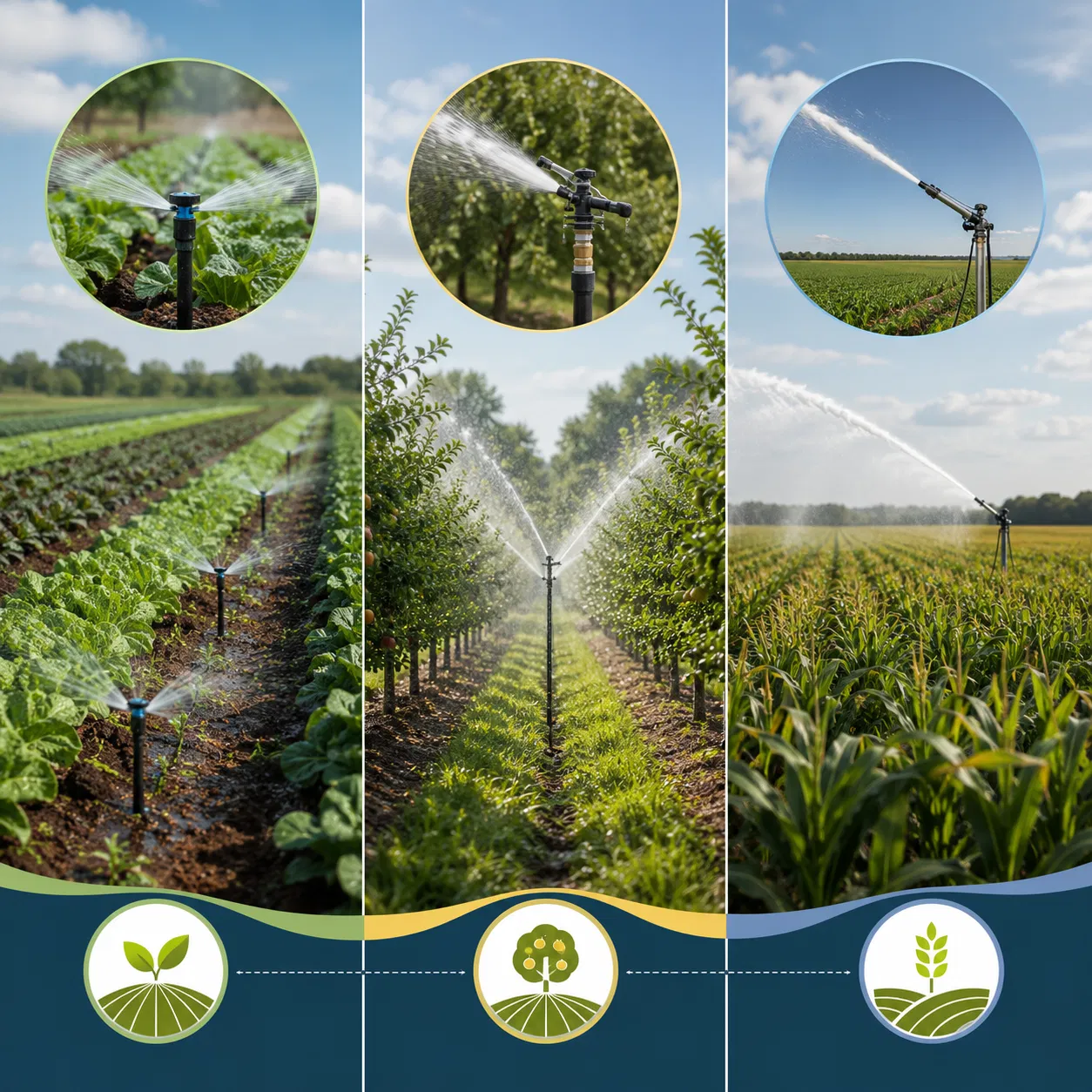
Impact sprinklers are known for durability and wide coverage. They are commonly used in agricultural fields, pastures, and large open areas. They work well under higher pressure and can cover large zones efficiently.
Best for: Large fields, orchards, and crops needing broad, uniform water distribution.
2. Rotor Sprinklers
Rotor sprinklers rotate slowly and distribute water evenly over a defined area. They are efficient and often used in large-scale irrigation systems where consistency matters.
Best for: Medium to large farms, grass crops, and areas requiring steady, controlled application.
3. Spray Sprinklers
Spray sprinklers release water in a fixed pattern and are ideal for smaller areas or crops that need more targeted watering. They typically apply water faster than rotors, so they are better suited for soils that absorb moisture quickly.
Best for: Small plots, vegetable beds, and shallow-rooted crops.
4. Micro-Sprinklers
Micro-sprinklers deliver low-volume water close to the ground. They are highly efficient and commonly used in orchards, vineyards, and specialty crops where precise irrigation is important.
Best for: Orchards, vineyards, nursery plants, and crops with localized root zones.
5. Traveling Sprinklers
Traveling sprinklers move across the field as they irrigate. They are useful in flexible farming setups but may not provide the same precision as fixed systems.
Best for: Temporary setups, irregular fields, and small to medium farms with changing irrigation needs.
Match the Sprinkler to Your Soil Type
Your soil plays a major role in sprinkler selection. If water is applied too quickly, it can run off before soaking in. If it is applied too slowly, it may not meet the crop’s needs efficiently.
Soil considerations:
- Sandy soil: Absorbs water quickly but drains fast. It often needs more frequent irrigation with lower volumes.
- Clay soil: Holds water longer but absorbs it slowly. It needs sprinklers with lower application rates to prevent runoff.
- Loamy soil: Offers balanced absorption and drainage, making it compatible with many sprinkler types.
If your soil has a low infiltration rate, choose a sprinkler that applies water slowly and evenly. This helps reduce surface runoff and improves root-zone moisture.
Check Water Pressure and Flow Rate
Water pressure and flow rate are critical when selecting a sprinkler for your crop. A sprinkler that works well at one pressure may perform poorly at another. Too much pressure can cause misting and evaporation loss, while too little pressure can lead to poor distribution.
Water pressure affects how far and how evenly the sprinkler throws water. Flow rate determines how much water is delivered over time. Together, these factors influence efficiency and coverage.
Always check the manufacturer’s specifications and make sure the sprinkler matches your irrigation system’s pressure range. If you are using pumps or long pipe runs, evaluate whether the system can maintain consistent output across the whole field.
Evaluate Coverage Pattern and Uniformity
Even water distribution is one of the most important goals in crop irrigation. A sprinkler should cover the intended area without leaving dry spots or overwatering certain sections.
Uniformity is not a luxury in irrigation; it is the foundation of healthy crop growth and efficient water use.
Look for sprinklers that provide a spray pattern suitable for your planting layout. Overlapping coverage may be necessary in larger fields to avoid gaps between sprinkler heads. For row crops, it may be better to choose a system that directs water precisely where it is needed.
Think About Wind and Weather Conditions
Outdoor irrigation systems must perform under real-world conditions. Wind can distort spray patterns and reduce efficiency, especially with high-pressure sprinklers that create fine droplets. Hot, dry weather can also increase evaporation loss.
If your farm is in a windy area, choose sprinklers that produce larger droplets or operate closer to the ground. Micro-sprinklers and low-angle systems can often handle challenging weather better than high-trajectory designs.
Consider Maintenance and Durability
A sprinkler system should be reliable and easy to maintain. Agricultural use often involves dust, debris, mineral buildup, and frequent operation, so durability matters.
Look for:
- Corrosion-resistant materials such as stainless steel or UV-stable plastics
- Simple cleaning access to prevent clogging
- Replaceable parts for long-term cost savings
- Compatibility with filters if your water source contains sediment
A slightly higher upfront investment in a durable sprinkler can save time and money over the long term by reducing breakdowns and replacements.
Balance Cost With Long-Term Value
It is tempting to choose the cheapest sprinkler available, but price alone should not drive your decision. A low-cost system that wastes water or fails to meet crop needs can cost more over time through lower yields, higher utility bills, and frequent repairs.
Instead, compare the total value of each option. Consider installation costs, energy use, maintenance requirements, water savings, and expected lifespan. In many cases, a well-designed sprinkler system pays for itself through better performance and reduced waste.
Choose Based on Crop and Field Layout
The shape and size of your field also affect sprinkler choice. A rectangular vegetable plot, a circular orchard, and a sloped pasture all require different approaches.
Use this simple guide:
- Small, intensive plots: Spray sprinklers or micro-sprinklers
- Large open fields: Impact or rotor sprinklers
- Orchards and vineyards: Micro-sprinklers
- Variable or temporary layouts: Traveling sprinklers
Also, think about whether your crop is planted in rows, clusters, or beds. The more precisely the sprinkler matches the layout, the less water you waste.
Final Tips for Making the Right Choice
If you are still unsure which sprinkler is best, start by reviewing the following questions:
- What crop am I irrigating?
- How much water does it need?
- What is my soil type?
- What are my water pressure and flow limits?
- How large is the area I need to cover?
- Do I need precision, flexibility, or broad coverage?
Answering these questions will quickly point you toward the most suitable option. In many cases, the best sprinkler is not the most powerful one, but the one that delivers water consistently, efficiently, and in a way that matches your crop’s needs.
Conclusion
Choosing the right water sprinkler for your crop is one of the smartest decisions you can make for productivity and water efficiency. By considering crop type, soil conditions, pressure, coverage, weather, and durability, you can select a system that supports healthier plants and better yields.
Take the time to match your sprinkler to your crop instead of forcing your crop to adapt to the wrong system. That simple step can improve irrigation performance, reduce waste, and help your farm thrive season after season.