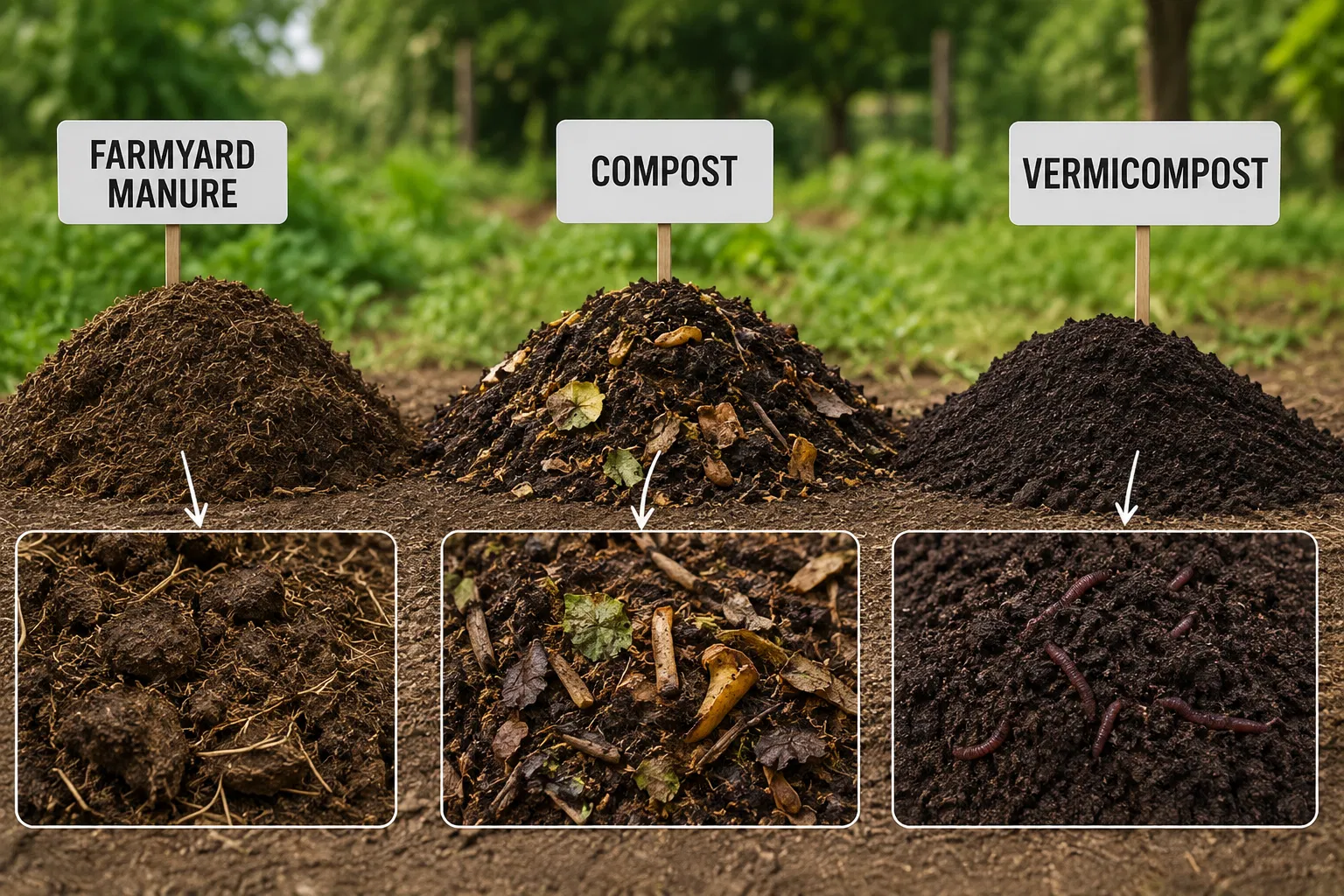
Farmyard manure, compost, and vermicompost are widely used organic inputs, but they are not identical. Each differs in raw materials, preparation method, nutrient concentration, speed of nutrient release, labour requirement, and best field use.
Choosing the right material can improve soil health and reduce unnecessary input costs. None of these inputs should automatically replace all mineral fertilizers; the best choice depends on the crop, soil test, available biomass, production system, and nutrient goal.
What Is Farmyard Manure?
Farmyard manure, commonly called FYM, is a decomposed mixture of cattle dung, urine-soaked bedding, leftover fodder, and farm litter. It is traditionally collected from animal sheds and stored in pits or heaps until it becomes sufficiently decomposed for field use.
FYM normally contains modest nutrient levels but adds a large quantity of organic matter. Its quality varies widely depending on animal feed, collection method, urine conservation, storage, exposure to rain, and decomposition period.
What Is Compost?
Compost is produced by controlled decomposition of plant residues, animal wastes, kitchen waste, market waste, and other biodegradable materials. The process relies mainly on microorganisms and is managed through moisture, aeration, carbon-to-nitrogen balance, and periodic turning.
A well-managed compost pile heats during active decomposition, which can help destroy many weed seeds and pathogens. The final material should be dark, crumbly, stable, and free from foul odour.
What Is Vermicompost?
Vermicompost is produced when earthworms and microorganisms process partially decomposed organic matter. It is generally finer and more biologically active than ordinary compost and may contain nutrients in forms that become available relatively quickly.
The method requires moderate temperature, consistent moisture, shade, and protection from predators and chemical contamination. The raw material must be pre-decomposed before worms are introduced.
Farmyard Manure vs Compost vs Vermicompost
| Factor | Farmyard Manure | Compost | Vermicompost |
|---|---|---|---|
| Main raw materials | Cattle dung, urine-soaked bedding, fodder waste | Crop residues, animal waste, biodegradable farm waste | Partially decomposed organic waste processed by earthworms |
| Production process | Traditional decomposition in pits or heaps | Microbial decomposition with moisture and aeration | Earthworm-assisted biological decomposition |
| Nutrient concentration | Usually low to moderate | Moderate and dependent on feedstock | Often relatively concentrated and plant-available |
| Organic matter addition | High when applied in bulk | High | Moderate because lower quantities are often applied |
| Preparation time | Several months | Usually two to six months | Often 45 to 90 days after pre-decomposition |
| Management requirement | Low to moderate | Moderate | High because worms need controlled conditions |
| Typical cost | Low when produced on-farm | Low to moderate | Moderate to high |
Nutrient Value
All three materials supply major nutrients and small quantities of micronutrients, but actual values vary. Laboratory testing is the only reliable way to know the nutrient composition of a specific batch.
FYM usually supplies nutrients slowly and is most valuable for adding bulk organic matter. Compost can provide a more uniform material when the raw ingredients and process are controlled. Vermicompost is often used in smaller quantities because it is finer, biologically active, and relatively costly.
Effect on Soil Structure
FYM and compost are usually more economical when the goal is to add large amounts of organic matter to broad-acre fields. Their bulk improves aggregation, porosity, water infiltration, and moisture retention.
Vermicompost also improves soil structure but is often reserved for nurseries, horticultural crops, root-zone placement, or high-value production because of its higher production cost.
Speed of Nutrient Release
FYM releases nutrients slowly and may continue contributing to soil fertility over more than one season. Compost is relatively stable and also supplies nutrients gradually.
Vermicompost may produce a quicker crop response because the material is finely processed. However, it should not be treated as an instant high-analysis fertilizer. Crop response still depends on soil conditions, moisture, root health, and the amount applied.
Water and Irrigation Considerations
Organic inputs improve water-holding capacity, but they work best with proper irrigation. Overwatering can cause nutrient loss and poor root aeration, while very dry soil slows biological activity and nutrient release.
After applying manure or compost, maintain adequate moisture to support decomposition without saturating the soil. In drip-irrigated crops, place the material within the wetted root zone rather than far from active roots.
Which Is Best for Different Uses?
For broad-acre soil improvement
Well-decomposed FYM is often the most economical choice when large quantities are available locally. It adds organic matter and supports long-term soil conditioning.
For recycling mixed farm waste
Composting is suitable when the farm has crop residues, weeds without mature seeds, animal waste, and biodegradable market or kitchen materials. A controlled composting process creates a more uniform product than unmanaged decomposition.
For nurseries and high-value crops
Vermicompost is useful in nursery media, transplanting mixtures, vegetable beds, orchards, and protected cultivation. Its fine texture makes it suitable for placement close to young roots.
For integrated biological nutrition
Any of the three materials can complement approved bio-fertilizers. Organic matter helps support microbial survival, but the microbial product must still be stored and applied according to its label.
Quality Risks to Watch
- Fresh or incompletely decomposed manure can burn roots.
- Exposed FYM loses nitrogen through volatilisation and leaching.
- Poor composting can leave weed seeds, pathogens, or unstable material.
- Waterlogged vermicompost beds can kill earthworms.
- Contaminated feedstock may introduce plastics, heavy metals, or pesticide residues.
- Excessive application can increase salinity or create nutrient imbalance.
How to Choose
Choose FYM when low-cost bulk organic matter is the main goal. Choose compost when diverse biodegradable wastes need to be converted into a stable soil amendment. Choose vermicompost when a finer, biologically active input is needed for nurseries, root-zone placement, or high-value crops.
Many farms benefit from using more than one material. FYM or compost can build the field's organic matter, while vermicompost can be applied selectively where the crop response is most valuable.
Final Verdict
There is no universal winner in the farmyard manure vs compost vs vermicompost comparison. FYM is practical for bulk soil improvement, compost offers controlled waste recycling, and vermicompost provides a refined input for targeted use.
The best program combines available farm resources with soil testing, safe decomposition, correct application rates, and balanced crop nutrition.