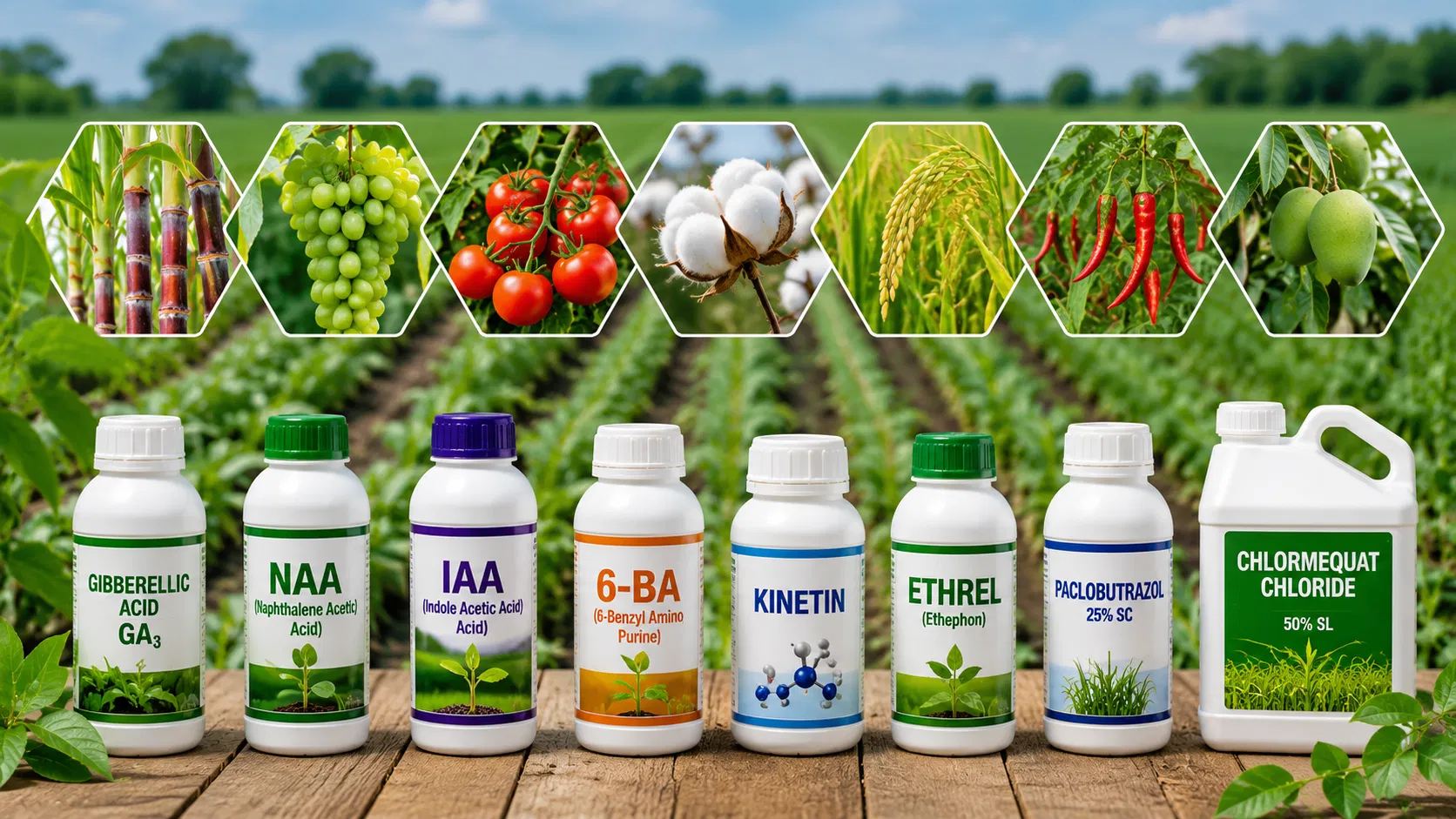
In Indian agriculture, timing and precision often decide the difference between average yield and excellent productivity. This is where plant growth regulators, or PGRs, play a powerful role. From improving flowering and fruit set to controlling crop height and boosting shelf life, common PGRs used in Indian agriculture have become essential tools for modern farmers.
Whether you grow fruits, vegetables, cereals, or commercial crops, understanding the right PGR and its application can help you improve crop performance, reduce losses, and get better marketable yield. Let's explore the most widely used plant growth regulators in India and how they support profitable farming.
What Are Plant Growth Regulators?
Plant growth regulators are natural or synthetic substances that influence plant growth and development in very small amounts. Unlike fertilizers, which provide nutrients, PGRs control how plants grow, flower, fruit, ripen, or respond to stress.
They are widely used in Indian agriculture to manage crop architecture, increase flowering, prevent fruit drop, improve fruit size, delay senescence, and enhance harvest quality. Their use is especially important in high-value crops such as cotton, sugarcane, grapes, mango, banana, tomato, and rice.
Why PGRs Matter in Indian Agriculture
Indian farming faces challenges such as erratic rainfall, temperature stress, pest pressure, and market demand for better-quality produce. PGRs help farmers manage these challenges more efficiently.
- Improve flowering and fruit setting
- Reduce pre-harvest fruit drop
- Control plant height and lodging
- Enhance fruit size and uniformity
- Promote rooting in cuttings and transplants
- Delay aging and extend shelf life
- Support stress tolerance under unfavorable conditions
Common PGRs Used in Indian Agriculture
1. Auxins
Auxins are one of the most important classes of plant growth regulators. They are mainly involved in cell elongation, root initiation, fruit development, and prevention of premature fruit drop.
Common examples: IAA, IBA, NAA, 2,4-D
Uses in Indian agriculture:
- Promote rooting in nursery plants and cuttings
- Reduce flower and fruit drop in mango, citrus, and apple
- Improve fruit set in some crops
- Control weeds using selective herbicidal action in some cases
Popular use: NAA is widely used in mango and citrus orchards to reduce fruit drop and improve yield stability.
Auxins are especially valuable in fruit crops where retention and rooting are key to productivity.
2. Gibberellins
Gibberellins stimulate stem elongation, seed germination, flowering, and fruit enlargement. They are widely used in horticulture and commercial crop production.
Common example: GA3 (Gibberellic Acid)
Uses in Indian agriculture:
- Break seed dormancy and improve germination
- Increase berry size in grapes
- Promote elongation in sugarcane
- Enhance fruit development in some crops
- Improve malting quality in barley
Popular use: GA3 is commonly applied in grapes for better bunch development and berry size, which improves market value.
3. Cytokinins
Cytokinins promote cell division, delay aging, and support shoot development. They are often used to improve fruit size, reduce senescence, and enhance crop vigor.
Common examples: Kinetin, Benzyl Adenine (BA or BAP), Zeatin
Uses in Indian agriculture:
- Delay leaf yellowing and extend shelf life
- Promote cell division in fruits
- Improve fruit shape and size
- Stimulate shoot growth in tissue culture and nurseries
Popular use: Benzyl Adenine is commonly used in apples and grapes to improve fruit size and cluster quality.
4. Ethylene
Ethylene is a natural plant hormone involved in fruit ripening, flower initiation in some crops, and leaf or fruit abscission. In agriculture, it is often used in the form of ethephon, which releases ethylene inside plant tissues.
Common example: Ethephon
Uses in Indian agriculture:
- Promote uniform ripening in banana, tomato, and pineapple
- Enhance flowering in some crops
- Facilitate harvesting by loosening fruit or leaves
- Improve sugarcane ripening and maturity
Popular use: Ethephon is widely used for ripening management and synchronized harvest in fruit and vegetable crops.
5. Abscisic Acid
Abscisic acid, or ABA, is associated with stress response, seed dormancy, and stomatal closure. It helps plants survive under difficult conditions such as drought and heat.
Uses in Indian agriculture:
- Induce dormancy in seeds and buds
- Help plants manage water stress
- Regulate ripening and senescence in certain crops
- Support stress adaptation in drought-prone regions
Although ABA is not as commonly applied as auxins or gibberellins, it is increasingly important in research-driven and high-value crop management.
6. Brassinosteroids
Brassinosteroids are newer plant hormones that help improve plant growth, stress tolerance, and yield performance. They are used in small quantities but can have strong effects on crop health.
Uses in Indian agriculture:
- Improve seed germination and early growth
- Increase tolerance to salinity, drought, and temperature stress
- Support flowering and fruit development
- Enhance overall plant vigor
These are becoming more popular in advanced farming systems, especially where stress management is a priority.
How Farmers Use PGRs in Different Crops
PGRs are not applied randomly. Their effect depends on crop type, growth stage, dose, and weather conditions. In Indian agriculture, the most common applications are crop-specific.
- Mango: NAA for fruit retention and reduced drop
- Grapes: GA3 for berry enlargement and cluster improvement
- Banana: Ethephon for ripening control
- Sugarcane: GA3 for internode elongation and better cane growth
- Cotton: PGRs for boll retention and controlled vegetative growth
- Tomato: Ethylene-based products for uniform ripening
- Citrus: Auxins for fruit drop reduction
Benefits of Using Common PGRs in Indian Agriculture
When used correctly, plant growth regulators can significantly improve farm profitability and crop quality.
- Higher yield: Better flowering, fruit set, and retention can directly increase output.
- Improved quality: Fruits become larger, more uniform, and more marketable.
- Efficient crop management: Growth can be controlled to suit modern farming practices.
- Better stress tolerance: Some PGRs help crops cope with drought, salinity, and heat.
- Extended shelf life: Delayed senescence helps in transport and storage.
- Better harvest planning: Ripening can be synchronized for easier picking and marketing.
Important Precautions Before Using PGRs
Despite their benefits, PGRs must be used carefully. Overuse or misuse can damage crops, reduce quality, or cause unwanted growth responses.
- Always follow recommended dose and crop-specific guidelines
- Apply at the correct growth stage
- Avoid spraying during extreme heat or strong wind
- Use clean water and proper spray equipment
- Do not mix incompatible chemicals without expert advice
- Consult agricultural experts or local extension officers before application
Incorrect use can result in poor response, leaf burn, abnormal growth, or even yield loss. Responsible application is the key to successful results.
Final Thoughts
Common PGRs used in Indian agriculture are helping farmers move toward smarter, more productive crop management. From auxins and gibberellins to ethylene and cytokinins, each plant growth regulator has a specific role in improving growth, yield, and quality. When selected properly and applied at the right time, PGRs can make a measurable difference in farm success.
If you want better fruit retention, improved harvest quality, or more uniform crop growth, learning the right use of plant growth regulators is a smart step forward. The future of Indian agriculture is not just about growing more—it is about growing better.
Use PGRs wisely, follow crop-specific recommendations, and turn plant physiology into better productivity.