Citrus canker is a bacterial disease, not a fungal one, and that single fact explains why so many orchards fail to bring it under control. The bacterium cannot force its way into healthy tissue. It needs an opening, and it needs free water to travel. Wind-driven rain supplies the water, and the wounds are supplied by thorn pricks, hail, pruning cuts and above all by the serpentine mines of the citrus leaf miner. An orchard with a leaf miner problem has a canker problem waiting to happen, and spraying only for the disease while ignoring the insect is the commonest reason the lesions keep returning. The two have to be managed as one job.
Symptoms
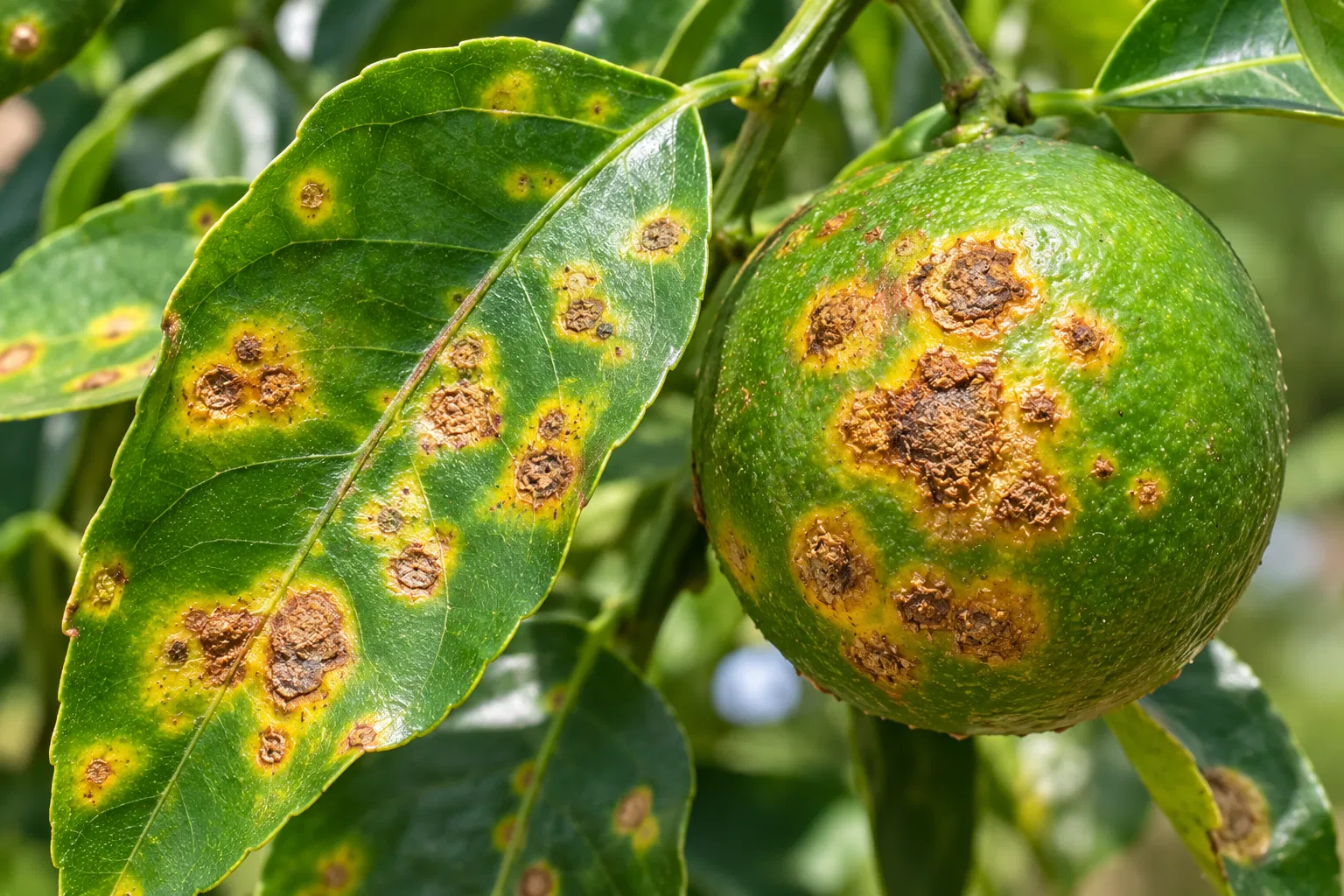
- Small water-soaked spots on young leaves that enlarge into raised, corky, crater-like lesions with a rough brown surface
- Lesions surrounded by a distinct yellow halo, visible on both the upper and lower leaf surfaces, and often with the centre eventually falling out to leave a shot-hole
- Raised, rough, scabby cankers on twigs and branches, which crack open, girdle the shoot and cause dieback of the growing tip
- Corky, protruding lesions on the fruit surface that do not rot the flesh but downgrade or reject the produce entirely
- Premature leaf fall and fruit drop, with repeated defoliation weakening the tree over successive seasons
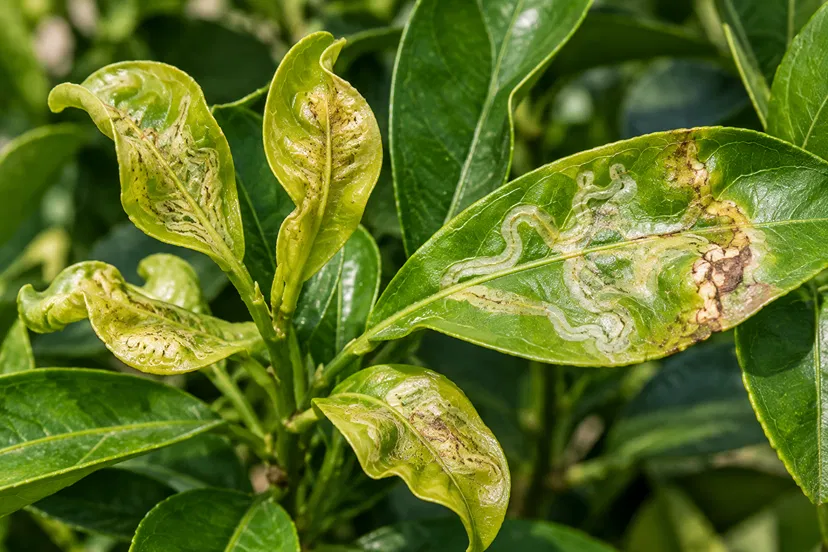
- Lesions concentrated along the silvery serpentine tunnels left by leaf miner, which is the pattern that gives the interaction away
- Severe dieback, thin canopies and declining yield in orchards where the disease has run unchecked for several years
Causes
- Xanthomonas citri subsp. citri, a bacterium that survives in old lesions on twigs, leaves and fallen debris and becomes active with the first rains
- Free water on the plant surface, without which the bacterium cannot move or infect; wind-driven rain is what carries it from lesion to leaf and tree to tree
- Wounds of any kind on young tissue, since the bacterium enters only through injuries and natural openings and cannot penetrate an intact leaf surface
- Tunnels made by the citrus leaf miner, Phyllocnistis citrella, which do not carry the bacterium themselves but open long wounds on exactly the young flush the bacterium needs, raising canker incidence and severity several times over in infested orchards
- Thorn pricks from neighbouring branches in a crowded canopy, along with hail damage, wind abrasion and unsterilised pruning cuts
- Warm, humid weather between roughly 20 and 30 degrees Celsius during the monsoon, which is when both the bacterium and the leaf miner are most active
- Flushes of tender new growth, which are highly susceptible for two to three weeks before the leaves harden
- Infected nursery plants and budwood, which introduce the disease into a clean orchard
- Highly susceptible types, with acid lime and grapefruit worst affected, followed by sweet orange, while mandarin and lemon are comparatively less so
- Overhead irrigation and dense unpruned canopies, which keep foliage wet and let the bacterium spread within the tree
How to Identify
The confirming feature of canker is that the lesion is raised and corky, not sunken. Run a finger over it and it feels rough and protruding, like a small scab standing off the surface, with a yellow halo around it and the same lesion visible on both sides of the leaf. That separates it from citrus scab, where the lesions are wart-like but distorted and largely on one surface, and from anthracnose and other fungal spots, which produce flat or sunken dry patches without the raised cork or the yellow halo.
Look next at where the lesions sit. Canker following a leaf miner attack lines up along the mines, so a leaf will show a silvery, winding, snake-like tunnel with the cankers strung along its length. Where that pattern is present, controlling the disease alone will not work.
Identifying the leaf miner itself is simple once you know what to look for. The mine appears as a silvery or whitish serpentine tunnel just under the leaf surface, with a thin dark line of frass running down its centre, usually on flush leaves. The larva is a tiny pale translucent grub inside the tunnel, and the leaf margin is often curled and puckered where it has pupated. The insect attacks only tender flush leaves, not hardened ones, which is precisely the tissue canker needs.
Inspect the orchard weekly during the monsoon and at every new flush, checking young leaves, twigs and fruit. Because both the disease and the insect depend on the tender flush, the flush period is the window where inspection and treatment matter most.
Control Methods
Chemical Control for the Disease
1. Copper Oxychloride 50% WP
Copper is the mainstay against canker. Copper ions released on the plant surface disrupt the enzyme systems of bacterial cells, and because the action is at several sites at once, resistance develops very slowly even after years of use. It is purely protective, forming a barrier that stops the bacterium establishing on tissue it has not yet infected, so it must go on before or at the very start of infection rather than after the cankers appear. Begin spraying with the onset of the monsoon and repeat through the wet period, and cover the new flush thoroughly, since that is the tissue at risk.
Product Recommendation
2. Streptomycin Sulphate 90% + Tetracycline Hydrochloride 10% SP
This antibiotic combination acts directly on the bacterium, blocking protein synthesis in the cell, and it is absorbed and moved within the plant rather than sitting on the surface. That systemic action is what copper cannot provide, and it is why the two are used together: copper protects tissue that is still clean, while the antibiotic reaches bacteria already inside the plant. The standard practice is to tank-mix the antibiotic with copper oxychloride or to alternate the two through the season, and to spray with each new flush and after any hail or storm damage.
Product Recommendation
- Aries Plantomycin Bactericide
- Tagmycin Bactericide
- Crystocycline Bactericide
- Strepto Plus Bactericide
- Katyayani KMYCIN Bactericide
Use the antibiotic with restraint. Repeated season-long spraying of streptomycin selects for resistant bacterial strains, and once that happens the product stops working in that orchard for good. Keep it to the critical sprays at flush and after injury, and let copper carry the routine protective cover between them.
Chemical Control for the Leaf Miner
1. Imidacloprid 17.8% SL
Imidacloprid is a systemic neonicotinoid that binds nicotinic acetylcholine receptors in the insect nervous system and disrupts nerve signalling. The systemic movement is the point here: the leaf miner larva feeds inside the leaf, sealed within its tunnel where no contact spray can reach it, and only a product taken up into the leaf tissue will kill it there. Time the spray to the emergence of a new flush, when the moths lay eggs on tender leaves, rather than after the mines are already visible and the damage done.
Product Recommendation
Treating the Two Together
The practical lesson of this article is that the disease spray and the insect spray belong on the same schedule, because both target the same tender flush in the same wet season. Plan the programme around the flush: as a new flush emerges, apply the leaf miner spray to stop mines forming, and cover the same flush with copper so the bacterium has nothing to enter through. Bring in the antibiotic where lesions are already present or after hail or a storm has wounded the tree.
The reverse also holds. An orchard sprayed diligently for canker but never for leaf miner will keep producing fresh cankers every monsoon, because each new flush arrives pre-wounded. If lesions are lining up along silvery tunnels on your leaves, the insect is the part of the problem that has been left untreated.
Cultural Control
- Plant only certified disease-free nursery stock and budwood, since infected planting material is the commonest way canker enters a clean orchard
- Prune out and burn cankered twigs and branches during the dry season, cutting well below the visible lesion into healthy wood
- Disinfect pruning tools between trees, because the blade carries the bacterium from one cut to the next as efficiently as rain does
- Collect and destroy fallen infected leaves and fruit rather than leaving them under the tree, where the bacterium survives to the next monsoon
- Establish windbreaks along the orchard boundary, which cut wind-driven rain and the wind abrasion that wounds leaves, and are among the most effective long-term measures available
- Prune to keep the canopy open and avoid crowded branches, since thorn pricks from neighbouring twigs create the entry wounds the bacterium needs
- Irrigate through drip or basin rather than overhead sprinklers, so foliage stays dry and the bacterium cannot move
- Avoid working in the orchard while the foliage is wet, and keep movement of workers and equipment between infected and clean blocks to a minimum
- Manage nitrogen so flushes are fewer and more uniform, since scattered tender flush through the wet season gives both the disease and the insect a continuous supply of susceptible tissue
- Choose less susceptible types where planting afresh, keeping in mind that acid lime and grapefruit suffer worst
- Remove and destroy severely affected trees in a young orchard rather than carrying them as a source of infection for the rest of the block
Mechanical Control
Most of the physical work against canker is sanitation, and it pays better than any spray. Prune and burn cankered wood in the dry season when the bacterium is least active, sterilise the secateurs between trees, and clear fallen leaves and fruit from under the canopy. Wash down tools and footwear before moving from an infected block to a clean one.
For the leaf miner, pinch out and destroy heavily mined flush shoots during weekly inspection, particularly on young trees where the flush is limited and removal is practical. Remove water shoots and suckers, which produce soft flush out of season and give the insect a bridge between the main flushes.
Conclusion
Citrus canker is a wound disease, and that is the key to managing it. The bacterium cannot enter an intact leaf, so the work is to keep the tissue unwounded and protected: control the leaf miner as the new flush emerges so no tunnels form, cover the same flush with copper so nothing has a way in, keep the antibiotic for lesions already present and for post-hail sprays, and put the long-term measures in place with windbreaks, open canopies, drip irrigation and clean planting material. An orchard that treats the insect and the disease on one schedule gets on top of both; one that sprays only for the disease will be spraying again next monsoon.
Disclaimer: Always confirm current label registration, approved dosage, water volume, and pre-harvest interval (PHI) for your state before using any product, since labels are periodically revised by regulatory authorities.
This guide is a general advisory. Do your own research and verification before using any product. Always confirm suitability for your crop stage, region, and field conditions before making any purchase, spray, or crop-management decision.